
The beauty of not researching an area of ahead of time is that everywhere I go becomes a discovery. I approach a new place with my mind, and expectations, a blank slate. (Some say I depart that way, too, but that’s their opinion.)
So when I land in a new region, I quiz the RV park owner, or hit the visitor’s center, to see what the locals think is important. And with amazing regularity, a theme emerges to shape my explorations.
In Golden, Colorado, that theme is drinking.
Or more precisely, the companies that make things to drink. The Celestial Seasonings tea manufacturing plant is in nearby Boulder. Wineries (yes, wineries) dot the ’burbs and farmland environs with Colorado-grown vines. And the Coors plant that gave post-gold-rush Golden a new identity still pumps out millions of gallons of beer a month under the shadow of Castle Rock at the north edge of town.
Tea, wine, beer. Sounds good to me. Let’s take some tours!
Boulder is about 45 minutes from Golden. When following the advice of my navigation system, it takes five highway exchanges to get there, thanks to the LA-like webwork of highways at Denver’s outskirts.
Boulder is the original, and only, home of the Celestial Seasonings tea company. The neighborhood of corporate headquarters is tidy residential, not industrial, which I found surprising. I just didn’t expect to find an international tea manufacturer around the next bend from that guy with the lawn sprinkler and the lady walking her dogs.

Too bad they only use these signs at headquarters, and not also in the surrounding neighborhood.
The company started in the 1970s, shipping small muslin bags of tea made from hand-picked local herbs. In 2000, they joined up with The Hain Food Group (makers of Jason, Avalon, Terra chips, and other organic brands). You’ll now find them on every box as The Hain Celestial Group.
With the exception of their newest high-end Saphara brand, every bag of Celestial Seasonings tea you buy anywhere in the world has been blended, tested, and packaged at this facility. (They don’t yet have the equipment to make anything other than their little tea “pillows,” and Saphara uses one of those triangular loose-tea bag thingies; they are done in Canada, I think.)
Smell is the first thing you notice when you walk into every new space at Celestial Seasonings. Cinnamon. Clove. Peppermint. Strawberry. Vanilla. Lemongrass. Chamomile. In the tea storage room, it’s a thick, musty, earthy flavor-smell that hits the back of the throat and lingers like warm, dark bread. In the mint storage room, it’s the eye-stinging, sinus-clearing sharpness of menthol, so strong that it chased out half our tour group the moment they walked in. I was one of those who stayed as long as possible, sucking in the peppermint and spearmint stored there. As needed, the room is also used to store one other member of the mint family: catnip, for their Tension Tamer blend (which also includes hops, by the way).
There are three good reasons to visit here. First, a free guided tour, which includes a trip into the Tea Room and Mint Room, past live inventory, and alongside the packaging assembly line. We learned how they clean, dry, chop, and mix the tea ingredients, sample each blend to match it to exacting standards, and send them on to packaging if they pass muster. They produce up to five teas at a time, with each blend given its own track on the assembly line. It takes only five minutes for a teaspoon of tea to go from loose in the bin to a cellophane-wrapped box in a shipping carton, ready for distribution. Sadly, no photos are allowed because their setup is proprietary.

My 1:00 tour ticket: a free sample of Black Cherry Berry tea.
They import ingredients from around the world with fair-trade practices, and the daily inventory varies greatly, depending on what they’re manufacturing that day. Sleepytime and Peppermint are their best sellers, so chamomile and peppermint are always on hand. We pass bins of fragrant lemongrass ready for production, and rolls of packaging ready to be folded into boxes.
The storage rooms for the “real” tea (black, white, and green, all members of the same
Camellia sinensis species) and the mint are sealed off with roll-up warehouse doors to protect ingredients from contamination. The real teas too readily absorb the flavors of nearby spices and herbs. The menthol in mint too readily infiltrates other goods. Black/white/green teas and mint meet other ingredients only right before they’re ready to become packaged teas.
The second reason to go to Celestial Seasonings is their free, “all you want to sample” tea tasting room, and the beautiful tea-related art on display there. I tried nearly 20 flavors of tea from their inventory, many of which I’ve never seen in stores in the west. The place was a bit crowded, but the staff was always relaxed and friendly and seemed genuinely happy to be working there. It’s certainly not hard on the psyche to be surrounded by original art from their packaging, as well as the inspirational sayings painted on their walls, just as they are printed on their boxes.
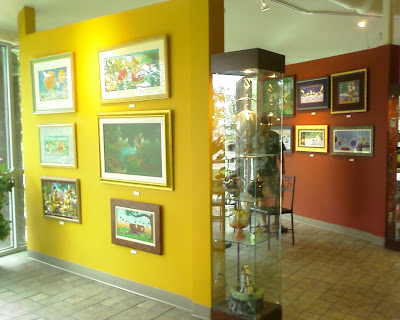
The tasting room and gallery.

Tea drinkers may recognize a few of these images, which look magnificent in the original.


One of the many amazing teapots on display.

Yep, a dress made of tea packages. Not suitable for rainy or muggy days.

I wanted to wrap this sign around the trailer.

Have list, will sample...a lot!
The third reason for visiting is, of course, a pretty cool tea shop. Here you can buy every kind of Celestial Seasoning tea, some popular Hain organic products, and loads and loads of gifties like candles, teacups, teapots, tea gadgets, and Celestial Seasonings merchandise. I now have a full larder of breakfast teas, afternoon teas, dessert teas, and anytime teas, from black to herbal, simple to complex. Good thing I really like tea.

The front seat of the truck now totally tea (a new meaning of teetotalling?), my next stop was a winery that was supposed to be in the heart of downtown Boulder. In searching for it, I stumbled on a weekend art walk, part of a year-long birthday party for 150-year-old Boulder. Turns out I was on the Pearl Street Mall, a multi-block, open-air space that is completely pedestrian, with brick pathways lined by boutiques, restaurants, world-goods shops, and lots and lots of art galleries. It reminds me of Faneuil Hall in Boston.


Book Cliff Winery had moved to a long row of warehouses a few miles up the road. Missing the entrance that leads to the front of the building, I wound around to the back, parked, and entered through a unwelcome-looking white steel door—and was immediately greeted by the swelling sounds of live classical music played by a string quartet to an audience of one, a table of cheese, crackers, and cherries, and stainless steel vats on one side, side-stacked barrels on the other.

The winery is owned by husband/wife team who started in their basement in Boulder. The shop is lined with vivid, semi-impressionistic oil paintings done by “Scramble Campbell,” an artist who creates his paintings during live music performances. The winery sponsors festivals at the (famed, but I would never have known it) local Red Rock Amphitheater, and Campbell paints during their shows; he also paints a limited number of bottles on Book Cliff’s reserve wines each year. At sixty bucks a pop, I decided to pass, although I did walk away with a couple of their white wines and a dessert, portlike red.


A few other people arrived for tastings, and I met a woman named Kim there. We swapped pours (the winery charges a small fee for five samples of our choice), and found we have similar tastes in wine, as well as for other things about life. She’s also single, about ten years older than I, and is looking for a life change that involves travel. She was intrigued by my RVg and especially liked the idea of working on farms with the WWOOFing program in the U.S. From her, I was reminded that it’s perfectly doable to trust the universe to guide me from job to job and adventure to adventure, no matter how long I do this or how old I get.
Three new bottles of wine joined the dozen boxes of tea, and I was ready for a third drinking tour the next morning: Coors. I’m not really much of a beer drinker, but I’m game to try out most new flavors and foods, so giving them a fair go seemed reasonable. After all, when in Golden, do as Goldeners do: get free beer from Coors.
Unlike at Celestial Seasonings, this tour is self-paced, all photos allowed, and guided by an audio-headset spokesman who walks you through many parts of the facility, even past less glamorous offices in connecting hallways.
And unlike tea sampling, beer sampling can, well, lead to stupidity when overdone. So while Coors makes a point of advertising “1. Free beer. 5. Did we mention the free beer? 10. Oh, and free beer!” as part of the top ten reasons to take the tour (you get up to three half-pints, plus a smaller sample midway through), they also take pains to ensure their clientele doesn’t overindulge on their “hops-itality” (sorry, that was mine).
When you check in, they require your driver’s license as proof of age to receive beer, and they scan the license to keep a record of your visit. Then they give you a personalized, hole-punchable wristband for tracking how much beer you’ve had. All of this is also to make sure you don’t receive more than your allotted share, and that you can’t come through the tour more than once the same day—such as under a disguise. Yes, it’s been attempted.

My personalized wristband, tracking my free beer intake.

Shuttles take vanloads of tourists to the Coors plant from a nearby parking lot.


The company was started by a German emigrant, Adolf Coors, in 1873. The clean, clear, Rocky Mountain water is what made him decide to build his brewery in Golden. To stay alive during Prohibition, the company sold malted milk, nonalcoholic beer (near-beer, marketed as “Mannah”), and porcelain from another of their business enterprises. Theirs was one of the few breweries able to start up seconds after midnight on the day Prohibition was lifted in 1933. This is one of the original brewing kettles.
The half-hour tour took me over an hour to absorb and enjoy, so excellent were the graphics and videos and placards. The tour takes you past displays of company history and hands-on bins of beer ingredients, onto viewing platforms of brewing vats and mash mashing, down office halls and quality control, and to a bird’s-eye view of the assembly line floor.
Throughout the trip, not-so-subliminal marketing messages punctuate the audio script. A woman’s seductive voice occasionally breaks in to purr “Coors” and “Killian’s” when the male guide mentions these brands. And the guide himself often concludes a blurb with things like, “Making you thirsty yet?” “Mmm, I’m getting thirsty. How about you?”

Barley, hops, and cereal grains (rice, corn, etc.). Just add water and cook.

Testing the brewing beer. This area smells of hot breakfast grains plus hot hops, slightly sour. It is very warm to be in. It's also quite pretty, with all the copper kettles and pipes.

Command Central for all the brewing, manufacturing, and packaging equipment. Every phase is precisely timed and measured here.


Even interim hallways are made more interesting with beer factoids and bubble etchings on office glass.

A speedy 18 minutes from finished brew to sleeved package, then onto trains and trucks for shipping. The whole goal is to keep the beer cold, cold, cold as long as possible in packaging and transit.
“Waste is a misplaced resource” a fourth-generation Coors magnate is quoted near the end of the tour. They live up to this maxim by selling almost every by-product of beer brewing. Mash goes to cattle, yeast to cat food, and “sad beer” (sub-standard batches) to producing ethanol. They make their own cans and bottles locally, with a heavy focus on recycling glass and aluminum. (In fact, it was Coors who started the use of aluminum cans in 1959, leading a recycling program that reclaimed a good percentage of their own cans and others’ for reuse.)
The tour ends in the Coors tasting room. All right, it’s a bar. I kept to half-glasses, as I hadn’t eaten much and am a liquor lightweight. I had already tried the original Coors mid-tour and disliked it. Killian’s Red was amber and more flavorful, and probably good mostly because it was on tap. Blue Moon Belgian white, served with an orange piece at the bottom, was sweet. None of the others available appealed to me enough to use my third free tasting, although I wished they offered more than six kinds out of the dozens they produce.

My stand-up table at the Coors tasting room. The flowers come from the onsite greenhouse, started by Mrs. Adolf Coors in the late 1800s. It still supplies daily roses and carnations throughout the factory and office buildings. I was disappointed that a tour of the greenhouse wasn’t included.


The gift shop offers the unusual alongside the usual. Here, a hat made out of a Coors box, and a beer holder that makes the Incredible Hulk look like a wimp. (My hand is gripping a bar inside the fist to hold it up.)
The final verdict? Call me a purist, but any beer that
must be kept, and served, ice cold in order to retain its flavor really isn’t much of a beer. So, as fascinating as the tour was, the only Coors you’ll find in my refrigerator is one of those labels that’s made to turn blue in cold temps. A freebie to those few of us who stopped to chat with one of the chair-bound docents stationed throughout the tour, this specially treated paper lets me know whether the Flying Heart’s fridge is still going strong. White mountains bad. Blue mountains good. Thank you, Coors.
For those interested in more info, here are the company websites:
www.celestialseasonings.com (I recommend the brief online virtual tour)
www.bookcliffvineyards.com
www.coors.com (snappy timeline; some video histories)
 The radio has been announcing storm watches and warnings all week across most western and central counties of Nebraska.


