My next four days in York fall into an easy rhythm: breakfast at the YHA, spend the morning editing journal entries and compiling photos on Perry at the YHA lounge, and then out into the city for Internet access and whatever sights seem interesting. I usually catch lunch on the fly at a bakery and go to the Evil Eye Lounge on Stonegate for two to three hours of Internet (extremely cheap at £2/hr), then amble around until I find a restaurant where I can end the day with an interesting meal.
Monday’s supper, for instance, is La Tosca for Spanish tapas, Tuesday at HaHa for a yummy chicken fettuccine, and Wednesday at Ate O’Clock for a three course “B 4 Ate” fixed price menu (£14, instead of £24 for the same meal a la carte). Thursday is at the Evil Eye Lounge—Japanese noodles at 9pm, after three hours of blog posting. Friday, my last night here, is Fellini’s for pasta vodka, which doesn’t taste as good as it sounds.
Ate O’Clock—almost a literal hole-in-the-wall place that you get to by walking down an easily overlooked alley—is the best restaurant for high-end ambiance and quality among those I tried. All the clocks here, big old-fashioned ones decorating the walls, read 8 o’clock. The dining room is cozy and intimate. The proprietor and waiter are very fun and proud of their offerings. I wandered in at 6:30 without a reservation and my table needed to be ready by 8:45...the maitre d’ was actually worried that two hours-plus wouldn’t be enough for me to fully enjoy their dining experience!


 Don’t let the idea of a fixed price menu fool you—this is classy food. I started with pan-fried Halloumi cheese from Cypress, with red pepper and beet and mixed greens—salty sweet chewy crunchy yielding oily good. Dinner was salmon on pea and sun-dried tomato risotto with buttered courgette (zucchini) ribbons—crispy salmon fry, creamy risotto. A rosé from the US to accompany the meal, and a vertical strawberry cheesecake (in a glass) and coffee to finish it off. It was one of those nights that I was glad to be living a mile or more away, just so I can walk off the meal.
* * *
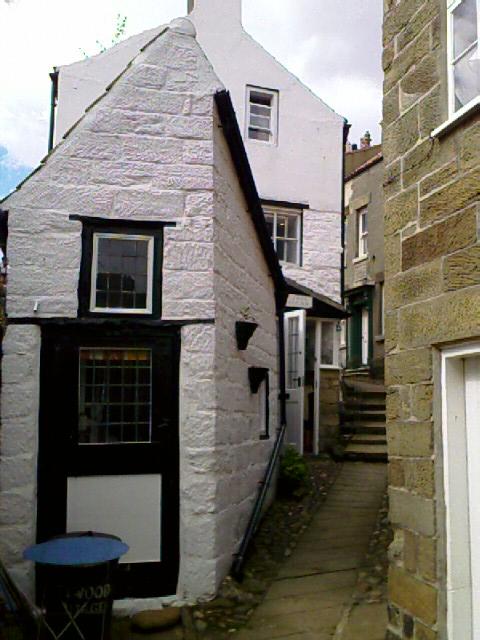
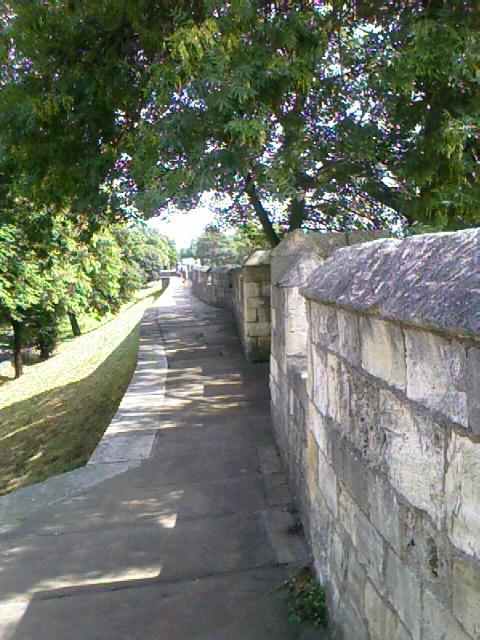
Funny. I’ve been walking around York as if I live here, instead of feeling like a tourist. Perhaps the difference is the fact that I’m writing so much, just as I do when I work. I’ve been “putting in” 6- to 7-hr days in front of a computer and barely noticing it, for the wonderful walks around town, the upbeat, funky atmosphere of the Evil Eye, and the walks to/from the hostel. I like this easy habit. York Minster dominates the city, a fixture that’s easy to use for getting my bearings, or at least the signs to it are. The Minster itself is not always visible despite its spired heights, because most of the streets of York are not only three stories high, but also very narrow and twisty. I feel like a mouse in a high-walled maze as I wind from one street to the next.
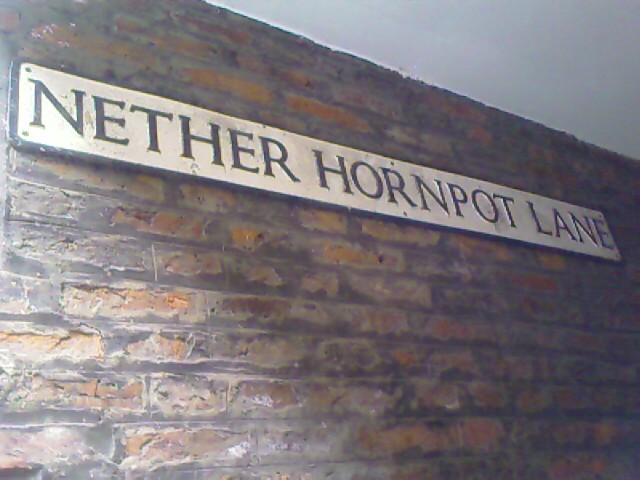
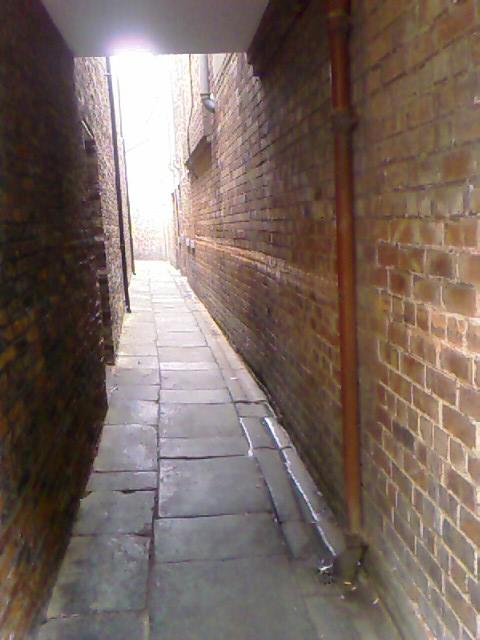 It takes me three days and lots of missed turns before I can confidently retrace the same route through the Shambles, find my way back from Colliergate or Coppergate, or point my feet to the River Ouse and know where I’ll end up. I never did find Nether Hornpot Lane again, though.


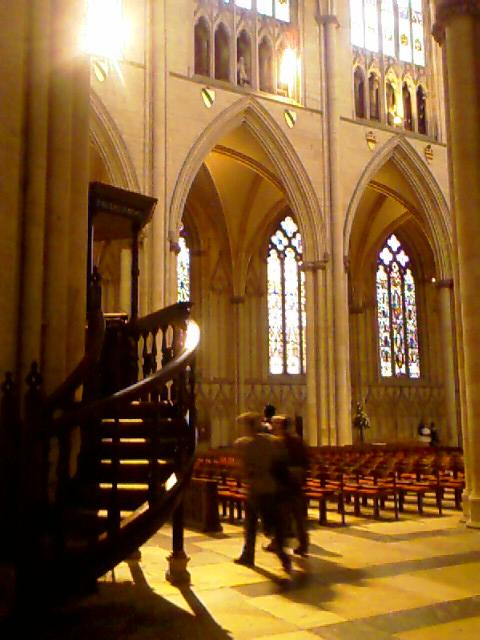 I visit the Minster, and get treated to the fits-and-starts singing of a choir practice while I wander the vaulted interior. The pipe organ roars and rings along filigreed stone and wood carvings, accompanied by an almost stifling quiet from the rest of us at ground level; the cathedral is so vast that footfalls get swallowed up in a padded hush, the kind you get when your ears are stuffed up from a cold.
 The bells toll at night as I walk home from dinner. Bong. Bong. Bong. The Minster looks lovely under amber street lights. I backtrack down a neighboring street that is lined with trees, catching the same viewpoint that Cotterill had used on the chalk drawing he gave me. Except for the cars and streetlights, it’s the same as it was 20 years ago—heck, probably hundreds of years ago.
Another York fixture in my walks has been Michael the Purple Guy, who hangs around the Evil Eye on Stonegate. Let me explain Michael. Street performer. Paints himself bright orchid. His trousers. His shoes. His face and hands. His shopping bag. His windblown-wired jacket and tie and shoelaces. His inside-out, broken umbrella. All purple. He stands still, mostly—a ludicrous, semi-gloss violet statue with puffed-out cheeks and an imaginary storm in front of him.
Some people pass him by. Some pause, wondering. Some snigger as if they’re not quite sure it’s a real person, but afraid to find out. A few figure it out. A coin clinks into his collection box. Michael relaxes his pose, leans forward, talks with the crowd. No mime is he. He calls a young child over, tells him to close his eyes. Takes a purple-coated paintbrush from a purple-coated paint can and paints the child’s hair. The boy is horrified, reaches for his scalp; the audience laughs—the paintbrush is dry. The child giggles his relief.
Elsewhere, in the twilight hour at St Sampson’s Square with its closed-up stores and the day’s detritus blowing across the cobbles, a grizzled war veteran sits in a wheelchair, one trouser leg hanging limp over the seat. He presses a harmonica to his lips. “Oh Shenandoah.” The same song the busker in Penzance was playing two months ago.
I smile into his eyes and drop a pound into his round biscuit tin. He gives me a husky thanks—more, I think, for looking him in the face than for the contribution. How important it is to acknowledge each person’s humanity. Sometimes that’s all anyone really wants. “See me. Remind me that I’m here. That I count.” Thursday has me going to the touristy Jorvik (old Norse, became “York”) Viking Center (worth a half hour wait), lunching at the Pret Manger, and visiting the York Art Museum with Carolynne, another guest at the YHA. Carolynne is good company. She’s British, and has traveled a lot around her country—so much so that she can actually pinpoint specific coastal areas just by looking at photos of the beaches.
 She succinctly sums up what I’ve sometimes thought on this trip: “Travel is 75% boredom. Just getting through one day after the other, finding food, finding a place to stay, getting from one place to the next, waiting for buses and trains.”
Nonetheless, I’d like to keep this feeling of travel going. This walk around a little, work a little, see a little, be a lot, semi-nomadic lifestyle suits me.
I could, if I chose, view my return to the US not as a return “home,” but as another step in an ongoing travel itinerary. I’ve spent three months in Britain. Now maybe I’ll spend a month in Olympia reconnecting to the stuff I’ve lived with and to my friends there, then maybe I’ll move on to that writing spot I need for six months, and then maybe Patchouli and I will WWOOF together somewhere in the US—a vineyard in California, a ranch in Wyoming...who knows? Then maybe I’ll go somewhere else in this Earth home, to another room where people dance differently and love differently from what I’ve seen so far.
I like this idea that Earth—all of it—is my home, and that I can visit any part of it I like, and that I can work and create and serve in any part of it I like, and that all that I need for living in that part of it is waiting for me, ready.
It means that I’m not “going home” next week—I am home, all the time.
Hmmm. Possible business card: “Audrey—A human, being.”
Everywhere we go is circular, round trip. Across the kitchen and back. From bedroom to bathroom and back. Home to store and back. Desk to conference room and back. Across the country and back. Around the world and back.
Throughout the day we make endless loops, large and small. Tatting our way through time. We hardly notice them as “trips” unless they feel big, like when it means bundling up the entire family to visit Uncle Ted at the other side of the country.
And at the end of each loop, at the end of each day, we return to the place we left.
Or do we?
Is not everything slightly different from when we left it—them, it, and us—even moments before?
Perhaps life is more like an ever-expanding spiral. Outward, ever outward, built through time and billions of nano-decisions that billions of people make every day.
Shall I pause to pet the cat before I leave? Boom. Perhaps I just missed the green light ten blocks away.
Shall I skip the toast this morning? Boom. I just reduced my electricity bill a fraction, saved on toaster wear, gave the microbes in the bread another day to multiply, and maybe put myself at my destination in time to just miss, or meet, a new friend for life.
I remember driving with my dad and his wife in Washington D.C. a few years ago. We were on one of the big loop freeways around the city. Noma said, “Oh, I recognize this. We’ve been on this road before.” Dad replied, “No we haven’t. That big truck wasn’t here.”
Blip. Another light bulb of truth blinked on.
You can’t step in the same river twice. You can’t drive the same road twice. You can’t visit the same city twice.
“Been there, done that” is true only once each moment—we can’t return to “that,” exactly as it was, again. Even as a time traveler (which I believe is possible), to go back to a point in time is to change that time forever, just because you’ve gone back to it.
Douglas Adams had it right, I think.