 For me, there’s nothing like settling into a routine on a farm to let the days ease by, especially if it involves being anywhere near horses, tack, and barns. I can spend hours at a stable and never feel the time pass.
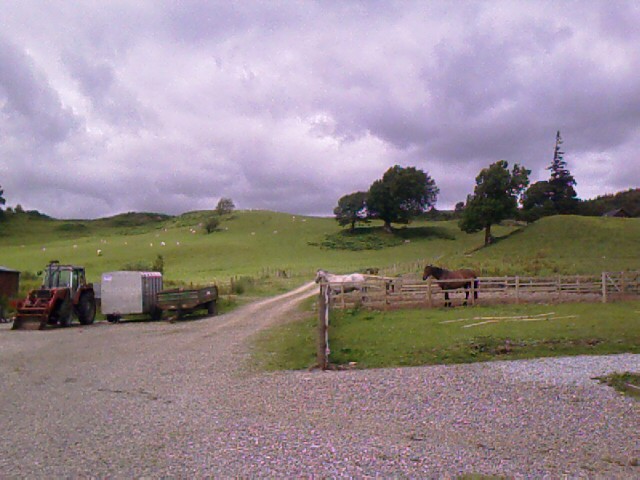
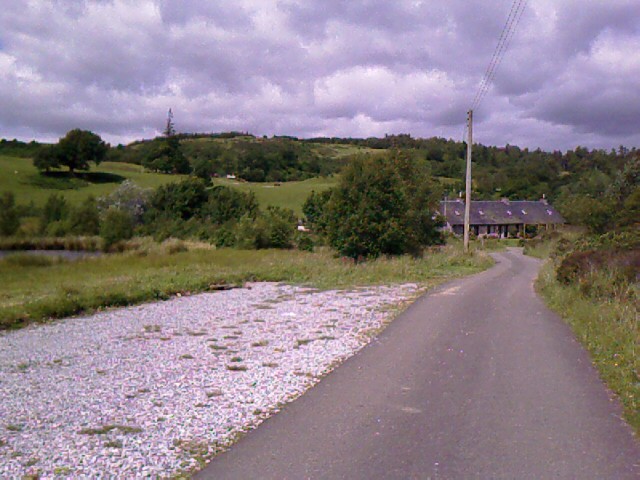
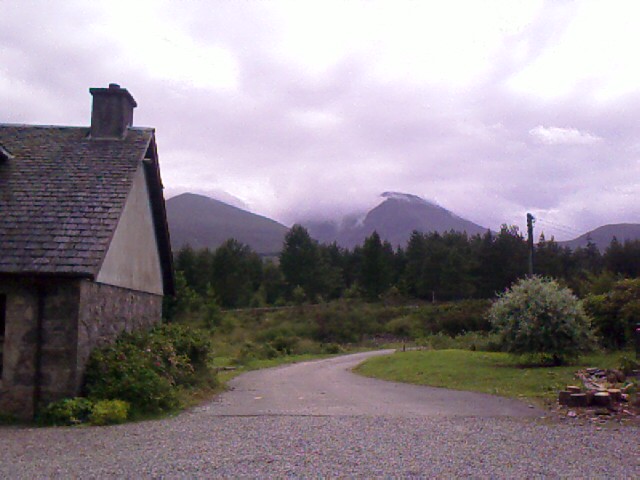 Torlundy Farm is an amazing place. It covers over five hundred acres of fields, woods, brooks, and hills. It is practically at the base of Ben Nevis, the highest mountain in Britain, over 4,400 feet. I didn’t see its top for three days because of cloud cover.
Legend has it, according to Charlie, that if the one particular spot of snow on the side of Ben Nevis ever melts, it will signal the end of the world. I check each day to make sure the snow is still there, especially as hotter days burn the clouds off toward the end of the week. I proposed to Charlie that maybe someone has painted the white spot on the side of the mountain so people don’t lose faith, like in that O. Henry story about the man who paints a leaf on an ivy vine to prevent a sick woman from dying when the last leaf falls. Charlie just rolled his eyes at me and grinned.
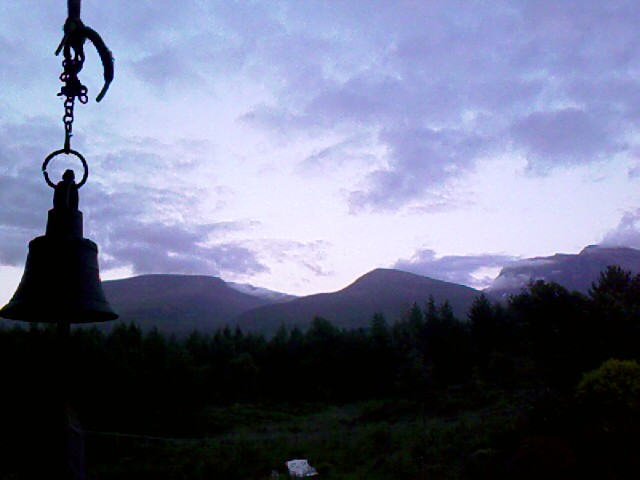
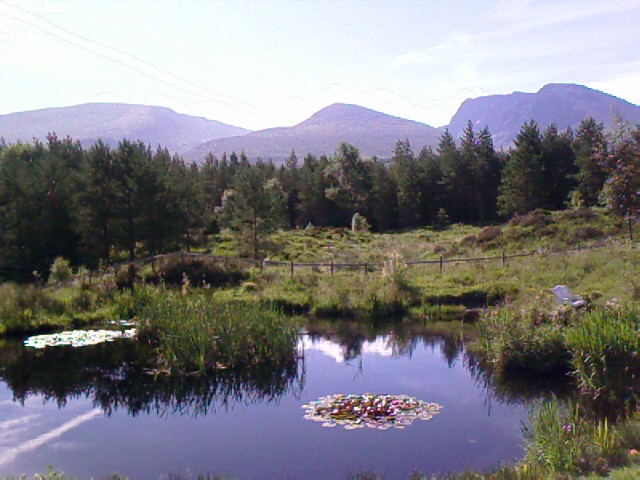 Ben Nevis and its two companion mountains, Carn Mor Dearg and Aonach Mor, are visible over the front garden from the window of my large private bedroom. The evenings are deep-blue sky. In the middle of one night, I woke up to moonlight flooding across my bed. There’s no sight like a full moon over Ben Nevis. I’m sad that Perry’s camera couldn’t capture it.
My first few days here were spent under Siobhan’s instruction about the animal feeding and horse routines, coupled with stall and tack cleaning, general farm chores, helping Chris with some computer problems, and grokking the reservation process for the chalets. I’m glad that Charlie has done that part before.
Siobhan took me on several horseback rides over hills and through shady glades on trails that are in almost constant view of Ben Nevis. We were checking on the horses or sheep, or taking a chalet guest for a ride. I haven’t ridden much for about two years, and have ridden the same horse for seven, and I felt really out of shape and clumsy riding the different horses from Torlundy. Trail riding takes a different kind of confidence in the horse and myself than arena riding, and I could tell it’s not a confidence I’ve cultivated yet.
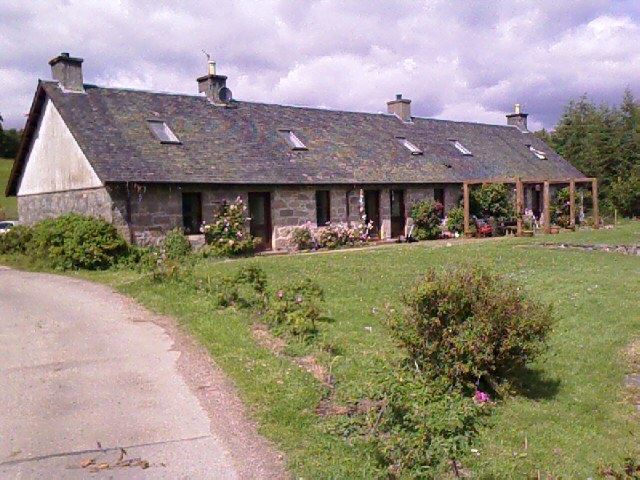 Mealtimes for the first two or three days united the entire family around the kitchen table over home-cooked food. Breakfasts had farm-fresh eggs (when we could get to them before the dogs did) and lunches and dinners had home-grown salad greens and organic foods bought from a tightly-stocked local grocery store outside of Fort William.
Siobhan and the girls are all wonderful chefs, and over the week I enjoyed a smorgasbord of from-scratch cheese soufflés, stew, and Thai food in between my favorite piece-together lunches of cheeses, meats, bread, and salads. I kept expecting (and hoping for) leftovers, but everything goes into the slop bucket for Miss Nicolette, including her daily dose of caffeine in the form of used coffee grounds and tea bags.
Daisy and Gemma left for their respective points east and south in Glasgow and London Tuesday, and Siobhan and Chris headed for London on Wednesday night. In their absence, Charlie and I fell into an easy routine of animal and yard chores. I took care of the animals and he took care of the yard work and “strimming” (weed-whacking using a string trimmer, or “strimmer”), and we both managed the phones for the guest house reservations.
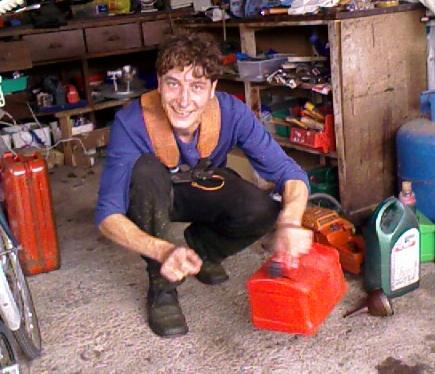 Charlie is great fun to be around—27, delightfully energetic and artistic (ask him about his lawn sculpting with a strimmer), with a brilliant mind for details, history, song, humor, and theatre. He has a willing heart and willing hands, and is thin as a strimmer himself.
He’d spend all morning in the gardens near the house with the strimmer, then disappear for hours on the tractor to mow acres of fields somewhere in the Scottish outback that’s the Carver property. I usually took care of the cooking or lunch prep, and Charlie was tops in adulation over the meals.
Thursday brought some excitement with helicopters all over Aonach Mor next to Ben Nevis. A gondola on the lift that goes to a restaurant halfway up the mountain had somehow collided with another one and fallen. It felt weird to watch the rescue activity from the driveway of Torlundy. Radio reports were sketchy. We found out later that no one was killed, although several people were flown to hospitals.
Charlie drove every day to Fort William to buy three to four local newspapers for their crossword puzzles. We’d spend lunch or dinner grappling with one puzzle, getting stuck, and moving to another. I cleaned the huge red-enamel gas stovetop one night with almost no effort because we were laughing so hard over mystifying crossword clues and Charlie’s horrible spelling, which often produced far more creative answers than the puzzle writers had anticipated.
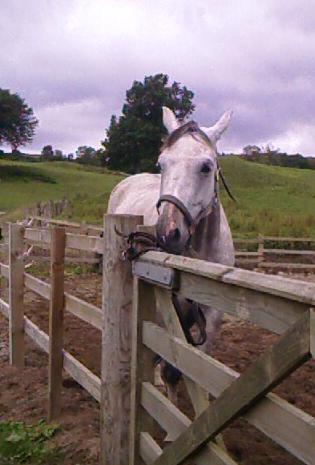
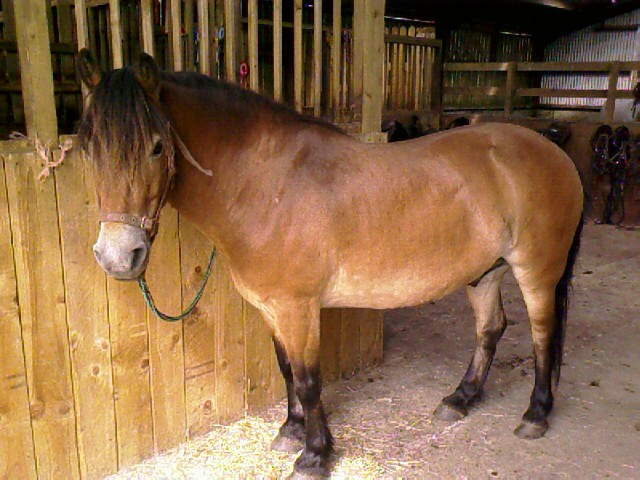 Working with Eric and Celene this week was both challenging and satisfying. Eric, pictured here, is an Exmoor pony who’s skittish about things coming at him from both sides, can be hard (as in last) to catch, moves away from anything near his feet and legs, and jerks away if someone reaches for the top of his head. I wanted to see if I could help him be more comfortable and confident in the world. Celene is a young-adult horse, and Siobhan had asked if I could help her be less head-shy with haltering and bridling.
I worked with both Eric and Celene using TTouches and techniques that I learned at the TTEAM training in Farmborough (sheesh, was that only a month ago?). I enlisted two young guests from the chalets—Tanya and Shaunie—to help me guide the horses through a labyrinth and other ground exercises a couple of times a day.
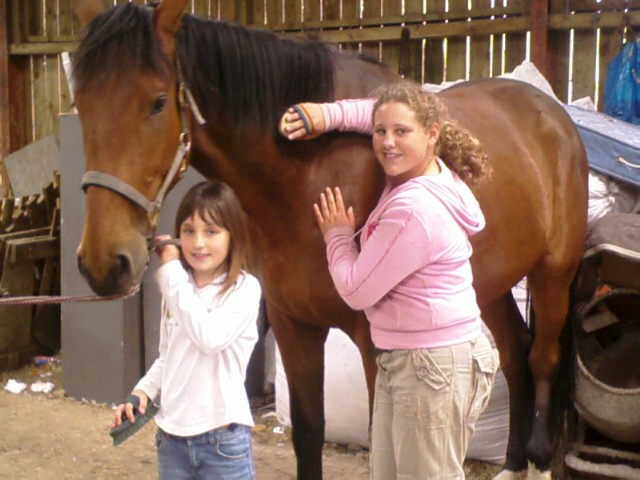 Tanya and Shaunie were both very good at learning the TTouches, and were a tremendous help getting Eric used to more skin contact. That’s them grooming Chris’ horse, Great Glen, in the barn.
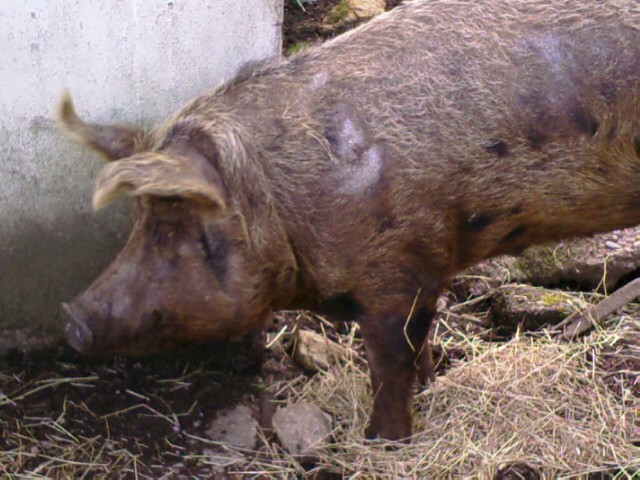
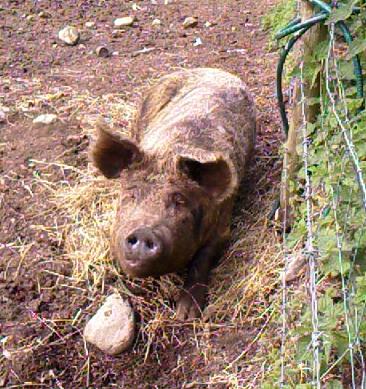 Even Nicolette loved the TTouch. I’d lean over the fence of her sty and she’d move around on her wooden feeding platform to present first her butt, then her head, then turn around at my request so I can do her other side. Her hair is wiry and her skin is wrinkly, but softer and warmer than I expected. And those ears are so big I could put my whole palm on them for stroking. She liked having her jowls TTouched, too. I’ve never gotten this chummy with a pig before; I liked the opportunity as much as Nicolette seemed to like the TTouch.
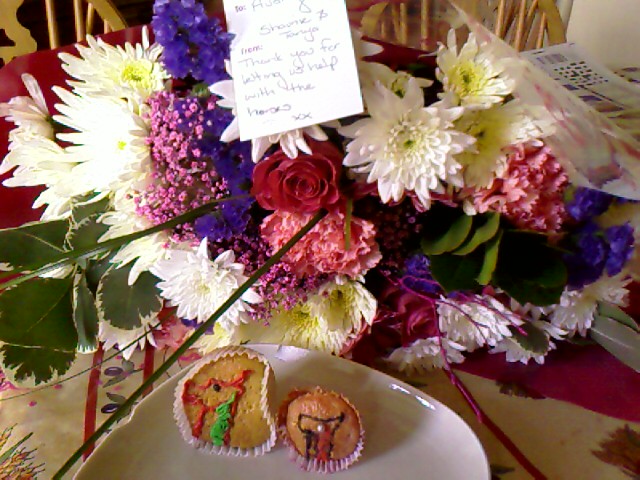 After our last TTEAM session on Friday, Tanya and Shaunie surprised me by coming back from the chalets with a gift of flowers, homemade cupcakes, and a lovely thank-you note for letting them help with the horses. They were indeed a great help to me, for Celene and Eric were both showing remarkable progress since we started with them on Thursday. By Saturday, I was able to halter Celene without her turning away, and Eric was not only coming in ahead of the rest of the horses, but was also OK with things all around his sides, and open to having his legs and feet touched without moving away.
Siobhan arrived home in the morning on Saturday, and I helped Liz, their chalet housekeeper, with some of the cleaning to get the chalets ready for the new guests.
Saturday afternoon lazed by as a picnic with Siobhan and Charlie at River Lochy, a primary salmon run whose banks demark a border of the Carver property. Siobhan explained that many rivers in Scotland have strict fishing rights and regulations. This one is fishable for trout, and only for fly fishing.
Siobhan took us to the river in her truck, driving straight through several seat-jouncing sheep fields and parking under a tree next to a barbed wire fence. We covered the fence with cushions, handed over picnic basket, wine, blankets, and other goodies, and climbed down through bracken to reach a sandy, half-shaded beach.
The day was hot. The water was cold. I swam across the river (another first for me, like the loch swim at Jura). We slathered melting Flora margarine over bread and crackers, peeled off slices of warm salami and cheese, ate olives and salad greens, nestled wine glasses in the sand to hold them up, and talked and laughed and napped in the sunshine.
On the way back, Siobhan gave us a driving/historical tour of the Fort William area on both sides of the river, including many views along the Caledonian Canal that runs from Fort William to Inverness. Neptune’s Staircase is here—eight locks to navigate through the elevation change of the canal. Sometime I’d like to grab a friend and rent a canal boat to travel part of the UK this way.
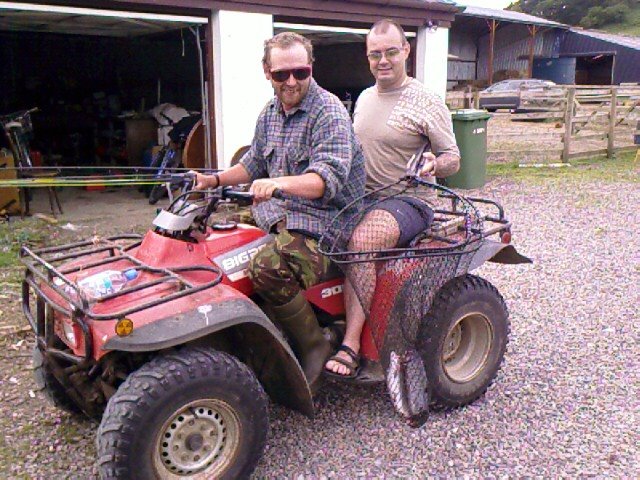
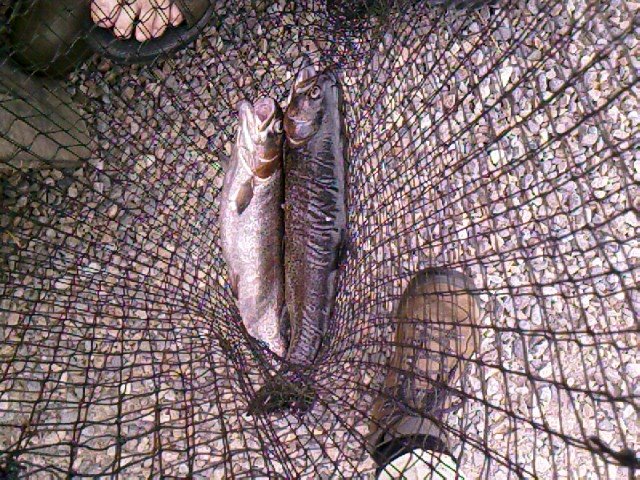
I had been invited all week by Ian, Torlundy’s almost-resident ponds-keeper, to drop in for a free fly fishing lesson, and I finally took the time out on Saturday to do it. Besides teaching fly fishing, Ian manages the catch records, trout stocking, and fishing fees for the three ponds on the property. That’s him driving the ATV with a guest who caught two large trout in the upper lake.
Now let me begin by saying that my only other foray into fishing was almost twenty years ago, with Richard on the Snohomish river in Washington. We had brand-new gear, freshly minted fishing licenses, and no idea what we were doing. We somehow found our way to a part of the river where no one else was fishing, and where the water ran rapidly over some rocks. I snagged a 4-inch fish, which was so under the size limit that the thought of having it for dinner gave a whole new meaning to “small fry.”
The only other catch of our day was also mine, and it put up a bit of a fight against the current and over the stones. I was already salivating for supper when my prize cleared the water—a sodden, black leather work glove. Richard and I guffawed, and he unhooked it and flung it away behind us. When it landed in the bushes, the glove was palm up, with only its middle finger extended to give us the bird. Years later, we sold all that brand-new fishing gear in a garage sale.
With this redoubtable record, I wasn’t particularly hopeful about fly fishing, but decided it was worth trying as something new. I arrived at the pond about an hour before sunset, and the water was quiet and still. Even the midges weren’t biting. Ian was happy to put a pole in my hand and explain the nuances of the toss and the fly and how the fish respond to it in the water.
Ian is a good teacher. Because I was a beginner, he had me use repeated tosses to get the fly way out into the water, instead of trying for a long-range throw all in one shot. Within only a few minutes, I could do a few semi-decent casts that actually reeled line out and sent the fly away farther each time. Consistency was harder to achieve.
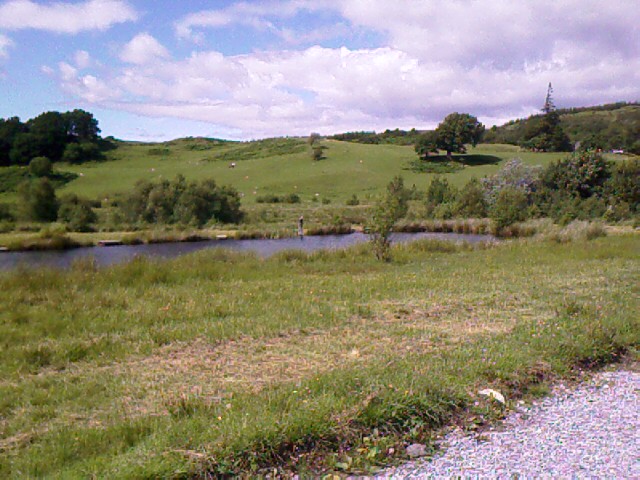 I found out a lot of ways that casts don’t work. Sending the rod too far back over my head meant that I’d hook a wad of meadow grass and fling it—plop!—into the water, no doubt scaring every fish in the pond. I could just hear them muttering to each other below, “Hey, man, stay away from that dock. There’s some big sh!*&^# comin’ down!”
Part of the trick was knowing when to release the fishing line from where I pinned it under my finger during the throw. If I released too soon, the line would whiiiinggg straight up into the air and the fly would drop down almost on top of me. It I freed it too late, no fresh line would reel out, the fly would snap-stop in mid-air, and the whole would plummet straight down—kerplunk—creating a watery ripple of “Oh, god, another amateur” spreading outward over the pond.
Ian, of course, could consistently send the fly arcing up and over with one graceful throw that spun out yards and yards of line in a satisfying whir and never got snagged on anything. Years of practice does that.
Thirty minutes later, Ian and I were still casting from our respective little docks at the edge of the pond. I was enjoying the relaxing rhythm and companionable silence. Fly fishing is one of those sports that’s enjoyable even if nothing more happens than flinging the fly through the air. I like the soft whizz of the reel feeding out line, the gentle plink of the fly landing in water, the subtle V that forms on the surface when I drag the lure back in. Being pond-side and in the open air seems to be enough.
Just as I was feeling the fatigue of continuous casts and ready to stop, Ian hooked a trout and called me over so I could reel it in. He taught me how to let it play out the line, then to pull it in steadily for him to scoop up into the net. It was a lovely shimmery thing, maybe a foot long, full of whipping muscle and gaping mouth and gills. I couldn’t bring myself to cook it for supper, so we let it go free back into the pond. I’m officially recorded in the log as someone who did a catch-and-release.
Sunday, my last day at Torlundy, I taught Siobhan some of the TTEAM basics with Eric, and we worked with 2-month-old foal of a mare named Jura (there’s that Jura again).
Siobhan thinks I should continue with the animal work and WWOOFing. She says I’m good at working with animals. I agree. This week has taught me that I really like farm environments, and that I prefer to work with animals much more than with plants, although I can still take or leave dogs. I have so much to learn about working with horses, too—young, old, different breeds and sizes.
 Siobhan commented on Sunday that Eric was “much easier to catch; he doesn’t walk away from me anymore,” which I was very glad to hear. I felt I’d done well by Eric, the WWOOFing program, and the Carvers’ generous hospitality.


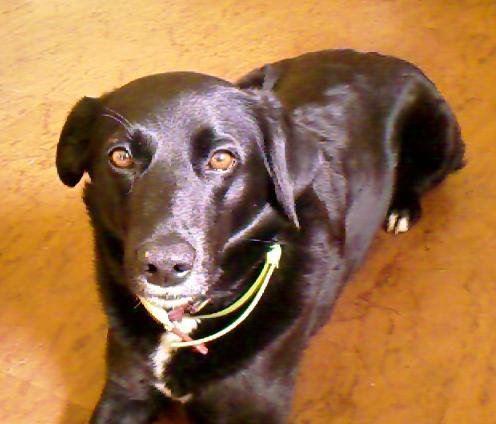
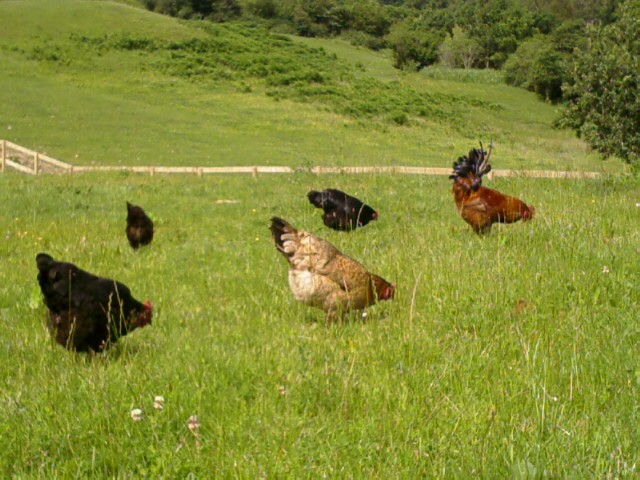
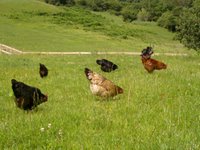 The critter contingent of the farm comprises two dogs, Pip and Tarka (shown here); a pig named Nicolette; a dozen or so horses (Cory, Merlin, Eric, Boswell, Great Glen, Celene...I was already having trouble keeping them straight); and lots of free-roaming chickens. I don’t see any cats yet.