Saturday, July 01, 2006

Inveraray Explorations

"Don't ask Why. Ask What." Hemingway was supposed to have said that. It may become my mantra for the rest of the trip. Or maybe my life.

The "What" I have for these two days has been "What's next? What's happening now?"

I spent some time Friday getting phone numbers and bus info for the Jura stay and found it easy to change plans--always a good sign. The Jura Hotel is booked, but they gave me the names of two B&Bs, and I've pieced together a full five-day stay by using them both. The WWOOFer family in Fort William, Great Glen Chalets, was also fine with my change in plans and can take me in the next week.

During lunch I sat on the seawall at the Inveraray park and fed pigeons, sparrows, a pushy gull, and several jackdaws from my bread roll, then poked around town a little. Decided to walk the mile south to Argyll Adventures, a family-run, family-fun place that advertises horseback riding, indoor laser tag, bungee trampolines, and--my objective--a 7-meter rock-climbing wall. Ever since seeing those girls climbing the wall at Okehampton, I've wanted to try that. And I want to see how different it would be from the tree climb on Wight.

My first adventure of the day happened before I got there. I needed a toilet, so I took a detour to a golf course on the way. Now this golf course isn't your typical American course, with a fancy-schmancy clubhouse and attendants, sports shop, and coffee shop. Access is obscure, the parking lot is gravel, and the clubhouse is a small bungalow of a building with a board on the outside announcing the next local tournaments, all of which occurred last month. Inside is a small paper-littered table, bulletin boards, oddball furnishings, and, hoorah, two bathrooms. No one was around to ask, so I just used the ladies' room.

When I went to leave, however, the bathroom door wouldn't budge. Not an inch. I pushed. It wasn't stuck, it was barricaded. Damn it all, who would block the door? I yelled out--"Hello! I need some help! Anybody there?"

Nuts. I had seen one man head out to the course with his clubs, and the parking lot had had very few cars. Hollering wasn't likely to rouse a response. But who would block the door anyway, and why? Had someone seen me go in and deliberately stopped my departure? I suddenly felt very aware that I was a woman traveling alone, and I didn't like it.

I wanted out. I wanted out now. I shoved on the door and got it a few inches open. A bench. Someone had placed a six-foot long bench against the wall, wedging it between the door and a table at the end of the room. What kind of perverse universal timing would make someone happen to block a door within the two minutes I was in the restroom unless they knew I was there?

I shoved and pushed more, and thanked god that the wooden table wasn't particularly sturdy. The bench pushing against its legs buckled them slightly and yielded the extra inches I needed to get the door open enough to reach out and tip the bench over and aside. I left it angled in the room with the bathroom door open, steadied the table legs to keep it from falling, and decided not to announce the situation to the thick, middle-aged man I saw coming up from the parking lot. He'd figure out what happened, whether the incident had been innocent or not.

All the way to the adventure park, I tried to recall whether the bench had been there in the room when I arrived or if someone perhaps had brought it in to furnish the room while I was there. Another bench had also been on the opposite wall when I left, but not blocking the men's room door because of more space on that side. The whole situation was probably void of nefarious intent, but it unnerved me just the same. And I was proud of myself for getting out.

The rock-climbing was different from tree climbing, involving my whole body and balance to stay on the wall. The first of four faces was easy--lots of fat holding spots, a flat surface. The young girl who spotted and instructed me was supportive and encouraging. She had climbed it many times, and knows the best handholds and how tricky the harder walls can be.

I was supposed to use my legs to push up instead of my arms to pull up, and I didn't always get it right or remember to do it. I sometimes felt scared to balance over my feet and then let one of my feet go to find the next foothold. I was harnessed to a hydraulic system that would let me down easily in case of a slip, but that didn't make it any less scary when it came time to let go of the wall once I'd reached the top.

The trick there is to let go and grip a plastic sleeve on the cable and walk the wall back to the ground as the hydraulics let me down. I kept swinging away like some flailing, panicked spider, or tipping my body flat so I was sliding bum first, or staying too upright and zooming down too fast. By the fourth time I'd done it, my body was trusting the system enough that I could walk the wall with enough balance to earn praise from my guide.

I managed the two beginner's faces, then got stuck halfway up the third face. It doesn't look hard at all, but once I got onto it, I found miserly protrusions and lots of recesses to clamber around, which makes for more awkward hand and foot holds than I would have thought. My muscles were fatigued from the previous ascents and practice, so I stopped on that wall, went up the beginner's wall another time, and then slid down, hot, sweating, sore in the arms, and proud of myself. I'd like to do this again when I get home, although right now I've got no desire to do it "for real" out in some national park or Olympic mountain. The body awareness is all I'm looking for.

I came back to a packed hostel. Peter, a middle-aged, bulky, rather loud man in a T-shirt, kilt, knee-high socks, and tennis shoes, kept trying to talk with me in the kitchen and dining room, but my barriers were still up from the golf course escapade and I wasn't in a talkative mood. He acted drunk, or it may be that he's got physical issues that keep his eyes off center, his words a bit slurred, his hips canted, and his walk hard on the ground. He stomps down the hallway like the hungry giant in search of Jack.

He's part of a group of about ten people (it seems like eighteen, they keep coming and going so much), three leaders and the rest in their late teens. All three other beds in my room are full tonight. After such an uncrowded time at the hostel, I closed up around this group of people--too many at once for me to process right away. The leaders seem kind, as do their somewhat shy charges, who each seem to have mild learning disabilities.


I ate breakfast early on Saturday and stuck my attention in a magazine to keep Peter out of my face. I was in no mood to talk or interact--it took too much energy to do it. I hopped a two-hour bus to Campbeltown, down the length of Argyll peninsula, which also took me past Kennecraig port, where I'll pick up the ferry to Islay and Jura on Monday. I was glad for the dry-run of that trip. Lovely coastal views most of the way, and startling to see sheep next to a loch, cattle next to the beach. Waves show up where there is no land mass between the coast and the Atlantic.


I walked around Campbeltown to check it out (interesting parking warnings and bumpers), then spent an hour in a lush green park by a school. Barn swallows swished over the grass and jackdaws hopped about and cawed. A woman walked by with a German shepherd who paused to snuff the air in my direction. The salami and cheese next to me were clearly on his preferred list.

Here it was quiet enough for me to make calls to arrange ferry, bus, and train travel for the next two weeks, including to St Bees, where I start the coast to coast walk on July 17. The plan is Jura five nights, Oban two nights as transition, Fort William seven nights, then on to the C2C walk.

Stopped for tea and chocolate cake with thick milk-chocolate frosting at a local café called Foncie's. The frosting's good, the cake was dry. I have yet to find a moist cake in Britain; maybe it's not a quality they look for in cake. Dined to a pop radio station, which was playing Spirit in the Sky: "Gonna go up to the spirit in the sky. That's where I'm gonna go when I die. When I die and they lay me to rest, I'm gonna go to the place that's the best."

I walked out from the restaurant, got to the pier, and then walked back to the restaurant--I'd forgotten to pay my bill again! I'm still confused about the variable dining-out protocol here...at pubs I order at the counter and they usually want me to pay ahead, although some will keep a running tab; at some coffee shops like this one, I order at the counter, but they want me to pay when I leave (and they don't bring the bill); at other restaurants, I'm to order from a waitress at the table and then need to ask for the bill, sometimes paying the server, sometimes paying up front. I shouldn't be surprised that I occasionally mess up on this, but I felt embarrassed and exasperated at my oversight. The café owner told me she had seen me leave but didn't want to chase after me and create a scene. She appreciated my honesty in returning, and a white-haired patron at the counter empathized--she had done it a few times, too. We had a good laugh, and I headed back to the pier.

One new bird caught my attention on the pavement--the body-size of a sparrow with striking black-and-white chevron markings, and a long tail that flicks up and down like a Hollywood clapboard. I described it to the proprietor of a nature-based craft store, and he said it was a pied wagtail. Appropriately named.

I sat on a rock wall by the harbor and watched seagulls fly and tree trunks get loaded onto a cargo ship. Once again I began to question my choice of Inveraray as my base on Argyll. Why not Lochgilphead, a sweet-looking little fishing village we passed today heading south? Or even Campeltown, which at least has more port activity and all the trappings of a large town and the chance of a movie theatre?

On the return bus trip to Inverarary, I spotted a wild swan swimming in the loch's waters, fish jumping the surface in three floating round pens, a white crane fishing in the tall grass of a marsh, two people tying off a sailboat as it bobbed in some kind of lock, and a family camping near the shore--their campfire on the sand, their tent on the grass, their brown skin shiny with sweat from the heat or maybe midge spray.

It's all a thread. An invisible skein of spider's silk that we unwind behind us, day to day to day. We connect with others, tie off a knot, launch into a new direction. We leave behind a trace of our energy, a shadow of our having been there, a wisp of us that no one else can recreate.

I chose Inverarary to meet Geoff and Jean and Heather and Ani and Peter. To get stuck and unstuck in a public bathroom. To see all these lovely sights today. To set my face toward Jura for equally mysterious reasons, for equally yet-unknown meetings. To be who I am every moment.

Thursday, June 29, 2006

Up to the Watchtower


The usual morning changeover of clientele has occurred at the hostel. Jean and Heather have packed their car and left, and I've moved back into the four-bunk room I originally reserved. Geoff has also gone, which I feel a little sad about; I enjoyed his company and was looking forward to talking with him more over meals at the hostel.

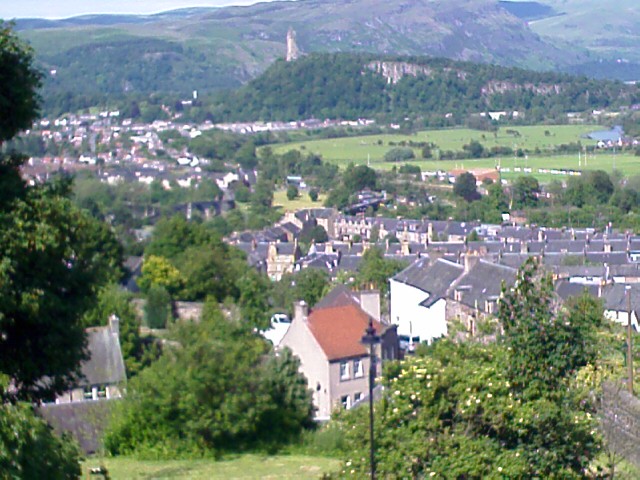
I took off from the hostel myself at 10am to overcast skies and the threat of rain--the first I've had in weeks. My aim is the Watchtower, that little square blob on the hill in the photo.

It's accessible through a forest trail that starts at the castle parking lot (blue route) and passes by several long-ago-imported, but very familiar to me from Whimsor's backyard, towering Western Red Cedars. Next to the largest, there's a signpost on which someone has scribbled "BIG!! TREE..." Well, yeah.

The walk travels past an old lime kiln and processing house (no roof, overgrown inside), the foundation remains of military activity (this land was a munitions base in the war), and a derelict "beehive" house (a round stone building with broken timbers, debris-strewn interior, and a collapsing conical roof that in better days would be reminiscent of Hagrid's home).

Rain pattered through the trees, so I stopped long enough to pull on rain pants and jacket. Good thing, as the water started coming down in earnest afterward.

The trail is mapped on a brochure (which I quickly found out was not waterproof) and pretty well numbered with signposts. But I couldn't find post #16. I continued to follow a trail of bootprints past #15, but after slopping through a quarter mile of slick mud, slapping wet tree branches, waist-high sopping fern, and rivulets of water running down the hillside, I figured I was on the wrong track: I was staying level and spiraling around the hill instead of going up. I was also beginning to lament my decision to leave my trekking poles at the hostel and began sampling a large array of muddy fallen branches to use instead.

I doubled back and was soon huffing and puffing my way up the steepest part of the ascent--a stony track alongside a brook. The rain had lightened up, and I pulled into a clearing to a stupendous view of Loch Fyne and Inveraray...and I wasn't even at the top of the hill yet.


I reached it at 12:15, and what a reward for the effort: a 360 view of Loch Fyne to the east, Inveraray Castle and town to the south, and hills on the Argyll peninsula at the west and north. The rain had almost stopped, and mists were coming in over the land and water.

The 1740s tower itself is far less interesting than the broken down beehive house--blockish with a few simple tiers of stone at the top, like a square wedding cake. I took shelter from the wind inside with a lunch of salami, cheese, tea, apple, shortbread, and Hula Hoops chips. Hula Hoops have become my favorite crisps for travel--they taste like Pringles, are shaped like finger rings, and don't crush into bitty bits while riding in a daypack.

I hung around the top of the hill for an hour, then took the quick trail down, over the gravel vehicle road at the back of the hill. The trip up would have been so much faster had I taken that road, but far less interesting. The bridge over the river Aray had some interesting old graffiti, some of it looking like it had been carved by someone who knew how to do it. Had tea and hot soup at the Inveraray Castle tea room.

I came back from the hike to meet a new guest at the hostel tonight: Ani, a Tibetan Buddhist nun who told me a lot about Jura, one of the islands that Geoff had talked up. She was on her way to Glasgow to pick up her granddaughter, who has just graduated from University outside London and is joining Ani for a visit on Jura.

I liked Ani immediately, and by the time we spent an hour together, I was convinced that I needed to change my plans and spend several days on Jura. It's a remote place in the Scottish Hebrides. Ani describes it as an island with only 200 residents, where the red deer outnumber the people thirty to one, and the phone directory is one A4 page printed on both sides.

I broke out my local maps and brochures, we spread them out, and she described how I'm to get there--an hour bus from Inveraray, a two-hour ferry to Islay (EYE la), and a five-minute ferry to Jura, where a bus can meet the boat to take me to Craighouse, the only village on the island. ("Gwen The Bus Driver will tell you all the island stories on the way to Craighouse.")

I went to bed that night excited over my decision. This side trip to Jura is another one of those "I'm not sure why I'm doing this but I'm supposed to" excursions. The trick will be to reschedule the week I'm to spend WWOOFing in Torlundy for one week later, to arrange all the appropriate bus and ferry tickets to and from, and to find affordable lodging on the island for five nights in a row.

And here I'd had discarded a visit to an island because I thought it would be too much trouble to arrange.

Wednesday, June 28, 2006

The Road to Inveraray

On the noon bus from Glasgow to Inveraray, I had lots of time to think, scribble, play solitaire, nap. I reached my destination way before the hostel office opened, so I left my bag in an alcove off the dining room and toured the TIC for information about the area.

The way I look at it, Inveraray qualifies as either a small town or a large village. It comprises two main streets off the busy, Argyll Scenic Coastal Drive, a country road that hugs the town in a curve on its way down the east coast of Argyll. It's at the mouth (inver) of the river Aray, which feeds down from the hills at the west. I spot several restaurants and crafts and souvenir shops, two large hotels and numerous B&Bs. Residences are behind the town, and there are also a waterfront park, a golf course, a woolen-mill outlet store that draws in tour coaches every few hours for shopping.

Oh, and there's the castle, of course, home of the famous Campbells, the primary clan of Argyll and the forebears of a Thompson line. (Thompsons can apparently spring from Scottish, English, or even Irish ancestry; I've been told my lineage is Scottish or English. I had expected some sort of instant "at home" feeling here in Argyll, but it's not here, not like what I was sensing closer to Dumfries, which I don't think was Campbell territory. Perhaps the heritage is stronger from the English side, after all.)

The Inveraray hostel is lightly booked tonight; I'm here for five nights in a room with four bunks, but only two roommates, who have yet to show up. I usually select a bottom bunk nearest a window. Preparing a stir-fry dinner at the onsite kitchen, I met Geoff from Belfast, who now lives in Edinburgh, and who has just finished cooking an eggs, sausage, and bacon dinner. He's a big man, tall, dark-haired, thick-bodied, with a big booming laugh that reminds me of Tom back in Oly. He is a freelance bird counter, naturalist, and just got another PhD that he's going to Glasgow to collect in a week.

He tells me he's near the end of a three-month bird counting job in which he goes to saltwater lochs to count black-throated divers and red-throated divers (loons). His client is checking the changes in population since the last census, about ten years ago.

He talked a lot about the Hebrides islands nearby and especially recommended going to Jura or Arran. I'm doubtful of this idea, though, because of the distance and the need for buses and ferries and coordinating their schedules. I've already booked a WWOOFing week in Torlundy immediately after my stay here, and doubling back geographically afterward would take more time than I'd like before going south for the beginning of the coast to coast walk. An island visit will have to wait until another trip.

At his invitation, we had a drink at pub--him a beer, me a fruity J2O, sharing a small bench and table. The physical nearness of another person felt good, especially since it wasn't impaired by a lot of flirtation or nervous attraction or forced, polite conversation. We just talked about our lives and plans and enjoyed each other's company.

We walked back to the hostel and had a late night talk with Jean and Heather, two middle-aged nurses who've left their husbands at home so they can travel other parts of Britain. They remind me of Janet and Trisha from Bridestowe--rambunctious and funny and down-to-earth.

The Jean, Heather, and I were slated to stay in the same room, but the single room across the hall ended up being empty for the night. We all joked about snoring and middle-of-the-night pee breaks (with them using a carton in the room--they're nurses, after all) and we laughingly decided it would be best if I could move into the empty room for the night. Fortunately, the hosteler agreed, "but only for one night because I've got more coming in tomorrow."

So I tossed all my stuff into the pack and shuffled it across the hall. The hall here is dank. A faint odor of mildew comes from the showers and bathroom, which have poor ventilation or small windows with no chance of a cross breeze. Everything is cleaned daily, so nothing to give me the willies from a germ standpoint, but the moistness is an unpleasant reminder of dorm living every time I enter the hall.

The toilet seat in one of the stalls can also be a surprise if I forget about it. Improperly held on by two clips that face the same direction (instead of opposing each other), it skids over the porcelain when I sit down and once nearly dumped me to the ground with my pants down. I try to avoid that stall now.

Last summer I went to the Scottish Highland Games in Enumclaw, an hour or two from where I live in Olympia. This annual festival brings together people of Scottish persuasion and Scottish interest. Bagpipe-band competitions (blood-enthralling things to me, blood-curdling to others), market and food stalls, Scottish dancing and fiddling, and "heavy" athletic competitions like tossing the caber (think sending a telephone pole end over end while wearing a kilt), throwing the open stone (think shot put while wearing a kilt), and flinging weights overhead (think granny shot with a basketball, only you send a 56-pound weight over a bar above you and hope it doesn't land on your head--and, yes, while wearing a kilt). Curvy women everywhere in tartan, burly men everywhere in tartan. And of course clan booths galore.

I had stopped at the Campbell booth to look up the Thompson line and met a trueblood Campbell who lives in Arlington, WA. He showed me the map of Argyll and a small guidebook from Inveraray Castle. He lamented that the guidebook was over ten years old, and I promised to send him a current one if I ever got to the castle. I decided then and there to go as part of this holiday.

That task, purchasing an updated version of the guide, was what I did today in the Inveraray Castle gift shop. The half-size guidebook of the past, with its faded photos and outdated kitchy copy, has become a grown-up glossy booklet with up-to-date family tree and photos of its many rooms and regalia. I looked it over while taking tea and cake at the onsite tea room, and decided that I didn't need to visit the house itself. The photos were enough to show me that it would be a similar experience to the tour through Drumlanrig, which is still fresh in my memory. I can quickly get "museumed-out" while traveling, and seeing more than one estate every fortnight is pushing my definition of travel entertainment.

Instead I plan to take in one of the castle's outdoor offerings: a walk up to the Watchtower, a fake-ruin folly at the top of the hill near the castle.

The Watchtower is one of the few "things to do" in Inveraray aside from the shopping, golfing, and a local adventure park that offers horseback riding. A long-term tourist destination spot this place is not. Which is precisely why I selected it.

Even the hostel receptionist asked when I made the reservation for five nights, "Why Inveraray? There's nothing to do there."

"That's the point," I said. "I'm looking for place to Be, to do nothing. To sit and see what it feels like."

As I scoped out the town and the castle grounds and sat on the grass looking down the mouth of the River Aray to a pretty little bridge and Loch Fyne beyond, I realized, "Huh. This is it," and wondered at the wisdom of this decision.

Tuesday, June 27, 2006

Stirling and the Glasgow Boys

"FREEDOM!" yell the school boys on the count of three from atop the tower. "FREEDOM!" rings the cry far above the fields of Stirling. Mel Gibson couldn't have done it with more enthusiasm.

We are all crowding the top deck of Wallace Monument in Stirling, celebrating, reliving--and on their part, re-enacting--the story of William Wallace, Braveheart of Scotland, whose father, brother-in-law, and wife were murdered in massacres by the English.

Wallace spent the rest of his life fighting for Scotland's independence, leading rebels against Edward I, winning a definitive and infamous battle at Stirling Bridge (visible from this vantage point), invading northern England to send food back to Scotland, losing roundly at Falkirk, and then being betrayed into custody by a friend. He was driven 17 days to London strapped to the belly of a horse, sentenced without trial for murder, arson, and pillaging, and finally, on August 23, 1305, dragged through the streets by a horse, strangled, disemboweled, quartered, and sent to four corners of England and Scotland as warning against further insurgency.

It didn't work.

Although Wallace was, as the Munchkins would say, "not only merely dead, [but] really most sincerely dead," Robert the Bruce (there he is, again) rose up to take the throne, and Scotland won its independence in the years that followed.

Wallace Monument is a Victorian achievement, one of many celebrations of Wallace throughout Scotland. From its highest level, nearly 200 feet up, we oversee all of Stirling, Stirling Bridge, The Trossachs and Ben Lomond. The University of Stirling, too.

From this site, Wallace was said to have run down a hill and ambushed the English in a particularly bloody and definitive fight. The story has fired the imagination of the third graders who have clamored up the 246 spiral steps to this viewpoint, hence the cries.

Stirling was a good side trip today. I bused alone to the Wallace Monument, then talked to a young man from Portugal and two traveling buddies from Idaho and Atlanta on the way back to town.

I meandered toward Stirling Castle via the back roads, along the old town wall where an engraved stone plaque honors Robert Spittal, "Taylor to King James the Fourth," for erecting a hospital for the "relief of decayed tradesmen." I came upon (I shouldn't be surprised by now) a cemetery near the castle, from which I listened to a warm-up session for a James Blunt charity concert that's being set up in the castle's bailey. The high-tech amphitheater looked like something dropped in from the Puyallup Fair.

A few young boys tried to climb the wall to watch, and the youngest tyke got stuck halfway up and cried for help. A Scot I was talking with came to the rescue from the cemetery grass.

The castle was under scaffolding, pretty much closed off for the afternoon because of police escort for the evening's concert, and I felt no need to tour it. The grounds provided a lovely view of the Wallace tower in the distance, though.

I took the early evening train home and had the pleasure of whiling the night away with the Glasgow Boys (my name for them), some writer friends of Cynthia's, a gal I know from a writer's group in Olympia. She's lived in Glasgow and was closely connected to this writer's group, many of whom have published science fiction and fantasy novels and short stories.

My main contact point, Neil, and I had spent a couple of emails and text messages to arrange a meeting at 8pm Wetherspoons pub on Sauchiehall St. The others floated in and left as they needed to--Al, Craig, Mike, and Duncan--all seasoned writers and as gold as they come for making a gal feel welcome.

I had expected to visit maybe an hour or two, but the conversation hadn't ebbed even three hours in. This evening tested my ability to follow the notoriously difficult Glaswegian accent--all of the UK jokes about it, and I can see why: it's like trying to follow rapid-fire slurring. We had a good laugh every time I didn't get something and we nattered over the nuances of British, Scottish, and American vocabulary as only a tableful of writers can.

The talk waxed and waned over writing, beers, world fantasy conferences, readership, the why's of writing, bands (Neil plays in one), America, Glasgow, movies, the Glaswegian sense humor, the mental models by which we view the world and read books, how each of us approaches writing and why we do it...on and on.

We closed the place down at midnight, and Al and Neil walked me up the hill to the hotel, where we stood under the stars at the bottom of the steps and talked some more, until I got too cold to stay outdoors. We said goodnight near 1am, and I retreated to my room's warmth, happy to meet people who also feel, and follow, the compulsion to write, no matter what.

I had told Al and Neil about my grapplings with Sigil, that long-term, won't-let-me-go novel that I'm getting clear direction about finishing even though I'm feeling daunted and unconfident about doing so.

I don't have a bunch of plots and characters rattling around inside me to get out and into print. I don't have a shelf full of novels or short stories waiting to be told. I'm not that kind of writer, and I don't want to be.

Nor do I want continue to spend all my energy helping businesses reach their markets, or peddle their products, or explain their processes. I'm skilled at that, yes. But I'm an essayist at heart. I do best with short stints like these blogs, sent out to the world to say, "This is me. I am here."

I question: Do I really want to write, once I've let go of defining myself as a writer by trade, one who collects other people's thoughts and talks to their customers? What is my true passion of creation? Sculpting. Mud. Mess. Stories in clay, as well as in words. Animals and animal husbandry. Building but not crafting. Probably lots more that I'm still finding out.

Only this one tale is inside me. Alec's tale--my own tale. Written as I would write it, given structure as I would give it. Putting it out to the world without defending it, explaining it, or letting go of the core truth that's there. Making it available to those who are meant to find it when they're ready, and letting it have whatever life it's going to have as part of my own lifetime here.

Tonight, after talking to the Glasgow Boys, I felt seen and heard and supported and inspired no matter what I choose to do with it next.

Monday, June 26, 2006

Appointment in Aberdeen

Caught the 8:42am train to Stirling to go to the Wallace Monument and whatever awaits me this day, and had a sudden urge to stay on the train all the way to its terminus: Aberdeen. Have no idea why, but I feel like I'm supposed to meet someone there. Haven't been to Aberdeen in my other trips to Scotland, either.


The train pulled into Aberdeen about 11:30, and I went to the TIC, hoping to get a lead about where I was to go to next. Tons of material, including a lot about mine tours of the gray granite that's mined for the buildings here, but not much called to me.

I grabbed a brochure about a walk around King's College, headed out, and came upon the free Marischal Museum, part of Aberdeen University, on the way.

The ground floor offered a small marble-tiled room that housed about seven chunks of stone, each faintly carved in pictographs of shapes and animals.

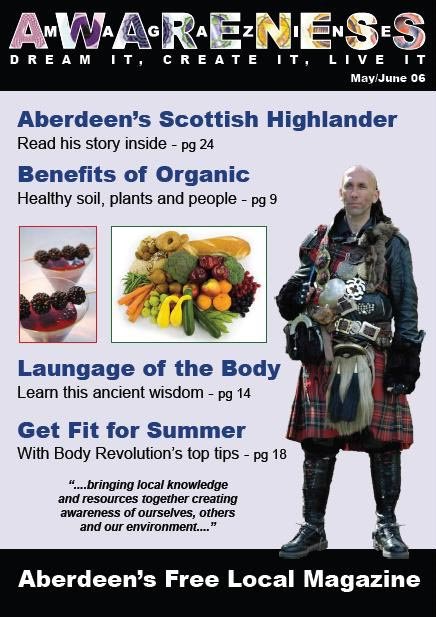
The only other visitor was someone who activated my "Warning, warning, Will Robinson" radar: a tall man dressed in full Scottish regalia and then some--kilt, sporran, buckles and shoulder scarf, accented with black leather jacket, palm-sized medallions across his chest, multiple wide belts with big square buckles, tall black leather boots with silver spikes around the ankles, a brown fur stole over a shoulder, black fur wrapped around his forearms, furred leather gauntlets, several chunky silver rings. He was bald except around the back of his head, which had black hair about a foot long trailing down his shoulders and back. All he was missing was a broad sword, and he'd be ready for the set of Rob Roy Meets the Terminator. I expected him to reek of unwashed body and sweat-soaked wool, but he smelled of fresh soap.

We examined the stones in the kind of respectful, mutual silence that people reserve for museum viewing, staying out of each other's way as we moved from spot to spot. After a few minutes he asked if my camera, which I was using to try to capture a high-contrast image of the stones in hopes of better viewing, could take a good picture of the carvings. Alas, it really couldn't in this indoor space, and he went on to speak about what he was seeing in the stones--a black aura shimmering over that one (invisible to me), an eagle consuming the world in that one (to me, it was a simple four-legged beast with a lizard-like snout), and that one over there, which, he said, was being displayed upside down.

I still felt wary but was hoping to find out a little more about him and his unusual getup, so I asked his name. He identified himself as Parasuram, a writer, astrologer, and just written up in Awareness Magazine. He then launched without pause into a dissertation on the Picts, stone carvings, astrological chakras of the Earth, Mars, and other planets, lay lanes in Aberdeen, and the fact that Aberdeen is the center of spiritual activity and energy for all of Scotland. (The concept lay lines has been popping up all over this trip, from Bath to Dumfries).

He said he was part of the healers, had lived in India a while, mentioned Krishna, Buddha, and Jesus as spiritual leaders who've been all over Europe and Scotland, and applauded Tolkein for tapping into the fact that our solar system is part of Middle Earth, with dark worlds below us and heavenly worlds above us and that's why we've got so much light and shadow in our world.

His world view was very different from mine, which was OK in its way, but I was starting to feel cornered and bored when he segued, non-stop, into how the Age of Aquarius ousted the Age of Pisces from 1960 to 1999 and that those were the times of questioning all the old ways, blahblahblah.

I may have found it more interesting if we'd been dealing with a conversation, but he just kept lecturing about all this knowledge, without really bothering to connect with me as a person or to ask first if I were open to hearing this perspective. He even offered to send me info over email. Bleah. I felt irritated, like I was being evangelized, and I had already had enough of that yesterday in Glasgow, when a Hari Krishna gal did a 180 and trailed along with me down the full length of a pedestrian shopping block, giving me her special spiel on human happiness all the way, just because I had made eye contact and said hello.

Why is it that these kinds of people so often glom on when I bother to acknowledge them? I say hello, give a smile, and whoosh--they swoop in like I've given them an open invitation into saving my soul. I don't feel so trapped and rude about dusting them off now, but the fact that some of the more evangelical religions and belief systems take any overture as an opening keeps me reluctant to create an opening with strangers at all. And I don't like that kind of distancing.

I was casting about for some semi-polite way to extract myself from this deluge of data while still acknowledging all he had just said, when he seemed to run out of steam long enough for a pause. "These stones do have a lot to tell," I conceded, and to my surprise, he stopped talking altogether and very soon wished me to enjoy the rest of the museum and left me to the room and the stones.

I let a few minutes pass, then went upstairs to see what was there, ending up in the Encyclopedia of NE Scotland, a room in which artifacts and information about this region's 8,000-year-old history are presented A-to-Z in glass wall-cases. "Broadsword" before "Burns," "spinning wheel" before "stone circle," etc. The juxtapositions were interesting.

Parasuram found me again in that room and invited me to take one of the Awareness Magazines he'd left in the foyer. Then he went. I drifted into the foyer after reaching Z, and found the issue.

I didn't have the nerve to photograph him in person, but that's him on the cover. He's interviewed in this edition. The magazine sounds sensible enough--deals with organic food, healing practices, speaking one's truth, being self-confident about accepting compliments: many of the kinds of things I lean toward now.

In the interview, Parasuram describes his attire as that of a Universal Warrior, a blend of costumes from India, Tibet, Native America, and Scottish Highlander/Celtic influence. He talks about travel being important. And about self-knowledge as the way of the freedom warrior.
One part stuck with me, quoted directly here. "Q: What is the best piece of advice that you can give to those who seek freedom?" A: “Trust your own instincts and develop your own mind. To find freedom physically, one has to think freely within one's mind. This comes from knowing what is one truly seeking? Never follow man made perspectives. Develop your own soul and intuition and learn to trust yourself. Let go of attachments which no longer have any meaning. The more you desire freedom the more truth comes to you. Ask your self the following: Who Am I? What am I doing here? What kind of world destroys its resources? What can I do to stop our destruction on earth? These questions will motivate you to go forward and these questions are the foundations which bring change and a new understanding into your life. This is when the journey begins and inspirational people come into your life.”

I sighed. Inspirational people do come in such odd shapes and sizes. I wouldn't have picked up this magazine if I hadn't met "Aberdeen's Scottish Highlander" himself in the museum. My purpose here done, I returned to the rail station and Glasgow, still feeling a little bemused and weirded out about the whole experience.

Sunday, June 25, 2006

On to Glasgow

It may be my mood these past two days, but Glasgow doesn't particularly light my bulb for an inspiring place to be. A busy M road bisects it into workaday east and posh west, and even though it has two main pedestrian-only streets on the east side, I can't seem to get far walking the area. It’s like there's some Acme Marketing Magnet that keeps sucking me back to Sauchiehall ("Socky hall") and Buchanan Streets--full of their mega department stores, salons, mobile phone stores, pharmacists, high-priced restaurants, jewelry shops, boutique stores, and shopping malls. The thoroughfares are packed with weekend shoppers.

I arrived on Saturday by two-hour train from Dumfries, moving through a low ceiling of clouds--soft gray, shadowing the fields. The train's vibration set up a very loud, deep harmonic that hurt my ears. A deer bounded through an unmown field, but the grass was so high all I could see was its brown back bouncing in and out of waving green.

The hotel I'm at here, McLays Guest House, has little merit beyond its location about a mile from both train stations and a few blocks from the Glasgow School of Art. The interior is serviceable enough, but it feels old and shabby, like a dowager who has aged poorly and is trying not to show it. The breakfast room is crowded with so many tables and chairs that getting to the cereal and coffee areas takes dexterous maneuvering, several apologies, and walking sideways. That's the view from my third-floor room. Most of the buildings on this street looked like this.

A few blocks from the hotel is a small U-shaped laundromat, which I welcomed after a week of hand-washing in sinks. Pay the grocer next door £3 for a funny-shaped token for the washer--a silver medallion with two opposite sides cut straight--and take your chances with the dryers for 20p for ten minutes.

I've been to two movies here so far. The Glasgow Film Centre is close to the hotel and has the charm of a small, local theatre that has been lovingly refurbished. Went to see The Wind That Shakes The Barley my first night here, and walked out half an hour into the film--no plot beyond English and Irish killing each other in brutal shootouts in the 1920s, with not much effort to hook me into the characters. I didn't want to stomach the rest of it. The man and woman I walked over in order to leave my seat were surprised I was going.

The second show was an American film, Thank You For Smoking. I found the satire wickedly funny, but the rest of the audience didn't seem to get it, or perhaps Glaswegians prefer not to laugh out loud. I overheard one young woman ask her boyfriend, "Who's Jimmy Stewart?," clearly missing the allusions of Mr. Smith Goes to Washington. But, then, most younger American audiences wouldn't get that, either.

The anti-smoking campaign in the plot seemed out of place here, too, since all cigarette packages in the UK are marked in red with phrases like SMOKING KILLS in words that take up half the package. And Scotland has just passed a country-wide no-smoking-in-public law, which is sending some smokers to distraction. We just passed a similar ordinance in Washington state, and it's already meeting with lots of flak.

I came too late for a folk festival that ends this weekend, but I like the humor and art that is all around Glasgow. Even a parking garage becomes a canvas for interesting metal sculpture.

My tour of the Glasgow School of Art on Sunday was given by one of the students at the school. This is one of the many buildings Charles Rennie Mackintosh designed in Glasgow. Alas, no photos allowed. Mackintosh is a native-son architect who practically defined the Art Nouveau style. He was working in the same time period as Frank Lloyd Wright, and their styles may have fed off each other. The rooms are an odd mixture of nature and geometry, of symmetry and asymmetry.

Mackintosh's famously simple rose pattern has grown on me. I've seen it a lot since entering Scotland, for the country is celebrating a 100th anniversary of Mackintosh this year. The Art Nouveau theme is in a lot of jewelry. And of course it's on everything in Glasgow from coasters to picture frames and aprons. I finished most of my souvenir shopping at the school's gift shop.


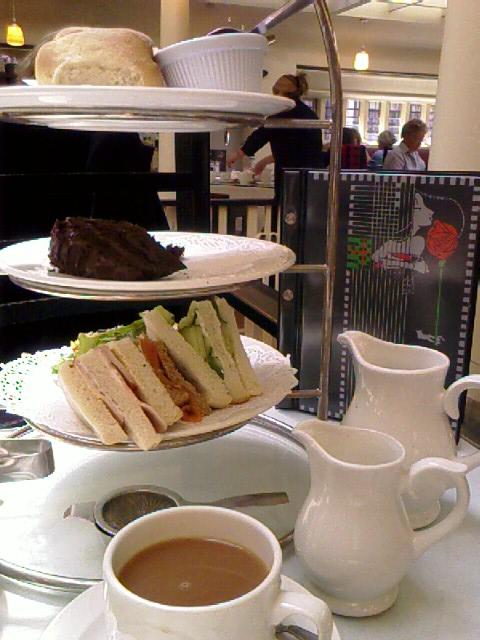
Took high tea at the Willow Tea Room, also designed by Mackintosh and renovated in that style during the 1980s. I like the fact that he created a unique design for each client--no one has the same thing, and the furnishings are easy to identify for where they came from because of it.

Glasgow does have some good dining places. My first dinner here was at Anduluza, a Spanish tapas restaurant. Good food, and very crowded--I ate at the bar in order to eat there at all. Reservations definitely recommended.

Will watch what I can of the football game today--England v Equador in round 2 of the World Cup. Whoever wins this one continues on; losers go home. England's been playing pretty badly in the last two games...they look out of their league against some of the other teams I've seen.

(England made it: 1-0.)

Friday, June 23, 2006

Winged Hearts and Other Weird Moments

Today was another Twilight Zone day, in which I kept feeling like I've been here before, have lived in this region in another lifetime. Especially at today's destination, Drumlanrig Castle.

The weather turned cloudy as I rode the 246 Stagecoach bus to the castle. Gray, heavy air that made the green hills look greener than usual. The bus drops visitors off on the main road out of Dumfries, about 1.25 mi from the castle. The paved drive in passes through a thin forest like many I've seen in the Pacific Northwest; I recorded some lovely morning birdsong here.


The forest opens into bridge over a river and then sheep fields and follows a long straight drive to the castle, with more forests around the north side of the house. Acres and acres of property.

Drumlanrig (meaning "hill long ridge," describing the estate's land) has three family names associated with it. The most well-known is Douglas, Duke of Buccleuch (buuk LAY). Specifically James Douglas, a close friend of Robert the Bruce, king of Scots in 1329. This was the time of the Crusades, but Robert the Bruce, who always wanted to go on a Crusade, died before he could leave. In steps friend James, Duke of Buccleuch, who carries The Bruce's embalmed heart into battle in his name. (Embalming and toting around hearts seems to have been the order of the day.)

The combat didn't go well for the duke, who, on receiving a mortal wound, is said to have flung the boxed heart ahead of himself into battle and yelled, "Forward, brave heart!" The cry of "Forward" continues as the family motto, and the Buccleuch line adopted a particular symbol--a winged heart with a crown--as its family motif. (This "brave heart" is not the same one as in Braveheart the movie. That was depicting Wallace, another Scot just a little earlier than Robert the Bruce, who helped bring about The Bruce's rise through his own efforts at rebellion against the English.)

I toured the home, which like most estates here is stuffed from baseboards to rafters with centuries-old furnishings, astounding artwork and portraits, figurines and cabinets and clocks and mirrors and candelabra and other treasures from all around the world. This one houses a Rembrandt, Old Woman Reading, which is marvelous to see in person.

Everywhere at the estate are images of the winged, crowned heart: woven into wool carpets, carved along stone eaves, etched into fireplace woodwork, worked into candlesticks, tapestries, and upholstery.

The guided tour starts and ends near a tea room--a converted kitchen, still housing some of the old cabinetry and pots. Their celery/potato soup and fresh-made organic bread makes for a welcome lunch break. Shopped at the gift shop and at the stableyard-converted-to-craft-stores, buying some yummy orange-cranberry jam and crunchy mustard for Norman and Jean. Also got a major-garlicky, melted buttery still-warm focaccia-like roll to eat in hand as I wandered into the onsite wildlife interpretive center.

Much of the Drumlanrig acreage is wooded, so it's a natural site for wildlife viewing. They've installed a forest blind where I watched native red squirrels ("SQUEER-ells" here) and lots of birds at the feeders--titmice, siskins, woodpeckers, finches.

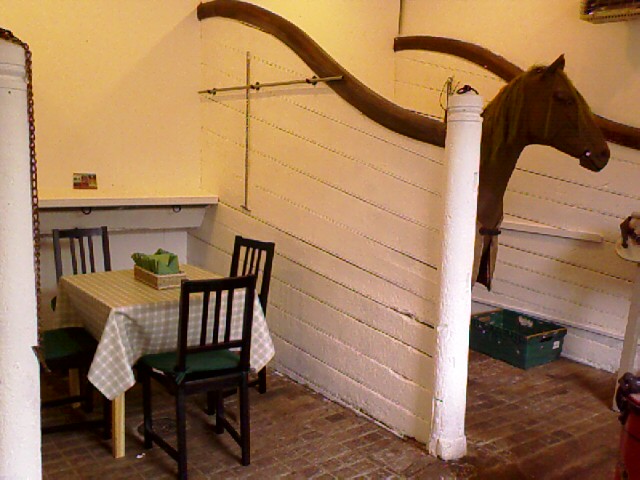
An on-staff woman ranger and a local fellow--over 6' tall, late 40s, with multiple silver piercings in his nose and lips, clown-red hair, tattoos, a tan, and leather jacket--helped me ID some feathers I'd found and photographed earlier in the trip. Magpie and wood pigeon. We got to talking and they treated me to the last cup of coffee at the stableyard snack bar (where the gingham-covered tables are set up in former horse stalls), which was closing for the day.

I had spent much of the day at Drumlanrig, and got back to town in enough time to check out Internet access at the library--two hours per day free with a temporary library membership, plus lots of computers to use. Score. Set up an appointment for tomorrow.

Closed the evening off with a lovely Italian pizza dinner with a friend named Anja who lives near Dumfries. She's a German import into Scotland whom I met at the TTEAM training a few weeks ago in Farmborough. The restaurant she recommended was popular and way crowded, so we had a drink beforehand at a local pub. Lots of laughs, and over our pizzas (mine with anchovy paste, no less), she explained the nuances of World Cup scoring and football rules with great knowledge and humor. You can even ask me what offsides means, and I could explain it!

And the Twilight Zone moments today? They piled up as I walked Drumlanrig. I've been using a winged heart as part of my signature on cards and letters for a few years, yet have never consciously known of its connection to this place. Hmmmm. The tea room at the castle is in an old kitchen, maybe the 1800s part of the house. I felt a strange flash of recognition upon walking in, as if I had once worked there. Hmmm. Last night's nearly fruitless search for a pub ended me up on Buccleuch St, at Robert the Bruce, direct connections to Drumlanrig. Hmmm. At the craft store of one painter in the castle's stableyard, I saw stacks of canvases, all turned away to the wall. My eye fell on the only canvas with a title written on the back: "Sense of Belonging." Hmmmm.

Coincidences? Synchronicities? Past-life overlaps? Collective memories? Fertile imagination? Selective attentiveness?

Whatever I call it, there's a theme at work for me in the Dumfries area, and I'm not doing anything consciously to create it. The best I can do is acknowledge and accept it and tell my rational mind to be quiet, already. As Hamlet has said, "There are more things in heaven and earth, Horatio, than are dreamt of in your philosophy."

I'll leave it at that.