Thursday, June 08, 2006

Bus, Sink, or Swim to St Michaels Mount

Today is my first official bus ride to a tourist destination--St Michaels Mount, an hour or so to the west in Marazion (mar uh ZIE un) on the Cornwall coast.

We are barely a few miles from Mullion when a seven-year-old girl behind me spots a seagull and screeches with delight. "Look!"

"I see it," says Grandma beside her. "Is that the same seagull you were singing to? Maybe it's looking for you." I instantly like this woman who encourages a child to commune with critters and to imagine possibilities that we adults often forget.

A few minutes later they stand up to take the stop just past Porthleven, about 6 miles out of Mullion, and pause to talk with me. The little girl is blonde, in shorts and tank top and a pink cotton hat that folds down in the back. We all smile at each other, they both wish me a happy holiday, and they wave goodbye to me from the side of the road as the bus pulls away. This brief but friendly interchange is just one of many that I've experienced here in the countryside. People greet me on the street, call me "love" and "darling," and label everything as "brilliant," "absolutely brilliant," or "magnificent." Very different from the diffidence of London and Bath.

Three preschool girls are now singing at back of the bus, a farm song that goes "The dog on the farm goes woof woof woof, woof woof woof, woof woof woof, the dog on the farm goes woof woof woof alllll daaaay lonnnng." On through cows, cats, chickens, geese, etc. Then one of the girls pipes up, "The people on the bus go up and down, up and down, up and down, the people on the bus go up and down allll daaay lonnng." Boy, does she have that right. The road we’re on is anything but smooth. The singers soon move on to Itsy Bitsy Spider, Twinkle Twinkle Little Star, and an "I love you...you love me" sung to the tune of Knick Knack Paddywhack, Give a Dog a Bone. Plays with my head, that one does.

The bus travels steadily along hedgerow lanes; I can't see much because the hedgerows are so high, but I can smell freshly mown hay, cow fields, and the sea.

Marazion is an ancient market town--I think the name even means "market." I witness an astonishing feat of bus navigation down its narrow lanes. A very wide propane fuel lorry is parked facing us on the left-hand side of the road, half on the sidewalk and half in the lane, leaving no space on the road for our wide-bodied bus. Our undaunted driver slows to about 10mph then heads right onto the right-hand sidewalk, where we jounce along an inch from the buildings and door jambs. I could have reached out the window and drawn a line right along the plaster as we went.

Such sidewalk driving is common here, both for buses and cars that must constantly pass each other on roads that were either built to be single lane or that become single lane because of parked vehicles. Passing on streets lined with hedgerows--just about any road linking towns around here--commonly knocks a bus's side mirror out of whack and the driver later pulls over to adjust it. Today’s chauffeur made it through Marazion without a scratch or bump.

St Michaels Mount is its own tiny island just off the coast--or at least it’s an island most of the day. As I disembark from the bus, the tide is out, the stone causeway to the site is open, and the air stinks of rotting tidepool and sharp salt.

I reach the head of the causeway at the beach and ferry workers call out from behind me, "The causeway is closed, you must boat across."

I look ahead. Many folks are already halfway across and sloshing through mere ankle-deep water. Beside me, others are streaming onto the causeway like a line of migrating refugees, stripping off shoes and sandals and hiking up trousers. I do the same with my skirt-culottes and gleefully wade onto a causeway that was built in 1425. Its lovely reddish-orange stones are soft-edged, uneven, and less slick than I expected.

The tide is coming in quickly, however, and soon I am calf deep in water that shifts from cool to warm to icy cold then back to warm around my legs.

A black crab, 3 inches across, scuttles sideways under the clear water and nearly over my toes. I drop a shoe into the tide while juggling camera, shoes, and skirt, but it is easily retrieved and undamaged. The far end of the causeway is still dry by the time I cross, but I'll need to take the ferry back.

The gardens on the Mount climb the hillsides to reach the house, which stands about 200 feet above the sea. Most of the plants were brought in during the 1800s--no surprise given the thrall the Victorians had for toting gardens and plants home from all points abroad. Tons of garden soil were shipped here to expand the walled garden that the 12th- and 13th-century monks had created when the castle was still a monastery.

The day is warm, almost balmy. The Cornwall climate supports a surprising variety of plants, many that hark from Mexico, Europe, the West Indies. Cactus, agave, aloe, succulents, Monterey pine, even a red bottle brush like I knew in San Diego grow among the more traditional peonies, roses, lavender ("Too young yet to have any fragrance," proclaims one middle-aged, round-bellied gent in shorts, shirt sleeves, and golf cap--he's right), iris, wild gladiolus, valerian, and more.


Stone steps and grassy paths lead me up terraces that wrap the base of the island and the castle. Everywhere is a view of coastline below and the castle rising as if it grew from the stone itself.

The scent of flowers runs over the air in pockets; I want to chase each one down, but the moment I seek its source plant, the fragrance has gone elsewhere. It’s easier to stay in one spot and whiff the flowers as the winds change.

I eat lunch under a tree at the front lawn--a ploughman's picnic that I've brought. Sea breezes, cool shade, people walking by in pairs and with youngsters. Most accents are British, with a few German and Japanese thrown in.

The castle is still a residence--the owners need to cross to and from the mainland and go up and down the flights of stone steps just like the rest of us who tour the place at our leisure.


The building and grounds represent an odd combination of monastery and fort and castle and private home. I walk a stack of steps worn smooth and shallow by pilgrims visiting the holy mount that had been, according to legend, blessed by a sighting of the Archangel Michael.


I watch a video explaining the legend of a giant whose heart was turned to stone and embedded in the cobbled road to the castle; read a framed print recording a monk’s winter and summer routine (rising at 2:30am--egads); survey the remains of fortifications and cannon at the top of the hill; mull over antique furnishings and portraits inside the home; and wander a small chapel that houses memorials to dozens of St Aubyns--the family line that has held the Mount in an unbroken line for generations. A plaque embedded into the stone floor in front of the altar commemorates a centuries-old casket of bones that workers found years ago and reburied in its exact location.


Part of the castle is under scaffolding and renovation today (including the chapel roof, which was dropping dust and mortar bits into my hair in the nave below), and in my usual nosy way during a walkthrough of an estate, I got an inside peek at something others were passing by. This time, it was a dim, usually-locked cupboard full of dusty journals and ledgers of land records and newspapers dating to the late 1800s, miscellaneous broken pots and bits of woodwork, piles of other papers, and a few rolled documents poking end-up from crates on the floor. A layer of dust covered everything, the kind of dust that I associate with movies in which the heroine finds a map to long-lost treasure or a family mystery better left unresurrected.

Alas, nothing so interesting is under way: when I ask a woman who is leaning halfway into the space and poking up toward the ceiling of it, "What's in here?" she pulls out and looks at the contents as if she hadn't noticed them before. "Don't know. I'm just inventorying the structure for design changes."

"You're one of the construction workers?"

"Yes. We have to be careful during renovation."

So much for discovering possible skeletons in the St Aubyns family closet. I'll have to leave them up to my imagination and the mystery of the body consecrated beneath the chapel.

Wednesday, June 07, 2006

Milling Around Mullion

Slept in this morning, had a breakfast scramble made with coded eggs (each one individually stamped like a Sunkist orange), and spent much of the day arranging plans for tours around the area--making phone calls, rifling through brochures, and trying to coordinate bus times. I'm glad the dining table at the cabin is big.

Buses are good here, but gauging the schedules based on holidays, Sundays, Saturdays-only, not-on-schooldays, and only-on-schooldays travel can be confusing.
I tried hard to arrange a way to see a performance at Minack, an amphitheatre built right into the Cornwall cliffs, but the trip requires three buses that don't make the right connections, so I finally bagged it.


The rest of the day was relaxing--mostly meandering around the village. I stopped to inspect a blue silk bag hanging from an iron hook in someone's driveway. Inside was a thin gold necklace with a gemstone charm. Either it's an alternative to the Royal Mail or the Mullion form of lost and found. It had been claimed later in the day.


A handsome garden gate indicated the former site of Lloyds Bank in Mullion. The building looks like it's now a private home. "Will you be sleeping in the vault tonight, dear?"


I ate a picnic lunch at a pocket park called Mullion Garden. I was careful to keep my food away from an overly interested gull that had stopped for a drink in the water fountain.


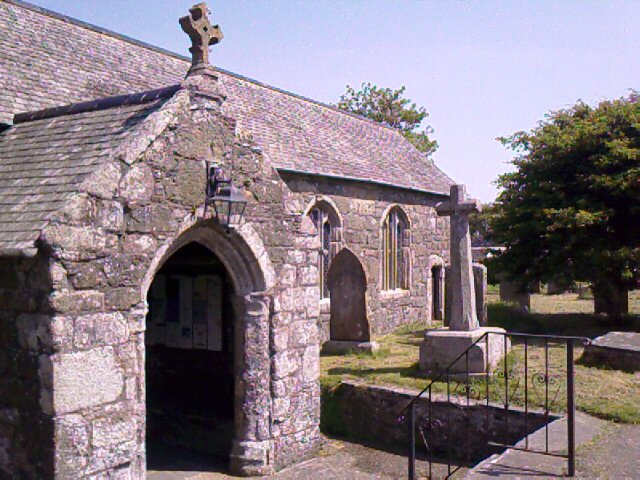
The garden is near St. Mellanus Church, a small place with a ca. 1420 start; the current building is dated 1691. Most of the tombstones in the tiny cemetery date from the 1800s.

My dose of social interaction today came in the form of an art class at the WI Mullion (Womens Institute of Mullion). It wasn't a class, exactly, as the teacher was out for the day "visiting a hospital," as one of the participants explained. The students were all women in their 60s or older. They meet once a week, every Wednesday 2-4, to paint and chat. Cost is a 50p donation per session, which they collect and give to the teacher at Christmas. They stop halfway through for biscuits and tea and warmly welcomed me as a drop-in.


I’m carrying only a small selection of 12 colored pencils, but did the best I could on some hedgerow flowers I had picked to sketch. I had no pink, and that seems to be the color of early June here. It was fun to take time out to draw, especially among other women who enjoyed painting. I think I'll buy a small box of watercolors to use sometime on the trip. These are more versatile since I can create the colors I need.


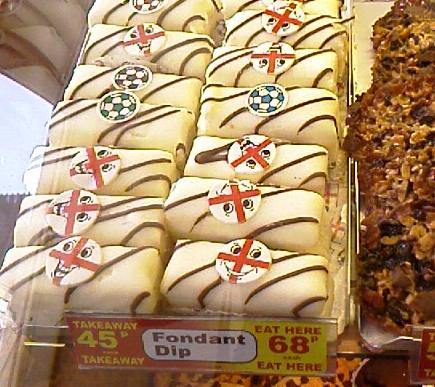
Everyone is flying the red-on-white Cross of St George flag to root for England football--the World Cup competition is over the next few weeks, and football fever (and its commensurate product marketing) is noticeable everywhere. It's like a Superbowl times ten. The games are hosted in Germany this year. England plays Germany Saturday; I plan to watch even though I know little about the sport right now.

Ate dinner at the cabin--a homemade stir fry of chicken, peas, onion, tomato, and fresh peach, washed down with a Doombar beer, a locally made ale endorsed by the St. Mellanus vicar. He happens to be relocating to Australia in a month. Maybe the beer is better there.

Tuesday, June 06, 2006

Lazing the SWC Path to Lizard

With its miles of coastline, Cornwall has many sections that are prime surfing regions for England, and Lizard Peninsula, where I’m staying, is home to many water-loving Brits. I was reminded of this on my walk to the grocer this morning, early enough to catch the mail being delivered. This part of the world doesn't use a typical “Royal Mail” red van and starchly uniformed postperson. Here mail is delivered via bicycle--a Royal Mail red bicycle--by a tanned, blond surfer dude wearing shorts and a red Royal Mail T-shirt. He climbs off the bike and walks up to each house with his bundle of mail.

Today began as a setup day--washed my jammies in the bathroom sink and draped them over a hydrangea to dry; shopped for a week’s worth of groceries--eggs, muesli, milk, jam, bread, butter, chicken, peas, fresh vegetables; scoped out the layout of Mullion village, pubs, shops, galleries, etc.

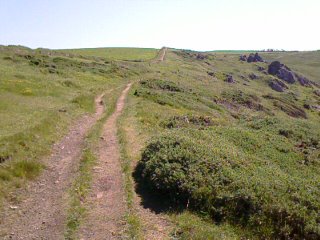
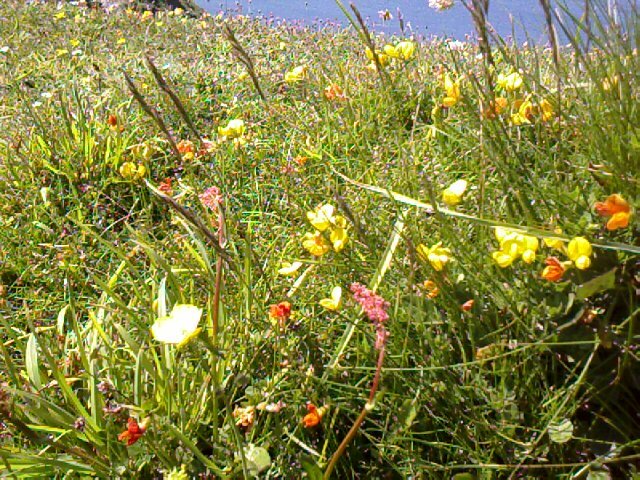
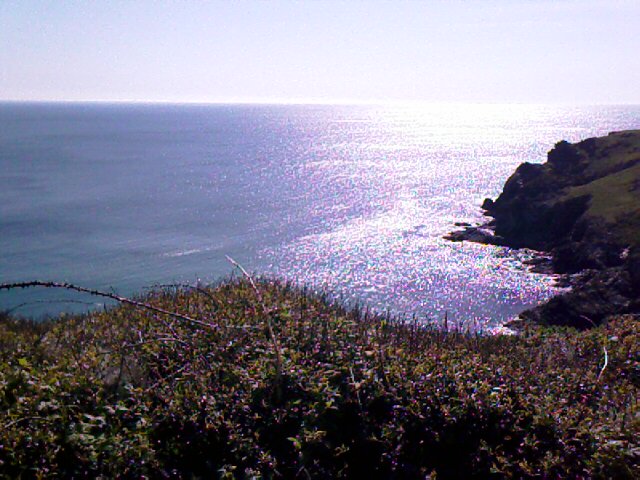
After a nap, I armed myself with trekking poles, Snickers bar, apple, and water and headed out at 3:15 for a walk south on the Southwest Coast (SWC) path, just to see what it was like. I kept stopping for photos, it was all so beautiful and interesting. New coves every half mile, meadow flowers blowing in the wind, changes in the trail, stiles to clamor over, gulls to watch dive over the cliffs.


I was about an hour and a quarter out when I paused to photograph a woman in red coming down one of the hills. When we passed to say hello, she said, "Who'd have thought we'd be meeting again this way?"

I looked more closely. It was Manuela from Carthvean Farm! She was walking north from Lizard. We exchanged notes about distances from our starting points. She had hopped a bus to Lizard and had spent about two hours, plus lunch break, to get to where we were. She gave me the return bus times from Lizard, and I decided to continue walking until I reached that village at the end of the peninsula, then bus back. We figured it was about four miles, corroborated by a mile marker I found a few minutes later.


Manuela had an Ordnance map of the region--the closeup, 25,000-scale version that shows practically every boulder on a trail. I wondered whether I was stupid to be heading out without a map, too, then decided that it was unlikely that I’d get lost on this path. Keep the Atlantic on my right, and even I couldn’t go wrong.

She mentioned that the route from Lizard wasn’t too hilly, mostly flat. She hadn’t, however, warned me about the group of highland cows that were waiting in one of the several gullies I would go down and up on the way. They have a lovely caramel coloring and horns like a Texas longhorn steer. One was an older calf. I'd already seen warnings posted to beware of cattle, especially those that had babies. I swallowed my nerves, said hello, and they let me pass through their little group about 15 feet from them.


The day continued to be scorching hot (I’m getting a serious tan on this trip), and I was happy to reach Kynance Cove, a beach on the trail just outside Lizard. The tide was coming in, and the coastline had been reduced from sand to an expanse of black rocks piled at the base of the cliffs. Ocean waves broke over the boulders and swept between a corridor of stone onto the only spit of sand still left. I stripped off my boots and socks to wade into the water. Ah, icy cold. Yow, my feet were numb within a minute. I took a video of the waves coming through the corridor. They made a great slapping sound with each advance.

When I got to Lizard village, a bus was waiting--the 7:04, and I'd arrived at 7:01. Perfect timing. I skipped a fish and chips dinner in Lizard and took the ride back to Mullion. What had taken me took me three-plus hours to walk took about 10 minutes by bus.

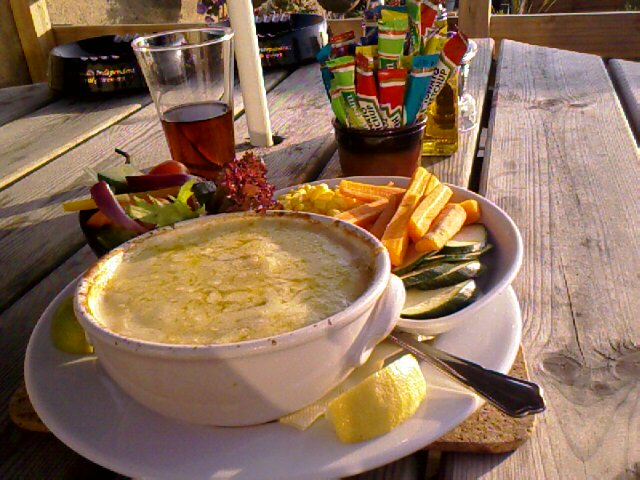
I stopped for dinner at The Mounts Bay pub--local ale and local fish pie. The pies here don’t have a crust per se--they’re served in baking dishes--but it was delicious. Dill and cream sauce, salmon, shrimp, crab, sliced potatoes. Over the rooftops I could view the Atlantic. It feels odd to see the Atlantic from this side--to me it's the “wrong” side; to UK it's the “right” side--sort of like what Tim and I each call the “front” and “back” of Mt. Hood--he lives to the south of the mountain, and I live to the north. I suppose it’s all in the perspective.

Church bells rang in the distance as I ate--the happy bells that peal around 7:45 and go for half an hour. I think it's the same melody as I recorded at St Clements in London. Next to me a family of a mum and three early teens share the sunshine over their meal. Sunset is still about one and a half hours away, and I’m feeling proud of my journey today, perfectly content to be right here, right now.

Monday, June 05, 2006

WWOOFs, Bleats, and a Sneaky Seagull

At the close of the TTEAM week, I traveled the three hours to Cornwall with Julie to her farm outside Helston. Julie had offered to have me stay Sunday night at her home with her husband, Andrew, a buddhist cleric. I've booked a self-catering cabin in Mullion, about nine miles south of Helston, starting tomorrow.

We drove across Devon and then Cornwall in her Mercedes caravan, a self-contained camper van, with her terrior, Henry, and her terrior/yorkie mix, Megan. Megan sat in my lap almost the whole time. Andrew had supper waiting--homemade garlic pizza with vegetables from their garden and the goat cheese they make from their goats' milk.


Andrew and Julie have a 70-acre landholding called Carthvean ("small holding") that was all field seven years ago and is now gardens and pastures and woods (they've planted a whopping 10,000 trees), replete with two huge polytunnels (plastic-sheeted greenhouse quonset huts). Andrew and friends had just put the plastic on the second polytunnel today--Julie was thrilled.

Julie's a TTOUCH practitioner for camelids (llamas and alpacas), and she and Andrew run the farm, grow most of their own food (fruits, berries, vegetables, greens), raise alpacas, make their own cheese and yogurt, and have all manner of critters around the place--rabbits, three llamas, alpacas, goats, guinea pigs, cats, ponies, dogs, chickens, probably others.

Their farm is a WWOOF member: WorldwWide Opportunities for Organic Farming. WWOOF hooks up people who own farms or ranches with people who want to work on them for room and board. Three WWOOFers John, Imiko, and Manuela, are at Carthvean on various schedules to help out. I met all three of them while I was here.

I woke at 7 Monday morning, bathed in a clawfoot tub, and had a breakfast of homemade muesli with fresh goat's milk, homegrown strawberries, and apples. John came in carrying seven eggs, this morning's generous output from the Muscovies in the coop.

The weather continues to be very hot and sunny, with a breeze at the top of hill. My laundry on the line dried in very short time.

Alpaca shearing was to start at 10a, but first we had to get the critters into the shearing barn--girls this morning, then the boys after lunch.

Julie, Imoko, and I herded the girls from the pasture using TTOUCH wands, a herding tape, and voice. There were thirteen alpacas in this group. They shuffled along the field in a great bleating, scrambling mass of round woolly bodies and long woolly necks, directed and, in some cases blocked, by our moving barricade of herding tape. As they reached the narrower wooded lane, they hustled and balked and shoved and walked at our insistence, eventually jamming up at the open doorway to the work barn.


The barn has concrete floors and moveable partitions so corrals can be resized and areas closed off to direct the animals through the shearing process. Julie clucked, cajoled, and shoved them into the main holding area, Colin the shearer arrived, and we all got to work--Julie, Imiko, another friend of Julie's, Colin, and me.


Shearing alpacas is different from shearing sheep. Alpacas are big, strong, feisty, and all flailing limbs and neck when you get them down. You can't just pin them to the ground like you can with a sheep.

Instead, the shearer must lift and bring the alpaca to the floor, truss it by forefeet and hind feet to a pulleyed stretcher system, and flip the animal over twice during shearing to reach all parts of its body for the fleece. Colin, well muscled and well skilled, did all this wrestling and shearing with expert maneuvers and a predictable rhythm that made it very easy to know where to be next to support him.

After photographing the first shearing, I helped with the rest, holding down the alpaca’s head to keep it from squirming, and doing TTOUCH on its ears to help calm it. Some of them screamed or whistled or bleated with astonishing shrill throughout the whole process, while others lay submissive and quiet until they were released, looking like fuzzy miniature giraffes, barely ten minutes later.


The deep drone of the clippers motor, the constant calling from those still in the holding pens, the screeches of the one being shorn--every sound bounced off the concrete walls, and my ears were ringing by the time all twenty of the alpacas were done. (The seven boys didn't want to come in for their turn in the shearing barn--they'd seen what the girls looked like when we herded the boys past their fields.)

By the end of they day, we'd collected bags and bags of alpaca wool. White, brown, fawn, caramel, black--I'd never known they came in such colorful variety. We took two qualities of fleece from each alpaca--first quality from the "blanket" (back, sides, upper flanks), and second quality from legs, belly, neck, chest, head. The textures and lengths also varied widely. Long and crinkly is best, according to Julie, for its elasticity.

Duties done, Andrew later drove me to the Criggan Mill cottages in Mullion and took Manuela, another WWOOFer I met at the farm, to her holiday hotel a few miles away.


The day had been hot, and although the cabin's windows were open, the cottage smelled a bit musty. And, ohmigod, I’ve traveled back in time—the whole place is decorated in 1960s orange, brown, and yellow, big stipes, and funky lamps. It's sunny, though, with a stream at the back behind an embankment and wood pigeons and magpies sharing the bushes.


I pay for electricity from a meter box that looks like it was built in the 1930s. The place has a kitchen, so I can cook my own meals for the week--yay.

The cabins are at the bottom of a hill in a fold of valley; I can't see the coast from here; it's 200 yards down the road. The landlady was brusque, as if she doesn't like her job today.

Cornwall has fields, hedgerows, gorse, heathlands, and--surprising to see--Monterey pines, which were imported by the Victorians. The pines do very well in this windy coastal area, just as they do in northern California. They've been here so long, though, that they're dying off of old age, and the government wants people to plant more. Andrew and Julie have planted about 50 on their land.

I had dinner at Mullion Cove Hotel, just up the hill from the cabin toward the coast. It has a spectacular ocean view. The evening was warm, so I dined outside on mushroom risotto and garlic bread at an umbrella-covered picnic table. The bread was hot and buttery and garlicky--a big, fat french roll sliced in half. I munched most of one piece before starting my meal. The waiter had forgotten my cutlery, and I went in to get it, leaving my food behind. I returned to several people all talking at me from nearby tables.

"We tried to stop him, love, but he was off quick as a wink."

I looked over. The other half of my luscious garlic bread was gone--nicked in all its melted garlicky butter crispy glory by an opportunistic seagull. Dang. And I'd saved the best piece for last, too.

The gull made short work of his catch, entertaining us all with how quickly he swallowed it, and practically whole. By the time I got out my camera, he was downing the last hunk.

"What wine are you drinking there?" one of my fellow diners asked. "He'll be comin' back for that next."

I laughed, finished my meal, and took the last of my white wine across the street to the cliff edge to watch the planet roll away from the last fifteen minutes of sunlight. The sky gave a burst of pink light after the sun was gone, like a little explosion of color.

I toasted the dayfall, ordered a takeaway dessert of cheese and biscuits to have for lunch this week, and toted my leftovers home to my 1960s cabin to enjoy a comfortable year 2000 bed.

Saturday, June 03, 2006

TTEAM Week, and Dinner with a Lord and Lady


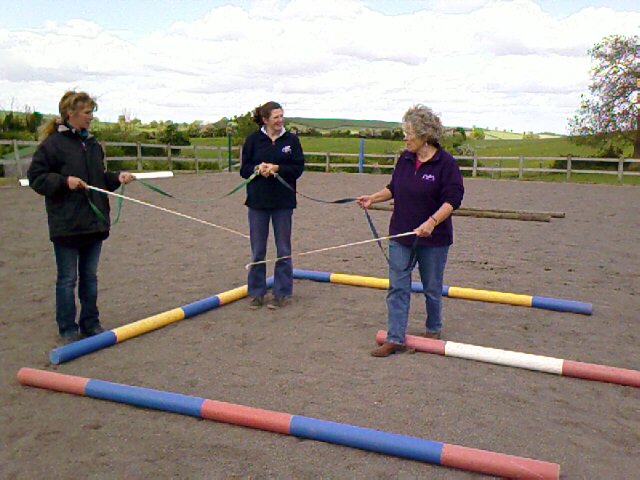
The TTEAM training was held by Edie Jane Eaton (leftmost in this photo), a Tellington Touch trainer whom I've had the good fortune to learn from twice before for the TTOUCH companion animal work. Our group has about 15 women (why is it that men don't get involved with this challenging, peaceful, intuitive work?). TTEAM is equine based, although many of the principles transfer to work with other animals.

We spent the week alternating classroom time, demo time, and hands-on time with the many horses and two knee-high donkeys on the farm.

This course, I didn't take as many notes as I have in the past. My learning energy was more tuned to taking things in without trying extra hard to study and perfect them. As this is my fifth TT-related training, I was feeling anchored in the basics, and just soaked in the new stuff as introduction that I can build on later.


It feels different to not stress out as a student, not try to catch every word and to be perfect in everything from the get-go. I like this style of learning. I would have made a good Socratic student, I think. Certainly this trip is its own opportunity for peripatetic learning.

Sunny, sunny all week. Got a farmer's tan, plus a little bit of burn on my shoulders and neck when I jumped at the chance to wear a tank top for the first time in what feels like a year. Am glad I changed my TT training session from the week before to this one. The week before it was rain, rain, rain for all five days. They could barely go outside to do anything. This week has been sun, sun, sun, and everyone is in a very good mood.


Aside from actually working with the animals, the best parts of the training, as usual, were the hands-on demos, where we got to pair off and play the parts of the horses and people as we practiced things like quick-release knots, special leading and tying techniques with ropes and wands, and how pressure on bridles work.

For the latter, Edie Jane had each of us wear a bridle on our head and hold the bit in our hands while someone else worked the reins. I was astonished that the pressure was so much on the top of the head instead of the bit. Anyone watching from the outside would have thought we were into some bizarre form of S&M.


We also got some chances to ride before, during, and after we did TTouches on the horses. TTEAM helps horses become balanced emotionally, physically, and mentally, so they're more prepared to meet situations with less fear. Part of the work can be teaching the horse to be ridden without a bridle. Riders use a bit of stiff rope looped around the horse's neck at the chest to steer and halt the horse.

A few of the students had brought their own animals to work with. I was surprised at how little time it took to get the horses willing and able to respond to this kind of riding and direction. The horses loved the freedom of movement, and everything was easy and gentle and step-by-step for training both the animal and people in how to go bridleless.


As usual at these sessions, everyone I met there was delightful to get to know, and we all bonded in various ways over the five days. Several women invited me to drop in on them if my travels take me to their regions of the UK. Even if I don't make it to their areas, I feel happy that I actually know people here, and that could call on them for help or information in a pinch.

My plans for next week are to be in Cornwall for seven days. I booked a cabin on the Lizard Peninsula, which both Julie and Erica, TTEAM participants, highly recommended as The Place To Go in Cornwall. I used the Ramblers listing book that Norman loaned me to find a self-catering cabin in Mullion, which, it turns out, isn't very far from where Julie lives.

Friday night I had dinner with David and Lisa at The Butchers Arms. I started with drinks with a few of the TTEAM gals at the back grassy area of the pub, where we nearly tipped the picnic bench over when everyone on one side of the table got up at the same time and we on the other side were still sitting down. Drinks slid, we all screeched, and we barely saved the whole table from going over backwards. We were still laughing minutes afterward.


David and Lisa, self-proclaimed "Lord and Lady of Farmborough," treated me to supper at The Butchers Arms. We laughed and shared stories of Londoners with wacky haircuts who charge for photos, US travel and Los Angeles, American vs. British English, pets and horses, and Halloween costumes--especially the one Lisa once made from a bin liner (trash bag) that, she claims, is the foundation of every good halloween costume.

David and Lisa live in Farmborough which, yes, is large enough to have a small grocer that's also the post office. They're only a block or so from the pub, and they walked me to my B&B with their new yellow labrador puppy, Reggie, who made a point of checking every doggie mail stop on the way.


Our final TTEAM dinner was Saturday at The Hunters Rest. These evenings are always bittersweet for me--acknowledging new friends and a great week, and knowing we're going to say goodbye the next day. Learned some new Sudoku tricks from Edie Jane by playing the game on Perry over dessert, which was fun.

Our TTEAM week ended on Sunday, and Julie (the one being led through the labyrinth in the photo above) offered to drive me to Cornwall and have me stay overnight at her farm, then to take me to my cabin the next day. She's shearing alpacas on Monday, and I get to help.