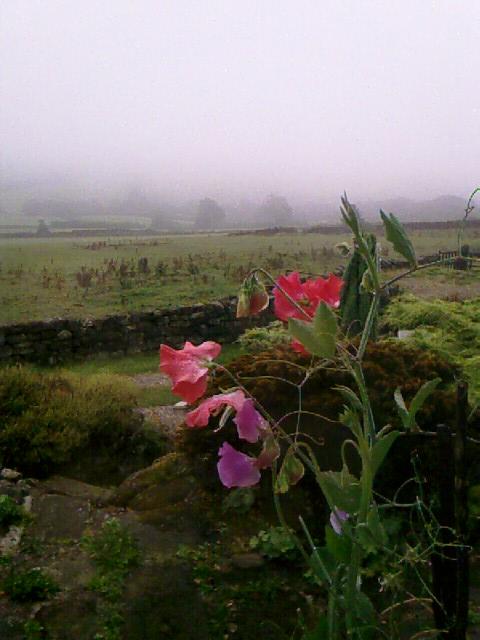
The things we remember define who we are” says the BBC Breakfast show this morning as I check the weather report. That’s a theme that’s been running through me lately. What do I remember? What am I paying attention to? How do I define who I am next, based on what I choose to remember about who I’ve been before? What will I remember of this trip, once it’s over?

A quote from the Audrey Hepburn book I bought in Bath: “Living is like tearing through a museum. Not until later do you really start absorbing what you saw, thinking about it, looking it up in a book and remembering—because you can’t take it in all at once.”
One thing I’ll remember about today is that it’s the England I expected—and that I’m glad I didn’t always get it.
Rain and wind pelted against the windows all last night at Shepherd’s Close Farm. This morning it is still wet, gray, windy, although the rains have stopped. I break out my base layer for the first time on the trip and attach my waterproofs to my daypack. Heavy rain is on its way by eleven, says the BBC.
I leave at nine thirty, much later than I’d planned, after standing in the wee kitchen of the lodge talking to Chris for nearly an hour.


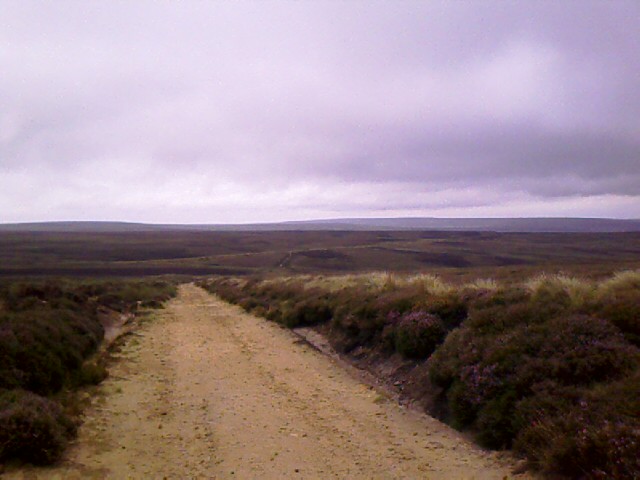
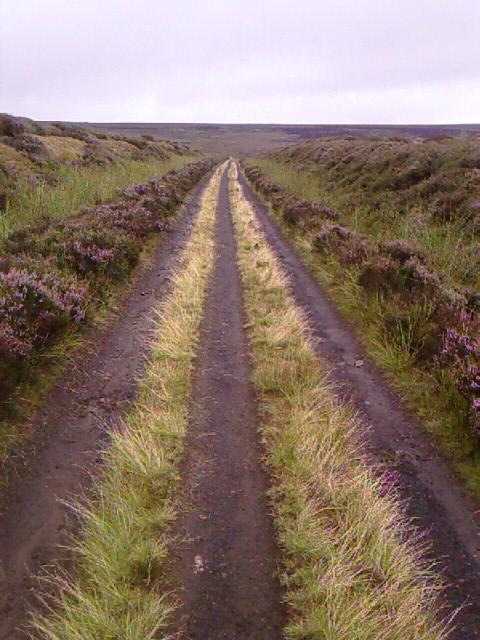
The walking, fortunately, is very easy: the path is a converted disused railway track most of the way. It’s a wide, level road, with sandy footing or gravel that’s so compacted it rivals asphalt.


The signage is meager, but the trail doesn’t need much anyway except at Bloworth Crossing, at mile 155, where the Cleveland Way and the C2C walk split. Much of today’s trail is still on the Lyke Wake Walk, too. Standing stones, some tall, some squat, act as occasional waymarkers.
And what d’you know: the BBC was right. By eleven o’clock, the overcast skies, which have been spitting all morning, dissolve to slashing rain, and I’m soon wearing every piece of warmth and wet-weather gear I’ve brought, including waterproof trousers that are designed to go on without taking off my hiking boots (nifty feature, that). I try to protect my daypack with a raincover that’s sized for my much larger rucksack, but it can’t keep water from going between the pack and my back. Soon much of the pack is too wet to open without sagging, but most of the stuff inside stays dry enough.


I forge ahead, the wind most often at my back, and feel disappointed at the decreased visibility as the storm moves in. I sometimes have no idea where the horizon is in relation to this moor in any direction.
A half hour into the rain, I meet up with the first group of people I’ve seen heading west on the C2C. They are leaning straight into the weather. They say that The Lion Inn, ahead at Blakey Howe, is worth the walk for the food—and that the place serves meals from noon to ten. That’s the first pub I’ve heard of that doesn’t shut down food service shortly after lunch. The anticipation of a hot meal keeps me going for the next two hours.
Through a wet curtain of gray, a thin rake of a man, tall, dressed in black, wearing a pack, makes steady way toward me like some specter emerging from the Other Side. This unearthly impression is clinched by his almost skeletal build. He is drenched to the skin, and his rain-soaked jacket and slacks stick to him like the membrane of bat’s wings. He is grinning broadly, a madman who’s perfectly aware of his madness.
“Don’t need to bother putting on the rain slicker now!” He cackles at me through the wet. “The weathermen predicted 25 mm of rain, and here it is! Wonderful, isn’t it?”
Uh, yeah, right.
A short time later, another group trudges toward me. Their enormous packs are lumpy bags on their backs, each raincover a block of solid color. Bright blue, electric orange, red. Eight of them form a clump with a tail, like a human comet straggling across the moors. They are head-down to the weather. I hear the five in front singing a hymn as they pass.

I reach The Lion Inn and Blakey Howe at one o’clock. It has taken me 3.5 hours to cover a little over nine miles door to door, including a snack stop and pee breaks. (The latter involves an exasperating process of first finding a semblance of privacy amid mostly flat, open lands, and then laboriously furling four layers of sopping, intractable clothing to expose an unprotected bum to the pouring rain and prickly heather—oh, to be a man at these times!)
I drip my way into the stone-lined foyer of The Lion Inn and peel off my wet gear before going into the pub. I pad around the carpeted inn in my socks, finding first a toilet, then a table, then a meal to order. I’m damp to the skin, and am not convinced the raingear is working against this sodden mess today.
I have just dived into a very tomatoey tomato soup when the New Zealand Pack ’n’ Boots walkers arrive, also soaking wet. They’re overnight here, lucky them. I have about four more miles to go today, two of which are off trail to get to my B&B, Sycamore House, on a farm road to Danby. I’m to look for a standing granite marker known as “Fat Betty” at White Cross for the right track to take to their home.
I overhear someone saying the weather’s supposed to get worse at five today; it’s about two o’clock now; I plan to be at the B&B long before then. I wonder how John and Elaine are faring in the storm. They were to have left The Lion Inn today for Littlebeck—a very long 20 miles away in this weather.
Full of a hot lunch, I climb back into my clinging wet clothes and call to verify directions to Sycamore House. Bless her, Mary offers to pick me up at Fat Betty, halving the reminder of my trip today.
Bundled up again and heading into buckets of rain, I walk down the road and across a stretch of moors on a true footpath. There are no paving stones, no brought-in gravel, no converted railroads here. Just the peaty moor ground, uneven and winding, like the trail I walked to Keld.
Only right now I am walking directly into the weather. Cold rain pelts my cheeks like needles, water runs down my face and drips off my nose. My oversized pack cover flaps around my packed poles like a flag in a storm. I turn my head to spit and the winds send it sideways—
whooosh—right away from me. Gloved hands stuffed into pockets, I hunker against the wind and squelch gamely down trails that are rivulets of water, up and around and over heath clumps, raising my head only often enough to locate the next tall stone marker so I can stay on track. I wring water out of the neckerchief that hangs from my pack.
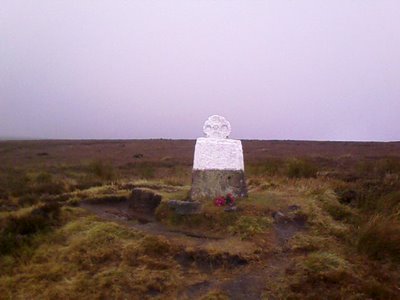

I make it to White Cross/Fat Betty before Mary arrives, and prop myself against a signpost with my back to the wind, feeling very much like a Fell horse withstanding a storm. I didn’t even notice my feet and toes at all today.
Mary collects me within five minutes, and we turn right around to go back to The Lion Inn to pick up Andy, another traveler caught by the storm. I like Andy instantly as we shake hands in the car, front seat (me) to backseat (him), in greeting. He’s finishing off the last bit of the C2C walk that he hasn’t done before, from the Clay Bank area (about where I was yesterday) to Robin Hood’s Bay. He’s also doing an experiment, traveling with barely more than a daypack, a light jacket, and shorts, and the universe played him a joke by deluging him with rain.

Coming in from the storm, we gratefully shed our wet things and hang then up in the 1560s front room of Sycamore House. Mary drives off to collect their third and final guest for the night, and her husband, Jack, has two pots of tea and cookies waiting for Andy and me in the sitting room.
Like his wife, Jack is full of talk and tales and warm welcome. He and Mary walked the C2C path a dozen years ago and have gone back to do the bits they missed enjoying because of wet weather. They took the walk as “business research,” to understand what C2C’ers experience, and to check out the “accommodations and competition.”
“We saw all the rules that B&Bs have,” says Jack, “and we have only one rule: ‘Make yourself at home.’ And you don’t have to follow it if you don’t want to.” Sycamore House rapidly takes its place in my roster of top lodgings on the C2C.
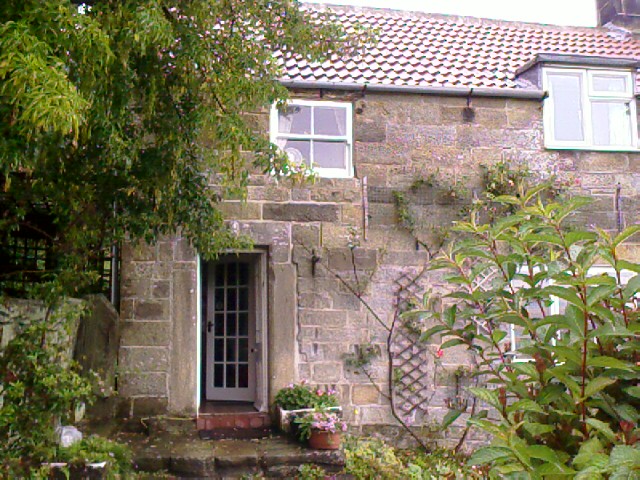
Sycamore House has a core living space from the 1600s, and Jack shares its history with us. The age is not surprising, since the nearby Lion Inn itself dates back to religious times, when land was granted for a friary and the building began to be used to serve wayfarers to supplement their income.

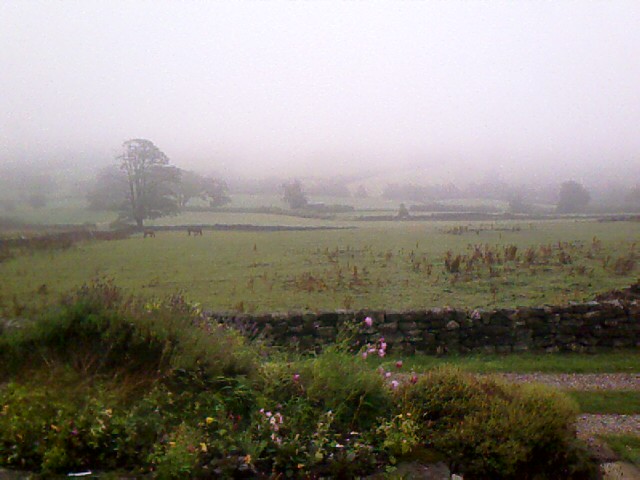
The storm continues to rage, and by six o’clock, winds are whipping around the house, sending dull harmonics to reverberate over eaves and around house corners, moaning like breath blown through a bottle. Trees seems to billow with each gust, and sheep are all butt-first to the wind in the stone-walled fields beyond the front garden.
The other two guests here are also solo travelers—Andy from the Hull area and Brian from the York area. Jack drives all three of us to the Downe Pub in nearby Castleton for dinner. The three of us share a bottle of claret wine, lots of laughter over meal mix-ups, and talk over UK and US politics, the merits and nonmerits of art (such as the Tate Modern in London, which I haven’t seen yet), being in between jobs, being in the Now.
That last topic gets to me to thinking after I return to my guestroom and record the day’s events. We put so much merit on what we remember of the past, and how well we remember it, whether it’s our own past or that of others we once studied in grade school.
Yet to write about the past, to dwell in it, is often to escape fully feeling and experiencing the Now. I’ve noticed, recently, that I’ve been taking fewer photos on the trip. Sometimes I just forget to. Other times I don’t want to. Most of the time I don’t feel the need to.
I’m beginning to understand what Toni Morrison means when she says, “At some point in life the world’s beauty becomes enough. You don’t need to photograph, paint, or even remember it. It is enough. No record of it needs to be kept, and you don’t need someone to share it with or tell it to. When that happens—that letting go—you let go because you can.”
What if I were to completely give up recording anything, whether by journal or camera or voice recording, to be reread, reseen, reheard later? What if I really enjoyed the Now of every moment as it is, without trying to capture it so that I’ll remember it again, for myself or for others?
Why do we place so much importance on our ability to remember the past, to collect again the memories associated with something? Is not most conversation merely remembering something we’ve seen or heard or felt, instead of being aware in the moment of what we’re currently thinking or seeing or feeling? We recall a similar taste of food, the place we were when we tasted it, a like experience we had elsewhere...always talking talking talking of the past or the future. Rarely saying, “This moment I feel, I think, I experience, I am.”
What would happen if I were to stop trying to capture knowledge for myself or others? It’s all a form of remembering the past—not only my past (which is big enough in itself to try to remember), but everyone else’s past, every other nation’s past, every society’s past. To me it’s so much mental clutter.
I haven’t been particularly interested in the archeology and history of England on this trip. Is this bad? Stupid? Foolish? Especially since this land is steeped in history?
Many would think so.

But I’m beginning less to think so. On this trip, I’ve been more interested in being in the space, feeling the space, feeling myself walk through the space as it is today, right now, not as it was then. I’ve already experienced this place in other times, anyway. Why not accept what it has to offer this lifetime around, and enjoy it?
Trail miles: 10; actual miles walked: 10.5


 Breakfast this morning includes an official menu to review, and a table that’s already laden with homemade mixed fruit preserves, fat and skinny milk (cleverly presented in fat and skinny jugs), butter and Flora (also on white plates/clear plates for easy distinction). “Sycamore Jack” takes menu orders, and every meal cooked to request...a right fine restaurant service we have. By far this couple has the most fun I’ve seen doing this B&B service in all my time and trips to England.
 After taking a photo of Brian, me, Jack, and Andy on the stoop, Mary drops us all off at our starting points on the trail for the day—Brian at The Lion Inn and Andy and me 45 minutes down the trail at Fat Betty. The mists are thick at this point, but we can still see ahead well on the trail. I am glad for Andy’s company through this part of the moors.
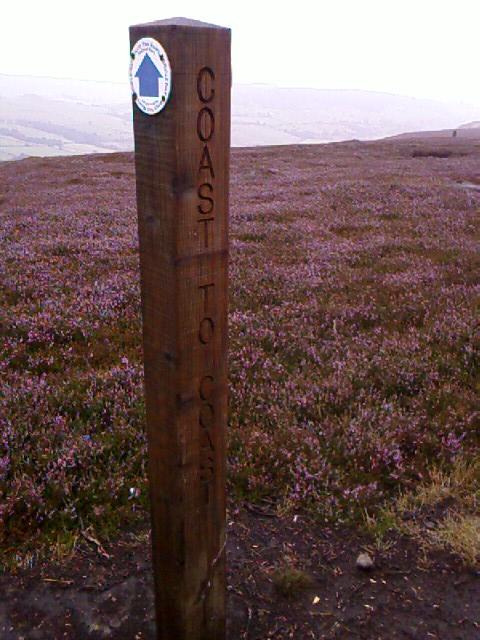


 The trail is mostly hilltop walking through cloud that lifts steadily as we move east. There’s little elevation change, with some ungroomed foot trails and mostly road or improved trails like yesterday. We get some lovely views down the Great Fryup Head (really, that’s what it’s called) and Glaisdale Moor, and we send several coveys of grouse into flight from the heather. Heavy wind pushes us from the side; it is cold, but brings no rain. The eight and half miles go fast in conversation that range from work and travel to personal goals and growth.

 Outside of Glaisdale, we meet a local named Jim on the trail. He is the quintessential Yorkshireman—long coat, Wellingtons, wool cap. He seems a bit taken aback at my effusive greeting, but willingly gives us directions through Glaisdale to the pub for lunch. He also warns us to be on the lookout for the results of scarecrow competition. We spot an entry immediately past a farm gate—a huge bumble bee made from a silage capsule.
 Andy and I lunch at Arncliffe Arms pub, and we are joined by Brian an hour later. This place has the best menu I’ve seen in a pub, with creative, cosmopolitan recipes that assure me that they know how to cook here. I order the chicken tortilla wrap with garlic, olive oil, and spring onion.

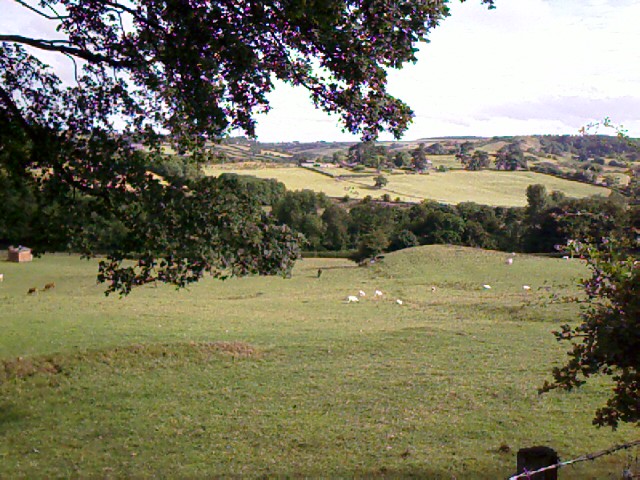 Both Brian and Andy continue on from Glaisdale today, and I stay here for the night. We say farewells and I head for Ashley House, just a few blocks from the pub. The views from their yard are spectacular—right over the valley of River Esk.
 While talking with proprietors Margaret and John, I learn that Tracy, the gal I’d met on Day 1 over breakfast at St Bees, had stayed with them a few days ago, as had Wessel and David, the Holland boys whom I’d met at Lining Crag on the way to Grasmere. And I just got a text message from Elaine and John—they’ve landed in Robin Hood’s Bay, 3:40p. Hurrah!
 I’m thinking I’d like to continue this point-to-point walking. Get a good medium-size backpack, B&B directory, and maps, and head out in other parts of the UK or in the US. A walk from London to Bath, East Sussex to Cornwall, across or around Wight. Or from Tacoma, Washington, to Vancouver, BC, say, on a trek that crosses local islands for overnights.