Sunday, June 25, 2006

On to Glasgow

It may be my mood these past two days, but Glasgow doesn't particularly light my bulb for an inspiring place to be. A busy M road bisects it into workaday east and posh west, and even though it has two main pedestrian-only streets on the east side, I can't seem to get far walking the area. It’s like there's some Acme Marketing Magnet that keeps sucking me back to Sauchiehall ("Socky hall") and Buchanan Streets--full of their mega department stores, salons, mobile phone stores, pharmacists, high-priced restaurants, jewelry shops, boutique stores, and shopping malls. The thoroughfares are packed with weekend shoppers.

I arrived on Saturday by two-hour train from Dumfries, moving through a low ceiling of clouds--soft gray, shadowing the fields. The train's vibration set up a very loud, deep harmonic that hurt my ears. A deer bounded through an unmown field, but the grass was so high all I could see was its brown back bouncing in and out of waving green.

The hotel I'm at here, McLays Guest House, has little merit beyond its location about a mile from both train stations and a few blocks from the Glasgow School of Art. The interior is serviceable enough, but it feels old and shabby, like a dowager who has aged poorly and is trying not to show it. The breakfast room is crowded with so many tables and chairs that getting to the cereal and coffee areas takes dexterous maneuvering, several apologies, and walking sideways. That's the view from my third-floor room. Most of the buildings on this street looked like this.

A few blocks from the hotel is a small U-shaped laundromat, which I welcomed after a week of hand-washing in sinks. Pay the grocer next door £3 for a funny-shaped token for the washer--a silver medallion with two opposite sides cut straight--and take your chances with the dryers for 20p for ten minutes.

I've been to two movies here so far. The Glasgow Film Centre is close to the hotel and has the charm of a small, local theatre that has been lovingly refurbished. Went to see The Wind That Shakes The Barley my first night here, and walked out half an hour into the film--no plot beyond English and Irish killing each other in brutal shootouts in the 1920s, with not much effort to hook me into the characters. I didn't want to stomach the rest of it. The man and woman I walked over in order to leave my seat were surprised I was going.

The second show was an American film, Thank You For Smoking. I found the satire wickedly funny, but the rest of the audience didn't seem to get it, or perhaps Glaswegians prefer not to laugh out loud. I overheard one young woman ask her boyfriend, "Who's Jimmy Stewart?," clearly missing the allusions of Mr. Smith Goes to Washington. But, then, most younger American audiences wouldn't get that, either.

The anti-smoking campaign in the plot seemed out of place here, too, since all cigarette packages in the UK are marked in red with phrases like SMOKING KILLS in words that take up half the package. And Scotland has just passed a country-wide no-smoking-in-public law, which is sending some smokers to distraction. We just passed a similar ordinance in Washington state, and it's already meeting with lots of flak.

I came too late for a folk festival that ends this weekend, but I like the humor and art that is all around Glasgow. Even a parking garage becomes a canvas for interesting metal sculpture.

My tour of the Glasgow School of Art on Sunday was given by one of the students at the school. This is one of the many buildings Charles Rennie Mackintosh designed in Glasgow. Alas, no photos allowed. Mackintosh is a native-son architect who practically defined the Art Nouveau style. He was working in the same time period as Frank Lloyd Wright, and their styles may have fed off each other. The rooms are an odd mixture of nature and geometry, of symmetry and asymmetry.

Mackintosh's famously simple rose pattern has grown on me. I've seen it a lot since entering Scotland, for the country is celebrating a 100th anniversary of Mackintosh this year. The Art Nouveau theme is in a lot of jewelry. And of course it's on everything in Glasgow from coasters to picture frames and aprons. I finished most of my souvenir shopping at the school's gift shop.
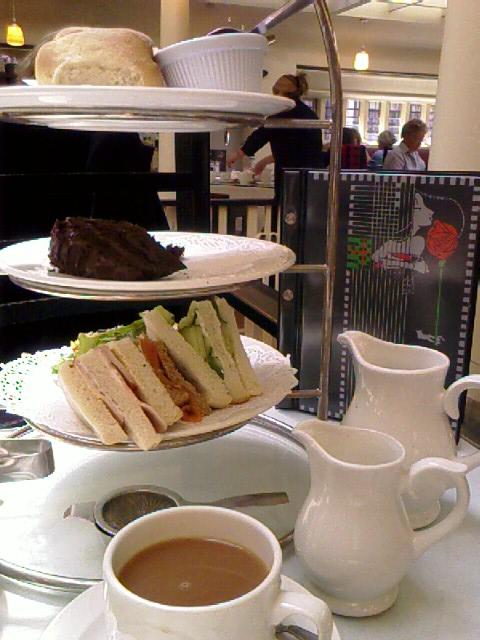

Took high tea at the Willow Tea Room, also designed by Mackintosh and renovated in that style during the 1980s. I like the fact that he created a unique design for each client--no one has the same thing, and the furnishings are easy to identify for where they came from because of it.

Glasgow does have some good dining places. My first dinner here was at Anduluza, a Spanish tapas restaurant. Good food, and very crowded--I ate at the bar in order to eat there at all. Reservations definitely recommended.

Will watch what I can of the football game today--England v Equador in round 2 of the World Cup. Whoever wins this one continues on; losers go home. England's been playing pretty badly in the last two games...they look out of their league against some of the other teams I've seen.

(England made it: 1-0.)

Friday, June 23, 2006

Winged Hearts and Other Weird Moments

Today was another Twilight Zone day, in which I kept feeling like I've been here before, have lived in this region in another lifetime. Especially at today's destination, Drumlanrig Castle.

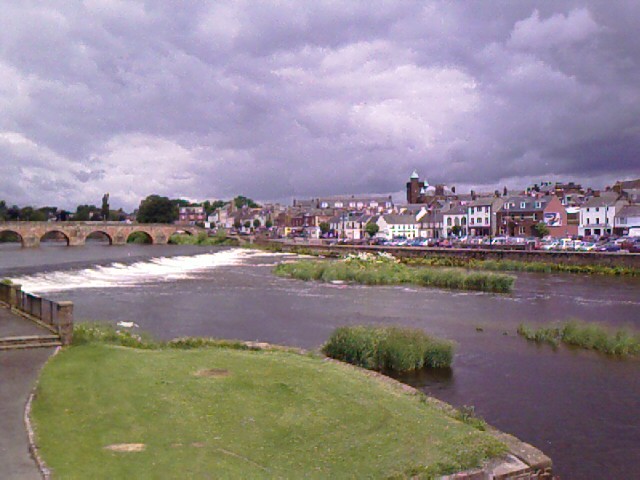
The weather turned cloudy as I rode the 246 Stagecoach bus to the castle. Gray, heavy air that made the green hills look greener than usual. The bus drops visitors off on the main road out of Dumfries, about 1.25 mi from the castle. The paved drive in passes through a thin forest like many I've seen in the Pacific Northwest; I recorded some lovely morning birdsong here.


The forest opens into bridge over a river and then sheep fields and follows a long straight drive to the castle, with more forests around the north side of the house. Acres and acres of property.

Drumlanrig (meaning "hill long ridge," describing the estate's land) has three family names associated with it. The most well-known is Douglas, Duke of Buccleuch (buuk LAY). Specifically James Douglas, a close friend of Robert the Bruce, king of Scots in 1329. This was the time of the Crusades, but Robert the Bruce, who always wanted to go on a Crusade, died before he could leave. In steps friend James, Duke of Buccleuch, who carries The Bruce's embalmed heart into battle in his name. (Embalming and toting around hearts seems to have been the order of the day.)

The combat didn't go well for the duke, who, on receiving a mortal wound, is said to have flung the boxed heart ahead of himself into battle and yelled, "Forward, brave heart!" The cry of "Forward" continues as the family motto, and the Buccleuch line adopted a particular symbol--a winged heart with a crown--as its family motif. (This "brave heart" is not the same one as in Braveheart the movie. That was depicting Wallace, another Scot just a little earlier than Robert the Bruce, who helped bring about The Bruce's rise through his own efforts at rebellion against the English.)

I toured the home, which like most estates here is stuffed from baseboards to rafters with centuries-old furnishings, astounding artwork and portraits, figurines and cabinets and clocks and mirrors and candelabra and other treasures from all around the world. This one houses a Rembrandt, Old Woman Reading, which is marvelous to see in person.

Everywhere at the estate are images of the winged, crowned heart: woven into wool carpets, carved along stone eaves, etched into fireplace woodwork, worked into candlesticks, tapestries, and upholstery.

The guided tour starts and ends near a tea room--a converted kitchen, still housing some of the old cabinetry and pots. Their celery/potato soup and fresh-made organic bread makes for a welcome lunch break. Shopped at the gift shop and at the stableyard-converted-to-craft-stores, buying some yummy orange-cranberry jam and crunchy mustard for Norman and Jean. Also got a major-garlicky, melted buttery still-warm focaccia-like roll to eat in hand as I wandered into the onsite wildlife interpretive center.

Much of the Drumlanrig acreage is wooded, so it's a natural site for wildlife viewing. They've installed a forest blind where I watched native red squirrels ("SQUEER-ells" here) and lots of birds at the feeders--titmice, siskins, woodpeckers, finches.

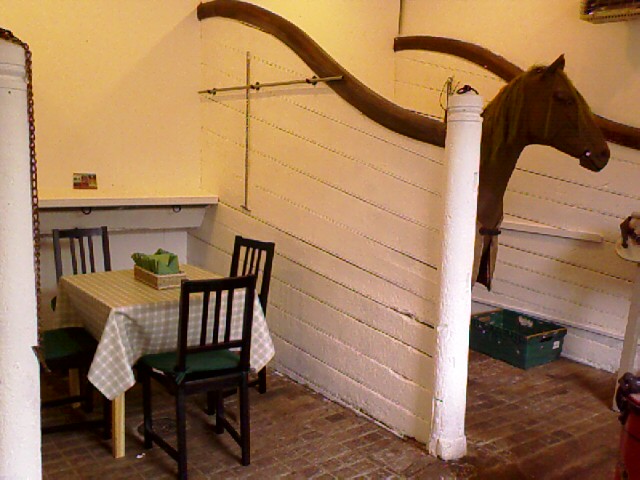
An on-staff woman ranger and a local fellow--over 6' tall, late 40s, with multiple silver piercings in his nose and lips, clown-red hair, tattoos, a tan, and leather jacket--helped me ID some feathers I'd found and photographed earlier in the trip. Magpie and wood pigeon. We got to talking and they treated me to the last cup of coffee at the stableyard snack bar (where the gingham-covered tables are set up in former horse stalls), which was closing for the day.

I had spent much of the day at Drumlanrig, and got back to town in enough time to check out Internet access at the library--two hours per day free with a temporary library membership, plus lots of computers to use. Score. Set up an appointment for tomorrow.

Closed the evening off with a lovely Italian pizza dinner with a friend named Anja who lives near Dumfries. She's a German import into Scotland whom I met at the TTEAM training a few weeks ago in Farmborough. The restaurant she recommended was popular and way crowded, so we had a drink beforehand at a local pub. Lots of laughs, and over our pizzas (mine with anchovy paste, no less), she explained the nuances of World Cup scoring and football rules with great knowledge and humor. You can even ask me what offsides means, and I could explain it!

And the Twilight Zone moments today? They piled up as I walked Drumlanrig. I've been using a winged heart as part of my signature on cards and letters for a few years, yet have never consciously known of its connection to this place. Hmmmm. The tea room at the castle is in an old kitchen, maybe the 1800s part of the house. I felt a strange flash of recognition upon walking in, as if I had once worked there. Hmmm. Last night's nearly fruitless search for a pub ended me up on Buccleuch St, at Robert the Bruce, direct connections to Drumlanrig. Hmmm. At the craft store of one painter in the castle's stableyard, I saw stacks of canvases, all turned away to the wall. My eye fell on the only canvas with a title written on the back: "Sense of Belonging." Hmmmm.

Coincidences? Synchronicities? Past-life overlaps? Collective memories? Fertile imagination? Selective attentiveness?

Whatever I call it, there's a theme at work for me in the Dumfries area, and I'm not doing anything consciously to create it. The best I can do is acknowledge and accept it and tell my rational mind to be quiet, already. As Hamlet has said, "There are more things in heaven and earth, Horatio, than are dreamt of in your philosophy."

I'll leave it at that.

Thursday, June 22, 2006

Déjà vu at Dumfries

OK, time to turn on the Twilight Zone music. If you're not into believing in past life experiences or weird reactions to surroundings, stop reading now, or you might begin to question my sanity.

This morning I planned to visit Sweetheart Abbey (yes, I admit it, purely for the romance of its story about its lady founder who is buried with her beloved's heart) and got a later start than planned because of my wandering feet and a sense of déjà vu that continues to tug at my sleeve everywhere I go today.

Coming into Scotland has tapped some deep visceral responses. On the train ride from Carlisle to Dumfries yesterday, I heard my first conversation of this trip in a Scottish brogue, and my whole body responded--an expansion in my heart and ribcage, and a buzz through my body that lasted for a minute or so. We had crossed into Scotland by this time, and the Scottish lilt wrapped like barely-remembered music around my ears.

This morning I wandered into the Robert Burns Centre (RBC) on my way to find a bus to Sweetheart Abbey. Much of Dumfries' identity is related to Burns, who is Scotland's literary son in the way that Shakespeare is England's. But while Stratford-on-Avon turns Shakespeare into pure tourism (from what I recall years ago), there seems to be real adulation here--his constant but low-key presence is manifest in a street named after him, annual events held at his belatedly-created tomb, signs at the places where he lived or frequented, a monument in the center of town, only one Robert Burns store. Dumfries comes across more like a Burns pilgrimage site than a Burns tourist attraction.

Discovering Burns here in Dumfries has also brought me full circle in a way I hadn't anticipated. I visited his birthplace in Alloway on my first trip to the UK in 1978, and here I am almost 30 years later, spontaneously visiting the town where he spent his last nine years.

I was the first and only customer as the doors to the RBC opened at 10a, and had the movie theatre to myself to watch a film about Burns' life. The video began with images of the Dumfries area and Scotland, and tears came to my eyes--grief, joy, yearning. This land is so lovely; how can I be missing it so much, even though I haven't lived here? I stayed a long time at the centre, reading all the placards about Burns, looking over all the artifacts. This is unusual for me. I usually get bored with this type of stuff and don't hang around over the glass cases.

By the end of the visit, I felt as if I had once known Burns personally, and that these were merely reminders of a time when we were friends. I didn't realize that's what I felt until I just wrote that. Well, yes, I did, only I didn't think I'd ever write it. All day long I've been feeling at home in a weird sort of way. More like I'm close to a long-forgotten home. Is this my imagination? Maybe so, and I choose to accept and trust it anyway.

Perhaps that's why I also lingered at the abbey later in the day. I felt as if I'd been there before. Had walked the cloisters. Touched the stones. I found many heart-shaped pebbles there among the gravel. And samples of the sandstone-like rock that's used at the abbey. And this funny little metal toy knight who is straddling an invisible horse. That will be fun for the mosaic.

Sweetheart Abbey is so named because it was built by Lady Devorgilla de Balliol who, with her husband, John Balliol, founded Oxford College and helped educate the masses. Their marriage was very close, and when he died, she grieved him for the rest of her life, cherishing his embalmed heart in a box that she carried all the time. She and the heart are buried under a large slab at the altar of the abbey.


The abbey is in ruins, ransacked for its stone centuries ago. And unlike Sarum Mound in Salisbury, this place is easy to understand and mentally extrude onto space--about a third of the walls and arches exist, and the outline of the remaining foundation is easy to follow. It was started in 1273 as a Cistercian abbey, by an order of Benedictine monks who were particularly rigorous in their lifestyle.

The churchyard at the back--you can't go far in the UK without running into a cemetery--is a forest of shoulder-high, brick-red tombstones dating from the late 1700s. A poignant headstone marks the death of five people: three daughters at very young ages, and the parents, the wife dying about a week after her husband, both in their 70s. The north side of the churchyard is the modern section, with the most recent grave I found from January 2006. The stones in the newer section are much shorter, too--only knee high--which makes for a less enclosed feeling in this part of the yard.

Back at Dumfries, I ate dinner at Robert the Bruce on Buccleuch Street, a columned bank built in the ubiquitous red sandstone and converted to a pub/restaurant. I had meant to go to any other pub before I defaulted to this one, but it was the only one on my short list that I could locate as I walked around town.

The pub has the atmosphere of a TGI Fridays and the first reasonably-priced menu I've seen since Farmborough. The most expensive meal is £7, and that's for a steak dinner. Prices average £1-3 less for the same kind of food here than in England. Decided on the chicken, ham, leek pie with chips and vegetables and half a pint of a "guest" ale--Dragonfly from a local Scottish brewery. It was described as a "light hoppy bitter" with only 3.8% alcohol. Sounds about right--it leaves a sharpness on my tongue and has a definite flavor of hops.

I've noticed a conspicuous absence of Cross of St George flags here in Scotland, given that its southerly neighbor is playing in the World Cup. Although most of the pubs advertise that they're showing the games, local conversations and newscasts about a Scot getting punched in the eye for openly supporting England indicate that there's no love lost between the Scots and English for this game. I've already been told that it's best to downplay that I've been following England's progress.

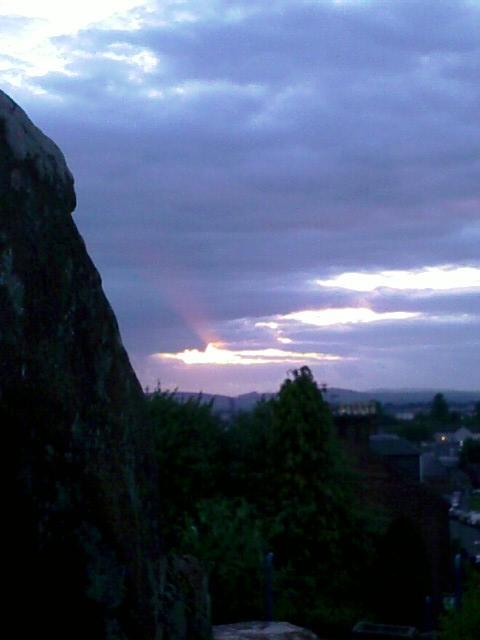
It's 10:22p, the sun set an hour ago, and the sky still looks like it's 7:00p back home. The later summer twilight at this higher latitude encourages me to stay up late. Tonight after dinner I walked the western side of town and entered the grounds of the Dumfries museum and Camera Obscura near my B&B.

The gardens are elevated and use old stone bits collected from who-knows-where in the steps and edgings--angels, animals, dates. I wouldn't be surprised to find a stone or two from Sweetheart Abbey.

Behind the main building is a weird collection of carved and broken stones, leftovers laid out from a century ago and others from the Depression. A thick iron plaque, its paint chipped and rusted, names the engineers and sub-managers of the Dumfries Gas Co in 1932.

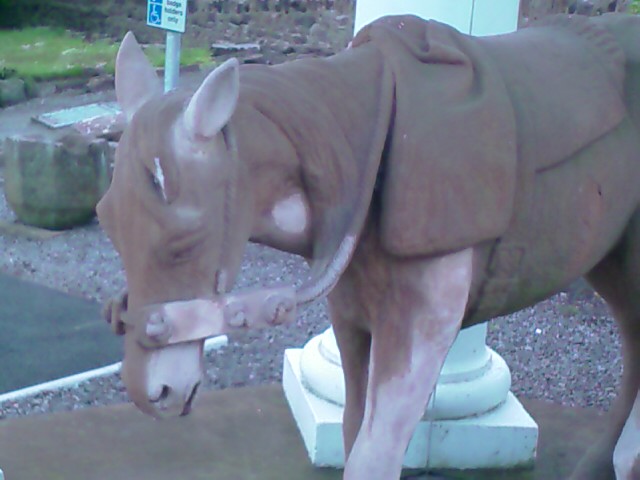
A statue carefully preserved in a huge cylindrical glass case with pillars inside--itself an incongruity beside the derelict stones and busts--shows "Old Mortality and His Pony," dated 1841. A sign explains that the statue had been won in a lottery on behalf of a Dumfries doctor, who then died in an accident the next day. I suppose the city was faced with the dilemma of where to put a multi-ton rendition of an old traveler who is reclining on a slab next to his life-size pony. Behind glass near the museum was probably as good a place as any.

I wonder what Burns, champion of the mundane, would have written about it.

Wednesday, June 21, 2006

Long Day's Journey into Dumfries

I walked into the breakfast room of the Malvern Hotel at 8:00am sharp (per the proprietor's orders) and for the second time in as many days, the group of two dozen grade school students on a field trip from Norfolk all stopped their eating and chattering to stare at me as if I were some weird life form--nothing to fear, perhaps, but something unusual to note. I was the only other guest there, and alone at that, which may have made for a phenomenon.

It was only after I served myself cocoa crispies and corn flakes from the various vats of cereal and sat down to my tea that they returned uneasily to their meals. They continued to eye me as if I might sprout antennae or pull out a laser gun while they weren’t looking. I was feeling a little unnerved by their scrutiny, myself.

This day with the longest amount of daylight is also my day of longest travel so far--Wight to Dumfries, an eight-stage travel that involves a walk to the Sandown train station, a ride on the rickety-rackitta Wight railway, a ferry crossing, a train to London Waterloo, a subway to London Euston, a train to Carlisle, another to Dumfries, and a walk to my B&B a mile and a half away. Departure time 9:30am. Estimated arrival time 9:00pm. Whew, I'm exhausted already.

Finally heading for Scotland, and feeling happy about it. Spent Portsmouth to London Waterloo gluing paper scraps and memories collected through Lydford into my scrapbook and then napping. The London train to Carlisle is a long one--3.5 hours. The tables are all set with flatware and glasses and paper placemats, so a meal must be coming. Or maybe they're for drawing. Naw, probably not--no crayons provided. First class cabins do have access to electric power, so I've pulled out Perry and its folding keyboard and am writing this at the dining table.

I'm liking the travel life again. Why the heck not do more of it? Before this month away, traveling long term seemed an impossible thought. How could I afford it? How could I live it, working as I go? Why shouldn't I keep going like this, get into apprenticeships and service programs in exchange for lodging and food and learning?

"Have you still got your curly whirlies?"

The comment booms from the seat ahead of me, so unusual that I just have to stop typing. A Englishman in a business suit is talking into his cell phone with the eagerness of a lovesick teenager. I suppress a giggle and try to keep my attention on my writing.

"Haven't had some of them cut off, have you?"

It's no use. My fingers have stopped on the keyboard, and I'm chortling into my water glass to cover a laugh.

"I'll be home soon to see your curly whirlies. Bye-bye, my love."

I just have to take that one down. Now where was I? Ah, right. Work, travel, living. I've needed this time to kick myself out of a groove and into trying and trusting new things. Before, I was a blank, afraid to start, not sure where to start. Now I feel open to all kinds of ways to earn my keep without necessarily earning an income. This is, for me, truly trusting the universe instead of my own figuring out of things...being open to nudges and ideas and leads and just going for what feels right, rather than what rationalizes as right.

I got into Dumfries to rain and high winds--the first wet weather I've hit in over two weeks. Bundled myself and my pack up in full rain gear and walked through town to cross River Nith as my B&B proprietor had instructed. There I got turned around a bit (yes, even with a map) and asked directions from a white-haired lady toting a plastic bag of groceries and using a hat instead of an umbrella. She got me righted in direction, then asked, "Traveling alone?"

I grinned Yes through the downpour and she said, "And a woman. Good for you." Her thumb went up. "One up!" she cried, and waved goodbye across the street.

One up, indeed. I folded my soggy map and grinned through the final blocks to the B&B, tired after a long day of traveling, but feeling less like a weird life form and more like a brave woman of the world.

Tuesday, June 20, 2006

Owls, Hawks, and My Time in a Tree

The Isle of Wight has a lot to offer visitors and locals. Miles of beaches and dozens of water sports; public footpaths across, and all around, the island; multiple amusement centers and parks; wildlife excursions, shopping towns, bus tours, golfing, etc. I opt for a visit to the renowned Owl and Falconry Center in the afternoon and the chance to climb a tree at sunset with the island's best-kept-secret-outdoor-opportunity, the Goodleaf Tree Climbing Company.

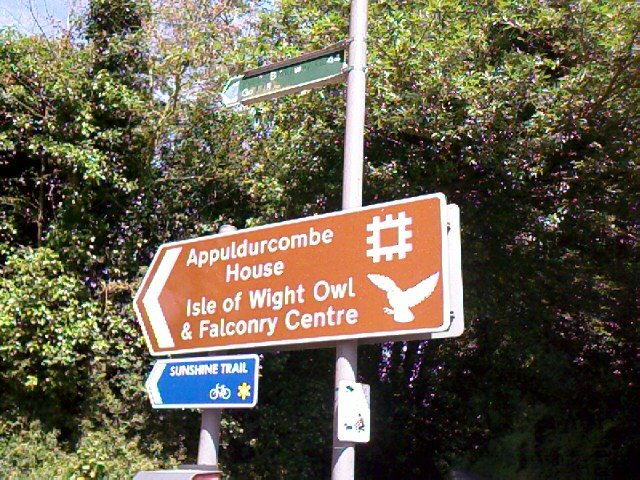
I bus to the Owl and Falconry Center (passing a miniscule but loudly-signed "Church Of The Roundabout" that's, you guessed it, right beside a roundabout looping through Newport) and arrive at 12:30, in time to sit for a while near the birds on their tethers and catch the 1:00p and 3:00p flight shows.

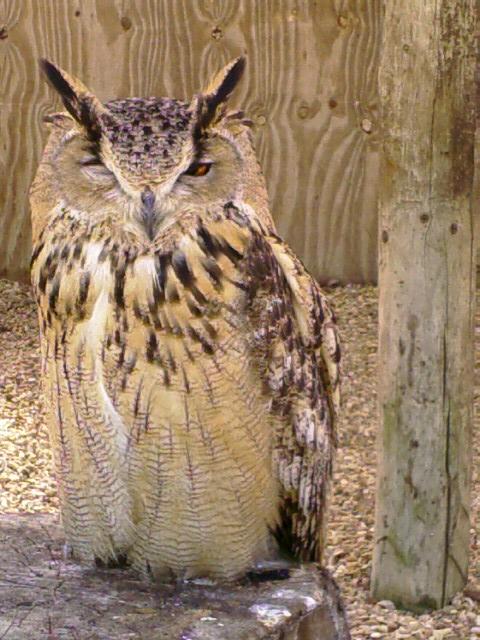
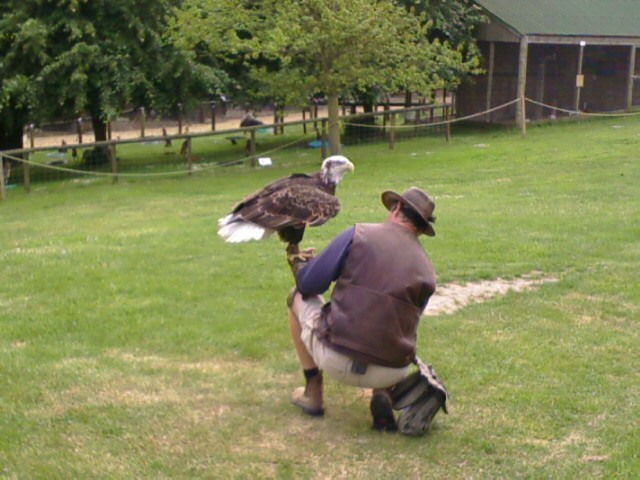
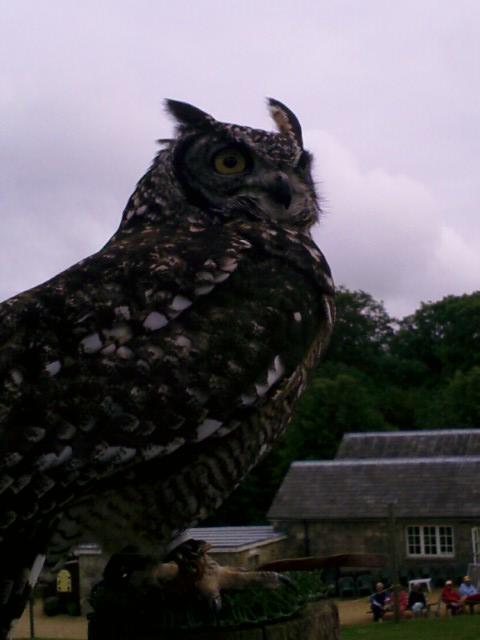
The inventory at the center includes harris hawks, European and bengal eagle owls, saker falcons, kestrals, peregrines, buzzards, bald eagles--many of which I'd never heard of or seen before.

The shows provided up-close opportunities to see the birds fly and stoop after lures, feel them skim inches by the audience--sometimes closer--and land in perches in front of us. Having seen the first show, I knew where to stake out an even better spot for the second show, smack in front of the left-end flight post. This put the birds barely a foot from me. Lovely.

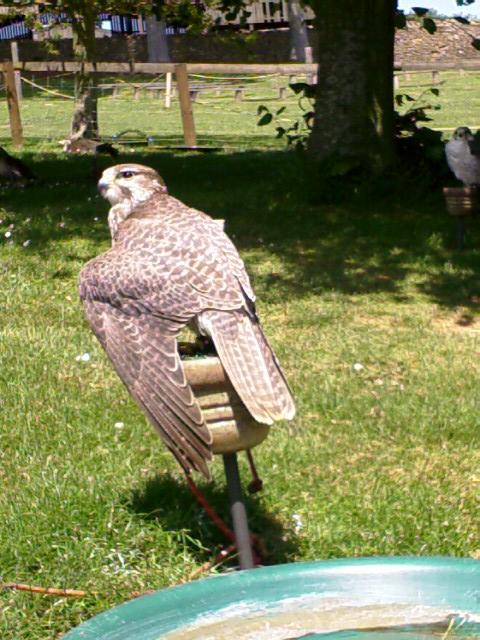
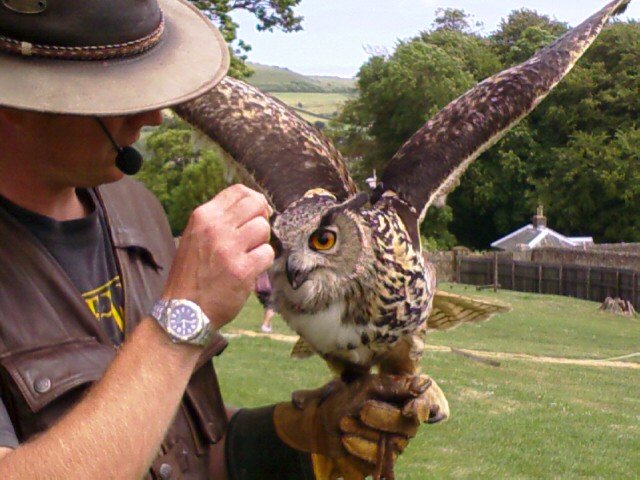
Here are a few I enjoyed from the collection, in order of appearance below:
On ground perch--Charlie, Saker falcon, 5 yrs old
On post perch, side vw--Will, Harris hawk, 7 yrs old
On handler's hand--Chester, European Eagle Owl
On stump--Joey, Bengal Eagle Owl, 5 yrs old
On handler's knee--Cherokee, Bald eagle, 5 yrs old
On post--Phoebe, African spotted eagle owl, 3 yrs old


Walking down the lane to catch the bus back, I felt completely happy to be traveling alone, on my own schedule, following my own whims. I've found I can live through times of boredom and that I don't need to try to distract myself from them. Like all other emotions, ennui passes and yields to something else.

The weather has stayed warm and comfortable and after another maddening trip through Wight's cell phone vortex, I finally managed to hook up with Paul, the husband half of the couple who runs the Goodleaf Tree Climbing Company.

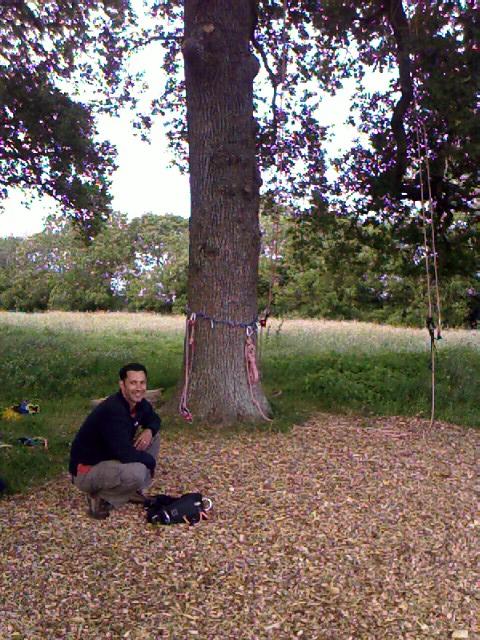
He picks me up outside Whippingham, a rural village with a post office and not much else for amenities, and we drive to a field that is part of acreage that belonged to Queen Victoria. Oaks more than 250 years old grow here, and I wonder what they've seen of royalty and romps over their years.

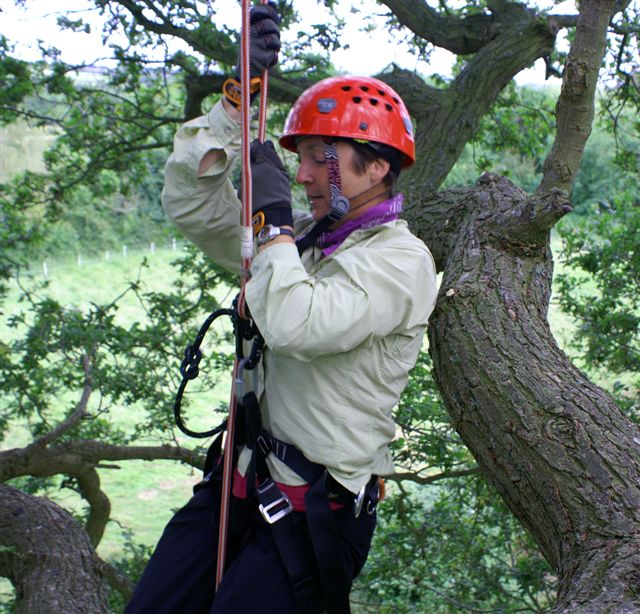
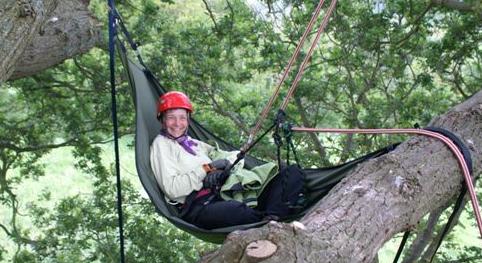
Paul has already set up the area for climbing. Ropes and harnesses drape from branches 30 and 40 feet up, a hammock sways high in the boughs, and a post-climb snack and hot tea in a thermos wait on a blanket on the grass. Llamas and sheep are nearby, the belching sheep kept at bay by a light wire fence. I am the second climb of the day--three gals from Spain came earlier for a bachelorette party; the bride-to-be stayed on the ground to take pictures.

Paul is a professional arborist and has brought his love of tree climbing from New Zealand to Wight. His favorite hours are spent sitting among tree branches and giving others the chance to enjoy the experience.

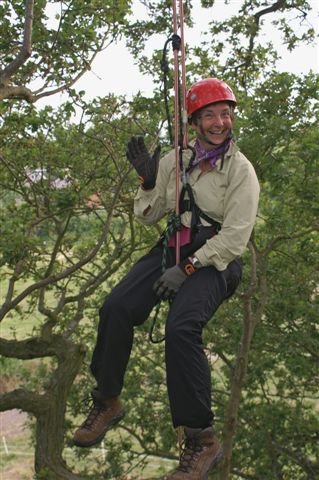
He hooks me into the step-in harness, a system that offers three-way support at thighs and back so the wearer can swing safely free anywhere the ropes and branches will allow. It is the same kind of gear he uses for his arborist work, and is different from rock climbing equipment, which primarily supports the legs and hips.

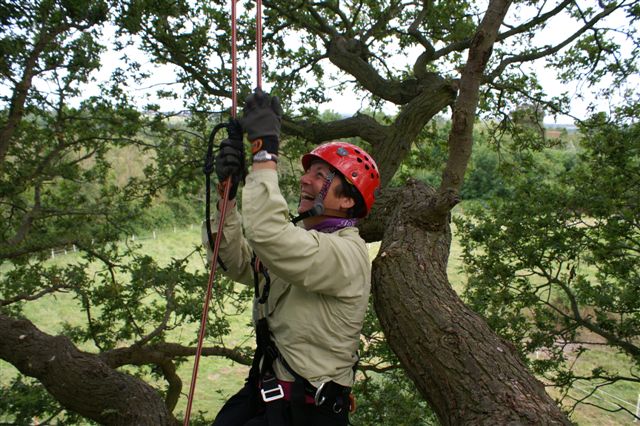
He teaches me the ropes, literally: explaining how to step into a loop, pull one side of the rope down, stand in the loop, and thereby lift myself up half a meter at a time under my own power. Raise the loop, step again. Occasionally set a knot in the rope below me, as a safety catch.

It's an easy, rhythmic process once I get the hang of it. Step into the loop, bring the outside rope down, stand in the loop, and go up. Look down. Wow. The leaf-littered ground seems far below.

I recall the sensation of being in a hot air balloon, standing still, in silence, 3000 feet above the ground. There, I could feel little but stillness and the rough wicker basket beneath my hands. Here, I can feel the wind swing the branch from which I'm suspended. I bounce a little with its sway. It's like riding a gentle swell, the wind lapping at the branches, me bobbing like an apple.

I experiment with swinging. It's scary, at first, to trust the harness to hold and the ropes to bring me back to center. To trust that I won't swung so far as to whack myself into a branch behind me or spin a foot into something at the side. And fun, too, once I relax into it.

I move the foot loop up another half a meter, step, slide, rise higher. Concentrating only on the ropes that I'm manipulating, I have no sensation of going anywhere. It is only when I pause, rest, look around, that I can see how far I've come and that I'm almost high enough to clamber onto the first big branch.

By its thickness, this branch is maybe 100 years old. Sturdy. Pliable in the wind. Its rough bark is easy to get a grip on with hand and boot. I pull my ropes higher and climb on to find a handhold and a standing spot.

The wind is picking up, and I prop against the trunk to feel a surprising amount of sway. I never knew how much a tree's entire body responds to its environment.

Paul wants me to lean back into the harness, away from the tree, propping my legs like an easel on the branch. He makes it look easy. I'm thinking the ropes are too short to enable me to do this, I need more slack. I give myself more. It doesn't work. I only feel more precariously balanced.

I shorten the line and squat tentatively on the branch, feeling the pull of the harness against my waist. No way I can lean back...nowhere to go on this short tether. This isn't going to work. Slowly, hesitantly, I stand...and understand.

By using the support, I am able to brace against the tree, to stand and turn, and, if I like, to release the tension and balance on the trunk. That last bit I'm not quite ready for, and I get to another part of the tree by clinging more than I suspect is necessary, while Paul skips around me like a monkey on a loose leash.

I learn a lot by watching him, and I put it to use hauling myself out of the hammock later, using the ropes and my feet as well as the harness. The hammock is about 25' up, a cradle hanging in the breeze. "When the bough breaks--" No, don't go there.

Paul has brought up a book for me to read. I decide to just lay back and look up into the late-day sky through the branches. Paul leaves me there for as long as I want to stay.

When I call out that I'm ready to come down, Paul rappels up with enviable speed. He reminds me how to release the rope in gentle slides, undoing my emergency stop-knots as I go, and I glide down with more grace and speed than I expected.

As I drink cooling tea and finish off the sweet, robust energy bars his wife has made, Paul collects and folds the equipment and sends a retrieval rope up the tree for the next climb. We haul the picnic basket, bags of gear, and helmets over the fence and back to his car, and he takes me on a scenic tour to the bus station, where a bus to Sandown is right there waiting.

On the ride back, I am able to assess what I've just accomplished. I'm feeling proud of myself and happy. And a twinge of disappointment: I could have been more daring than I was, could have practiced more stands on the branches, could have tried the climb between two trees that Paul had set up.

I catch myself in this moment of self-judgment. Yes, I am usually cautious the first time I try things out. A spiritual reader, Joan, observed that the first time she met me. I need information to know what to expect might happen, to know that I'm safe before giving it my all.

I see now that it's OK for me to be that way in the world. I'm not missing out on anything by being cautious. I only miss out by not showing up, not being present, not participating at all.

This is what finding my center is all about. Feeling for the edges, living through their expansion, through the fear that they will never end, that this extreme will never end, that I'll never reclaim my center. Swinging to the edge of the rope and then trusting that I will come back.

The inescapably physical nature of the tree climb has taught my body what my head and heart are still learning--what it's like to go out on a literal limb and lean into support, to release and swing, free and fearless, knowing that I will return to center naturally, easily, and at the proper time.

This climb, simple as it was, granted me a new sense of my own balance. The next time you see a big old oak tree, look up: you might spot me skipping around like a monkey on a loose leash.

Monday, June 19, 2006

Walk the Beach, Play the Deal

I was to meet with Kim, the friend I met a few weeks ago in London, at 10:30a and drive to a shire farm and then around the island a bit, but we missed each other thanks to a communication vortex and Wight's flaky cellular system. We never got each other's verification calls and text messages, and we were each in different spots at the same meeting time.

Have therefore spent the past three hours walking and sitting at the beach. Walked the two miles from Sandown to Shanklin and had a bit of a cry at the steps at Hope Beach. Sat on some wooden steps and heard only the wind and waves and the bamboo wind chimes hanging from the hut rental place behind me.

So why the cry? Some lonely. Some scare to lean into the moments of just being OK to be here, to be alive, doing nothing. A great grief and awareness of my bitty particle on the planet whirling through space, held here by gravity alone.

I kept remembering the sense of belonging, being cared for, in group, in friends' arms; I can hear their voices telling me I'm enough, there's enough for me, this is all I need to be doing right now.

Resting into the wooden steps, hearing the chimes, feeling the wind, tears came to wash away the fear of leaning in. There's nowhere I need to go, nothing I need to do, no one I need to be except exactly where and who I am in this moment.


Rather than keep walking miles along the beach or finding a bazillion steps to climb, I took a lift straight up the cliffside to reach the Old Village of Shanklin, whose thatched buildings look straight out of Shakespeare's time. Sat outdoors to lunch at The Pencil Cottage. (I don't recommend this restaurant. Lousy soup, doughy scones, not enough jam provided.)

The umbrella-ed tables had sewing machine treadles as their base. Singer and Jones. Decorative wrought iron painted black with weathered planks as the tabletop. A small robin redbreast went after my bread. Timid, though, and didn't want to stay.

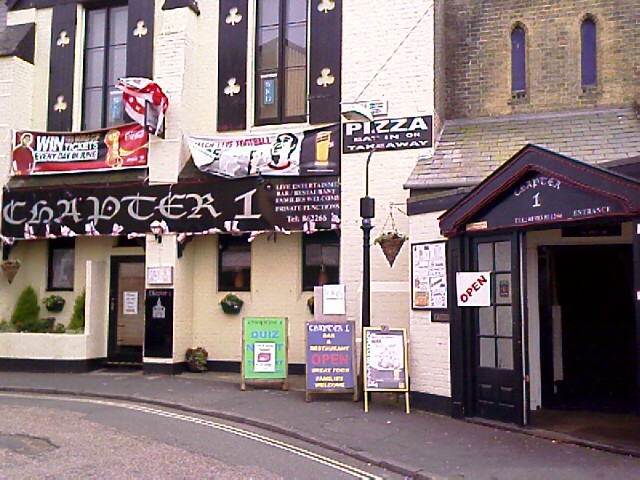
Stopped into the Chapter 1 pub (an old church) on the way back to Sandown and met a worker setting up for a local game of "Deal or No Deal," a game show I'd seen on TV last night. He told me it started at 8:30, and invited me to come along. Don't know about that one yet.

Rode a bus back to the hotel and had my flaky TV replaced, and then napped. Decided to go to the pub for the game; "Say yes" has been my motto on this trip. Better than staying in my room all night. I'm a little anxious about this idea though...evening visits at pubs aren't my thing, and this could be a disaster if I don't meet up with folks.

I am heartily welcomed at the pub by Stuart, the same fellow I'd talked to earlier. He introduces me to a group at a nearby table, and they all take me in as "Audrey The American." Most of them are imports from the London area. All of them are the salt of the earth.

At my table are Joe, Sue, Angie (Joe's wife), Steve (Sue's boyfriend), and Andy, all friends of Stuart (alas, not pictured). We joined the rest of the patrons playing video Bingo, Keys in the Safe, and three rounds of "Deal or No Deal" nearly all night.

The game show is simple: 22 sealed boxes, each containing a card with a dollar value. There are 11 low-dollar values in blue, ranging from 0 to £5; and 11 high-dollar values in red, ranging from £10-£90 plus an unknown jackpot amount--in the past this has been as high as £274. The TV version uses much higher stakes, of course, and they play for up to £100,000.

A player is drawn by raffle, selects a sealed box, and keeps it at his table in the center of play. He then chooses other boxes one at a time and selects people from the audience to open them. Getting blue (low) values is better than getting red (higher) values.

As more boxes are opened, the banker (Stuart, hidden away upstairs) calls in an offer to the emcee on the cell phone. The offer is always less than the highest amount still left to be found, which may, of course, be in the box the player has chosen. The contestant can accept the offer or keep playing--hence the name "Deal or No Deal?"

I bought £3 of raffle tickets for a chance to be a contestant and was just as glad that I didn't get called. But late in the third game, the players selected me to open one of the boxes, and it was blue (low number--very good), and one of them was so jazzed that he jumped off his chair and ran up to hug me in thanks.

Great fun and lots of laughter, and I was glad I stayed until 11:30 to see the last game through. Having outlasted the bus system, I took a taxi back to the hotel--a gift in itself, for the driver was a friend of Sue's, and my friends at the table spontaneously contributed to the tab.

Sunday, June 18, 2006

Wight On

Today's train has only two cars! A mother and her toddler sing "Twinkle, Twinkle, Little Star" ahead of me in the carriage. I wonder if they're the same mother and child I heard singing on the bus to St Michael's.


I'm aiming for Portsmouth, where I'll take a ferry to Wight. They run regularly, the ferries do, and the land and water transit groups do a good job of coordinating times. Portsmouth has some interesting buildings as well as beach front.

The ferry from Portsmouth is like a DC-10 interior but without the drop-down tables--two aisles with a row of five or six seats in the middle. The water is fast and smooth, but the chop at the landing pier had many of us grasping rails, walls and seats for balance while disembarking. A dalmation puppy onboard was all flailing feet at one point.

My hotel on Wight is a 5-minute walk from Sandown, which is about 20 minutes from the pier by a very bumpy train that's more like an obsolete subway brought above ground, or an aging coaster stretched out flat. Rickety-rackitta, rickety-rackitta all along the rails. The conductor slams doors with gusto as he moves from car to car to collect fares, and then mashes a set of three buttons at each station to bring us to a halt and open doors.

My hotel is The Malvern on Leed St. I am greeted in the lobby by a large bronze statue on a sideboard--an elephant-headed, multi-armed Indian god standing on a row of rearing cobras. It is surrounded by other gleaming bronze statues of India persuasion. The proprietors are gracious and kind and in the middle of renovating a six-bedroom house next door for a B&B.

I had a choice of a twin, en suite room in the hotel, knowing that 26 children and 4 teachers are coming for the next two nights, or of staying in the under-reconstruction house in a room that contains three twin beds, a bathroom down the hall that's so big it dwarfs the clawfoot tub that sits in the middle, a shower upstairs, and piles of dismantled dressers and wooden planks in the rest of the place. I would have had the whole house to myself.

I declined the larger space. No fun living alone in a construction zone. Besides, the kid time will be nutty and fun to experience.

I walked town a bit after getting myself settled into my room and making calls to arrange my Scotland time. Got a B&B in Dumfries and hope to schedule a hostel in Inveraray and Glasgow. Also checking into the WWOOFer service opportunity in Torlundy at Fort William.

The beach today was packed. Sandown is a destination spot for Brits on holiday, and it has over a mile of beach that's only a few blocks from my hotel. Coaches were dropping people--mostly families and elderly--at the beachfront hotels.

The sand here is the same color as Bath stone--dark creamy yellow, like a light curry, or ground-up Bath buildings. Lots of orange and gray flintstone in the whole south of England, too. The flintstone has a smooth white outer layer; break it open and the color of carnelian or transluscent slate shows up. People use big chunks of it to build their garden walls. Their smooth slices invite fingers to touch, and I half expect them to be sticky like chunks of rock candy or toffee.

There's an arcade on the pier--video games, casino, gambling machines that push coins off a ledge as you drop them in. Maddening, that one. People stood at it for half an hour at a time, feeding tuppence or fifty pence coins, watching a tray move back to front while the coins pushed each other forward and over the edge a molecule at a time.

The place also has an arcade shoot-'em-up that you play with your feet, dancing a mad jig on a grid of four pads to shoot guns at the enemy. You hang on to a bar behind you to keep your balance. By the looks of it, its grander purpose is to give teenage boys the chance to watch pony-tailed teenage girls jiggle up and down on the platform.


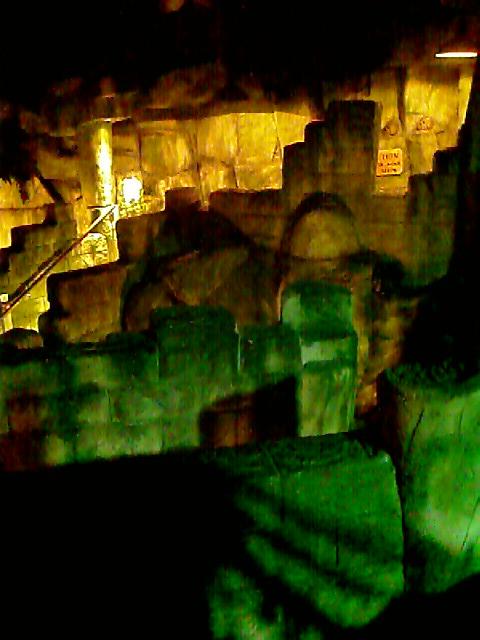
Played a game of indoor "adventure golf"--a themed miniature golf game that, in this very crowded venue, consists of 11 holes ingeniously contrived in 3-D space. I traveled up and down stairs following a different set of wild animal tracks for each hole--wolf, deer, cougar, raccoon, etc.

The set is designed like something you'd get if you turned a Rainforest Café into a miniature golf course. Lifesize stuffed animals, flashing lightning, forest foliage, yowling jungle monkeys, grotesque stone masks leering down from aztec-like ruins. I half expected to see Indiana Jones swinging from a vine, archeological prize in hand. Pretty engaging as these things go, although the greens themselves were tame.

Am eating supper at Simply Scrumptious on High St, one block from the beach. A very cheesy macaroni and cheese, made with white cheddar and gorgonzola, it tastes like. Salad has sprouts (uncommon here) and "rocket" (arugula), which is as ubiquitous as cole slaw here.

While going home walking, I went to the Spar and got Lotto based on a lotto card that someone threw away in Salisbury on Friday's draw. I picked it up for fun and did Mega and regular Lotto for £11 over the next few weeks.

If you don't ever hear from me again, I won.