Wednesday, August 02, 2006

C2C Day 16, White Cross (Mile 162.5)—This Is the England I Expected

The things we remember define who we are” says the BBC Breakfast show this morning as I check the weather report. That’s a theme that’s been running through me lately. What do I remember? What am I paying attention to? How do I define who I am next, based on what I choose to remember about who I’ve been before? What will I remember of this trip, once it’s over?

A quote from the Audrey Hepburn book I bought in Bath: “Living is like tearing through a museum. Not until later do you really start absorbing what you saw, thinking about it, looking it up in a book and remembering—because you can’t take it in all at once.”

One thing I’ll remember about today is that it’s the England I expected—and that I’m glad I didn’t always get it.

Rain and wind pelted against the windows all last night at Shepherd’s Close Farm. This morning it is still wet, gray, windy, although the rains have stopped. I break out my base layer for the first time on the trip and attach my waterproofs to my daypack. Heavy rain is on its way by eleven, says the BBC.

I leave at nine thirty, much later than I’d planned, after standing in the wee kitchen of the lodge talking to Chris for nearly an hour.
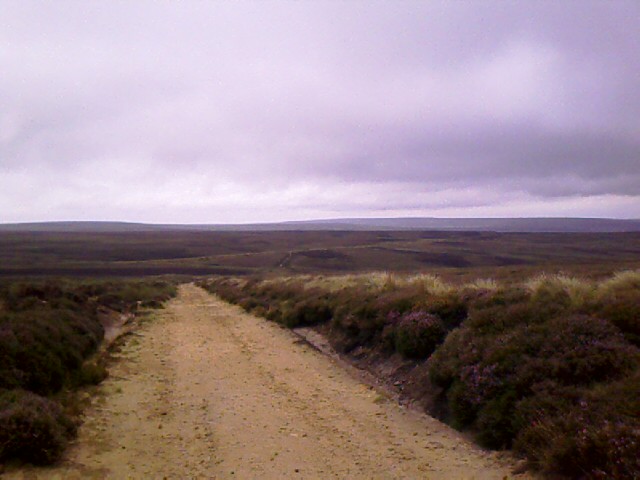
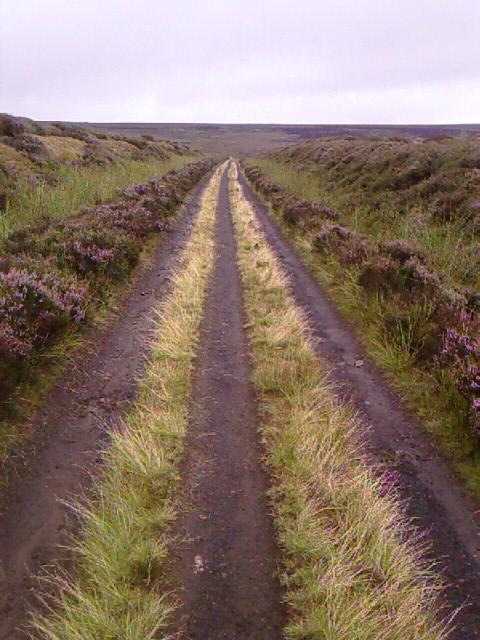
The walking, fortunately, is very easy: the path is a converted disused railway track most of the way. It’s a wide, level road, with sandy footing or gravel that’s so compacted it rivals asphalt.


The signage is meager, but the trail doesn’t need much anyway except at Bloworth Crossing, at mile 155, where the Cleveland Way and the C2C walk split. Much of today’s trail is still on the Lyke Wake Walk, too. Standing stones, some tall, some squat, act as occasional waymarkers.

And what d’you know: the BBC was right. By eleven o’clock, the overcast skies, which have been spitting all morning, dissolve to slashing rain, and I’m soon wearing every piece of warmth and wet-weather gear I’ve brought, including waterproof trousers that are designed to go on without taking off my hiking boots (nifty feature, that). I try to protect my daypack with a raincover that’s sized for my much larger rucksack, but it can’t keep water from going between the pack and my back. Soon much of the pack is too wet to open without sagging, but most of the stuff inside stays dry enough.


I forge ahead, the wind most often at my back, and feel disappointed at the decreased visibility as the storm moves in. I sometimes have no idea where the horizon is in relation to this moor in any direction.

A half hour into the rain, I meet up with the first group of people I’ve seen heading west on the C2C. They are leaning straight into the weather. They say that The Lion Inn, ahead at Blakey Howe, is worth the walk for the food—and that the place serves meals from noon to ten. That’s the first pub I’ve heard of that doesn’t shut down food service shortly after lunch. The anticipation of a hot meal keeps me going for the next two hours.

Through a wet curtain of gray, a thin rake of a man, tall, dressed in black, wearing a pack, makes steady way toward me like some specter emerging from the Other Side. This unearthly impression is clinched by his almost skeletal build. He is drenched to the skin, and his rain-soaked jacket and slacks stick to him like the membrane of bat’s wings. He is grinning broadly, a madman who’s perfectly aware of his madness.

“Don’t need to bother putting on the rain slicker now!” He cackles at me through the wet. “The weathermen predicted 25 mm of rain, and here it is! Wonderful, isn’t it?”

Uh, yeah, right.

A short time later, another group trudges toward me. Their enormous packs are lumpy bags on their backs, each raincover a block of solid color. Bright blue, electric orange, red. Eight of them form a clump with a tail, like a human comet straggling across the moors. They are head-down to the weather. I hear the five in front singing a hymn as they pass.

I reach The Lion Inn and Blakey Howe at one o’clock. It has taken me 3.5 hours to cover a little over nine miles door to door, including a snack stop and pee breaks. (The latter involves an exasperating process of first finding a semblance of privacy amid mostly flat, open lands, and then laboriously furling four layers of sopping, intractable clothing to expose an unprotected bum to the pouring rain and prickly heather—oh, to be a man at these times!)

I drip my way into the stone-lined foyer of The Lion Inn and peel off my wet gear before going into the pub. I pad around the carpeted inn in my socks, finding first a toilet, then a table, then a meal to order. I’m damp to the skin, and am not convinced the raingear is working against this sodden mess today.

I have just dived into a very tomatoey tomato soup when the New Zealand Pack ’n’ Boots walkers arrive, also soaking wet. They’re overnight here, lucky them. I have about four more miles to go today, two of which are off trail to get to my B&B, Sycamore House, on a farm road to Danby. I’m to look for a standing granite marker known as “Fat Betty” at White Cross for the right track to take to their home.

I overhear someone saying the weather’s supposed to get worse at five today; it’s about two o’clock now; I plan to be at the B&B long before then. I wonder how John and Elaine are faring in the storm. They were to have left The Lion Inn today for Littlebeck—a very long 20 miles away in this weather.

Full of a hot lunch, I climb back into my clinging wet clothes and call to verify directions to Sycamore House. Bless her, Mary offers to pick me up at Fat Betty, halving the reminder of my trip today.

Bundled up again and heading into buckets of rain, I walk down the road and across a stretch of moors on a true footpath. There are no paving stones, no brought-in gravel, no converted railroads here. Just the peaty moor ground, uneven and winding, like the trail I walked to Keld.

Only right now I am walking directly into the weather. Cold rain pelts my cheeks like needles, water runs down my face and drips off my nose. My oversized pack cover flaps around my packed poles like a flag in a storm. I turn my head to spit and the winds send it sideways—whooosh—right away from me. Gloved hands stuffed into pockets, I hunker against the wind and squelch gamely down trails that are rivulets of water, up and around and over heath clumps, raising my head only often enough to locate the next tall stone marker so I can stay on track. I wring water out of the neckerchief that hangs from my pack.


I make it to White Cross/Fat Betty before Mary arrives, and prop myself against a signpost with my back to the wind, feeling very much like a Fell horse withstanding a storm. I didn’t even notice my feet and toes at all today.

Mary collects me within five minutes, and we turn right around to go back to The Lion Inn to pick up Andy, another traveler caught by the storm. I like Andy instantly as we shake hands in the car, front seat (me) to backseat (him), in greeting. He’s finishing off the last bit of the C2C walk that he hasn’t done before, from the Clay Bank area (about where I was yesterday) to Robin Hood’s Bay. He’s also doing an experiment, traveling with barely more than a daypack, a light jacket, and shorts, and the universe played him a joke by deluging him with rain.
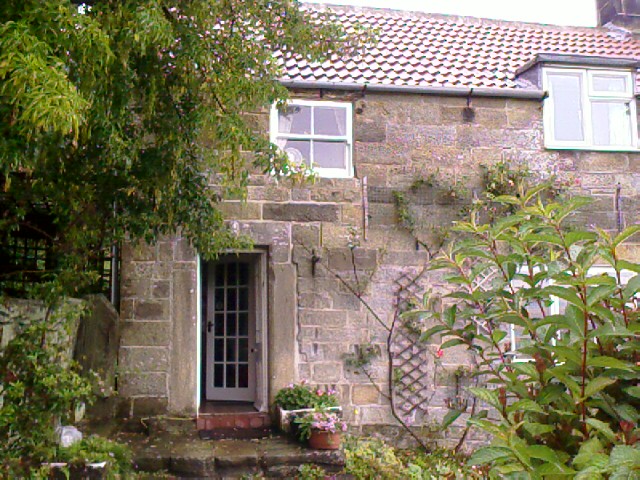
Coming in from the storm, we gratefully shed our wet things and hang then up in the 1560s front room of Sycamore House. Mary drives off to collect their third and final guest for the night, and her husband, Jack, has two pots of tea and cookies waiting for Andy and me in the sitting room.

Like his wife, Jack is full of talk and tales and warm welcome. He and Mary walked the C2C path a dozen years ago and have gone back to do the bits they missed enjoying because of wet weather. They took the walk as “business research,” to understand what C2C’ers experience, and to check out the “accommodations and competition.”

“We saw all the rules that B&Bs have,” says Jack, “and we have only one rule: ‘Make yourself at home.’ And you don’t have to follow it if you don’t want to.” Sycamore House rapidly takes its place in my roster of top lodgings on the C2C.

Sycamore House has a core living space from the 1600s, and Jack shares its history with us. The age is not surprising, since the nearby Lion Inn itself dates back to religious times, when land was granted for a friary and the building began to be used to serve wayfarers to supplement their income.
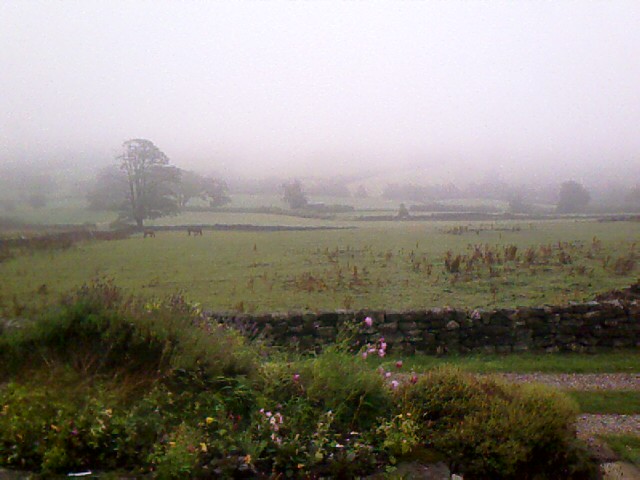
The storm continues to rage, and by six o’clock, winds are whipping around the house, sending dull harmonics to reverberate over eaves and around house corners, moaning like breath blown through a bottle. Trees seems to billow with each gust, and sheep are all butt-first to the wind in the stone-walled fields beyond the front garden.

The other two guests here are also solo travelers—Andy from the Hull area and Brian from the York area. Jack drives all three of us to the Downe Pub in nearby Castleton for dinner. The three of us share a bottle of claret wine, lots of laughter over meal mix-ups, and talk over UK and US politics, the merits and nonmerits of art (such as the Tate Modern in London, which I haven’t seen yet), being in between jobs, being in the Now.

That last topic gets to me to thinking after I return to my guestroom and record the day’s events. We put so much merit on what we remember of the past, and how well we remember it, whether it’s our own past or that of others we once studied in grade school.

Yet to write about the past, to dwell in it, is often to escape fully feeling and experiencing the Now. I’ve noticed, recently, that I’ve been taking fewer photos on the trip. Sometimes I just forget to. Other times I don’t want to. Most of the time I don’t feel the need to.

I’m beginning to understand what Toni Morrison means when she says, “At some point in life the world’s beauty becomes enough. You don’t need to photograph, paint, or even remember it. It is enough. No record of it needs to be kept, and you don’t need someone to share it with or tell it to. When that happens—that letting go—you let go because you can.”

What if I were to completely give up recording anything, whether by journal or camera or voice recording, to be reread, reseen, reheard later? What if I really enjoyed the Now of every moment as it is, without trying to capture it so that I’ll remember it again, for myself or for others?

Why do we place so much importance on our ability to remember the past, to collect again the memories associated with something? Is not most conversation merely remembering something we’ve seen or heard or felt, instead of being aware in the moment of what we’re currently thinking or seeing or feeling? We recall a similar taste of food, the place we were when we tasted it, a like experience we had elsewhere...always talking talking talking of the past or the future. Rarely saying, “This moment I feel, I think, I experience, I am.”

What would happen if I were to stop trying to capture knowledge for myself or others? It’s all a form of remembering the past—not only my past (which is big enough in itself to try to remember), but everyone else’s past, every other nation’s past, every society’s past. To me it’s so much mental clutter.

I haven’t been particularly interested in the archeology and history of England on this trip. Is this bad? Stupid? Foolish? Especially since this land is steeped in history?

Many would think so.
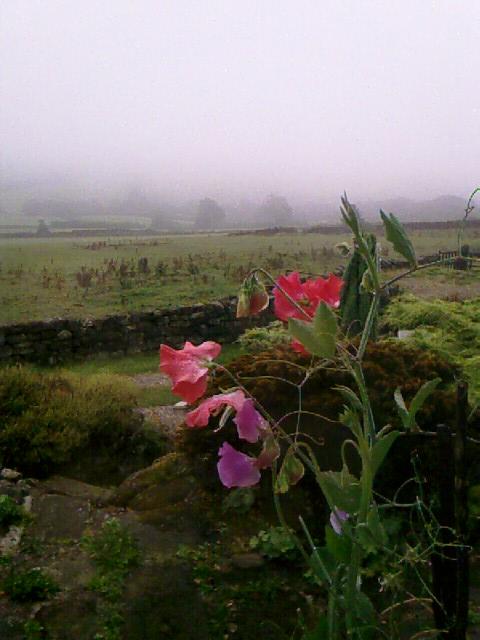
But I’m beginning less to think so. On this trip, I’ve been more interested in being in the space, feeling the space, feeling myself walk through the space as it is today, right now, not as it was then. I’ve already experienced this place in other times, anyway. Why not accept what it has to offer this lifetime around, and enjoy it?

Trail miles: 10; actual miles walked: 10.5

Tuesday, August 01, 2006

C2C Day 15, Carr Ridge (Mile 152.5)—So Remind Me: Why Did I Do This Walk?

Shit. Today I’ve successfully trekked an exhausting 13 miles up and over several moors but am almost in tears of frustration at the last 100 yards because no manner of doubling back reveals a way through or over a wall to the yard of Shepherd’s Close Farm, the self-catering B&B I’m at tonight. I am stuck on a forest road that I thought would pass by a stile, but it actually by-passes the farm completely.

A long-distance, semaphore-like communication (sweeping arms, compass-directing bodies) with someone in the east-most field indicates I should retrace my steps along the trail, but no overlooked path becomes evident. Another map check reveals the horrible truth: I have overshot a trail that leads to a driveway that’s three pastures long. Repairing the mistake means a hairpin backtrack and reroute of almost a mile to get to the same place that a crow could fly in 70 yards.

Every muscle in my legs and feet are protesting. My heels hurt to stand. My toes hurt to walk. I’ve been up since 5:30a after a poor night’s sleep. My clothes are drying on me from a recent rain, my pack is soggy against my back. I am tired, cranky, frustrated.

Then I remember: “Hey, you’ve got a cell phone.” (This high-tech instrument is new to my repertoire, and I still often forget to use it.)

Whew. The owner is home. She knows where I am on the forest road. She thinks there is a clear way over the fence at the corner of the field by the beck. She’ll come look for me.

A minute later, I see a petite, sandy-haired woman striding across the sheep field in blue jeans, short-sleeved shirt, and green Wellingtons. We meet across the beck, which at its closest point to me is impenetrable with weeds. I find a thin clear spot under the trees (oh, here’s a trail, kind of) to gain access to a barbed wire fence she has just stepped over. She greets me, then turns to step lightly back over the fence (it’s covered with a rubber hose at the crossover point), hustles across the field, and nimbly climbs over a pipe-metal gate to reach the main driveway that I should have been on an hour ago.

I, meanwhile, am mustering all my strength to do the same maneuvers without a) landing my crotch on the barbed wire, b) stumbling lead-footed across the field into another rabbit hole, and c) tangling my feet over the crossbars as I heave my tired legs over the 5-foot gate.


My accommodation tonight is a self-catering cottage attached to a farmhouse—breakfast makings in the fridge, a small kitchen and bath, a fire ready for burning, two beds upstairs. A mini-lodge all to myself. I decline a ride to town for a pub in favor of staying home and eating my leftover lunch for dinner. Mrs A had packed me a double-sized lunch, and I had supplemented half of that with a bowl of chips at a cafĂ© en route for some hot food on a cold day.

After disgorging my bag’s contents and strewing most of my damp things around the living room to dry, I go upstairs and immediately take a nap—a solid hour and a half of deep, drooling sleep. (You always know you’re sleeping deeply if you drool.)

I awake so sore and stiff that I can barely make it down the stairs. Not the good kind of sore and stiff, born of a hard day’s walk of which to be proud, mind you. But the ohmygodI’mgettingtoooldforthis kind of sore and stiff that leaves me clutching at the banister, wincing in pain, and begging my bones not to collapse on every step down. I wonder if this what it feels like to be eighty-nine and arthritic. I wonder if I’ll ever walk upright again. I wonder if I’ll ever want to move again.

Hobbling around the lodge a little improves my mobility and my morale, as does sitting down to make a few phone calls for directions to my next two nights’ lodgings. Tomorrow’s is the worst for added distance—two miles due north off the trail.

Right now I’m making a pot of tea to have with dinner and the shortbread that Chris, the proprietress, has baked. Tea makes everything better, but the shortbread is a tad stale.

So let’s see. Highlights of today. I left Osmotherley at about eight thirty, my belly laden with a full breakfast (including two eggs, not the usual one, and beans that weren’t soupy—yay) and my daypack laden with a full lunch (three small sandwiches on rolls—cheese/pickle, pate, meat; a KitKat, two cherry tomatoes, a box of raisins, a buttered scone, a homemade fruit bar, a homemade lemon muffin, and a homemade raspberry sponge bar. Mrs A knows what walkers need.)

The day threatened rain, so I hauled out my rain gear and fleece vest right before I left my bag for the Sherpa Van people. Good thing I did. The weather changed quickly throughout the day, and winds whipped at the top of the moors.


The trail was easy to follow and mostly easy to walk. This part of the C2C coincides with some of the 109-mile Cleveland Way National Trail, as well as with several miles of the 40-mile Lyke Wake Way (LWW). The latter is a race, actually: 40 miles in 24 hours in honor of the supposed path that pallbearers walked to carry corpses over the moors to villages where a church had a consecrated cemetery.


The path went through forests and fern fields, over moors, up and down hills. It’s well used, and to protect the moors from erosion and discourage off-trail foot traffic, much of it is paved with slabs of stone.


Beacon Hill, just outside of Osmotherley, houses a BT satellite station—pretty, in its way, of high-tech steel against a steel-gray sky. The moors I crossed are 1,000 to 1,300 feet high, and the path goes up a lot, down a little, then up some more, until reaching the highest point for today of 1,427 feet at Cringle Moor.


Views were, of course, spectacular, and the clouds and sunlight were constantly changing. It’s no wonder that the top of Carlton Moor is the headquarters for the local gliding club. These windswept hills and the extreme drop-off of Carlton Bank are perfect for catching updrafts for long glides.

I met several members of a Ladies Badminton Club taking a rest at the top of Cringle Moor. During summer they walk instead of play badminton, but today’s loop walk was cut short when thunder started rolling. Being on the moors in a lightning storm isn’t a good idea—you’re the tallest thing around for miles. “We have four seasons in an hour here,” said Dianna (DEE anna), a tall woman sitting next to Margaret on the semi-circular stone seat at the top of Cringle Moor. Today attests to it.

We chatted some, and Margaret perfected my camera enough to take a photo of me against the backdrop of North Yorkshire.

Today is Yorkshire Day, according to the BBC radio that was playing over breakfast at Mrs A’s B&B. They were making Yorkshire pudding on the air (!), comparing pudding cooking techniques from listeners, and taking calls from people who were proud to be from Yorkshire. That latter took a couple of pleas—the emcees were distressed that no lads and lasses were calling in to declare loyalty to their venerable heritage.

I met Nico and Marja as I arrived at a stone-walled coffee shop at Green Bank today. This is the only actual on-trail eatery I’ve found so far, aside from when Marv and I passed through villages on the way to Reeth. It certainly feels like it’s in the middle of nowhere. The only thing around it is a parking lot and a park.

Nico, Marja, and I had said last night that we’d meet one last time on the trail, and there we all were—me coming in for lunch, them leaving from lunch. We said hello, then farewell, and they invited me to stay at their home if I go to Amsterdam before I leave for the US.

Throughout the day, I got passed by, then I passed, then I got passed again by the New Zealand Pack ’n’ Boots hiking group of five. I wonder how John and Elaine are doing—they’re supposed to be at Blakey Howe by the end of the day today. David and Michael should be arriving at Robin Hood’s Bay tomorrow...wow, the end of the trail.

Dianna and Margaret told me about an easier route around the last moor (Cold Moor, the one straight ahead in this photo) and the famous Wainstones at Hasty Bank that Wainwright (no relation) tells about. My knees were beginning to ache badly on the downhill walks from Cringle Moor, so I decided to follow their advice and avoid that final hill for the slightly longer route around the base. It had the added advantage of skirting an evergreen forest (Broughton Plantations), which provided cover in a brief spell of rain.

I did take a quick detour up to the Wainstones, which rock climbers love, and they seem like boulders that someone would scrabble over easily. I often see shapes in these kinds of things, and one of them looked like a giant fox head sniffing at the air.

The path to Shepherd’s Close Farm leaves the C2C trail at Clay Bank. Just as I split off from it, the heavens opened with a light, pattering rain that didn’t stop until I was near to crying on that damned forest road, fruitlessly looking for a way in to the farm and rest.

Already, that frustration is dissolving—I’m fed, cleaned up, tea’d up, and getting more relaxed by the minute. The sky is aglow with a gorgeous sunset, the kind of light that comes with storm and fast-moving clouds. I can hear dozens of wood pigeons in the forest and the cackle of pheasant across the field. A warm bed beckons, and I’ll turn in early tonight.

Trail miles: 11; actual miles walked: 12

Monday, July 31, 2006

C2C Day 14, Osmotherley (Mile 141.5)—Motherly, Yes; Oz, No.

Off at a little past eight-thirty this morning from The Old School House, fortified with a famously huge English breakfast from Frank and Doreen. I travel with John and Elaine today, our last day on the same schedule.

After an encounter with a child-eating troll (one of many from a recent scarecrow competition), fields and some road-walking face us most of the way. I have left my trekking poles for the Sherpa folks to take to Osmotherley and am glad for the reprieve from hauling them around. I expect I’ll need them the next two days, though, as I head into another strand of fells to ridge-walk.


We are at one of the many dairy farms on the route when I stop to tighten my bootlaces and John and Elaine walk on ahead. I see a milk tanker around the bend and, sure enough, I catch up to find my very outgoing friends talking with the crew—Diane and a coworker who are shunting milk from a 15700-litre tank to a 27000-litre tank for delivery to Osmotherley. A just-born calf is in a field nearby, bright white and black from mom’s cleaning, still too weak to stand.

John and Elaine later tell me that Diane had offered us all a lift to Osmotherley, but they had declined.

“Why’d you do that?” I say only half-jokingly. I would have turned it down, too, but the dream of a ride is tempting. Dang.


It’s another easy walking day—all flat until the last two miles through Cleveland Forest, which feels and looks like it’s been lifted right from the foothills of Mt Rainier, only with a wide gravel truck track instead of foot trail. The weather stays with us all day, windy, alternately warmish/coolish, with gray clouds rolling in by the afternoon. We pass over train tracks and rickety bridges, and by new construction, old ruins, and a beautiful private farm/garden at Ingleby Cross.

We have a lunch break in the woods at Cleveland Forest, where John sets up their camp stove to make their usual batch of Australian billy tea. He shows me how to swing the covered kettle like a man pitching a baseball, ostensibly to swirl the tea in the water before steeping and pouring. Given that centrifugal force is at work, I more wonder whether it’s really just a way to squeeze the teabag without touching it.


A spate of rain comes as we leave our protected spot for lunch, but not enough to do more than wet the road. We part company shortly after, so John and Elaine can get a couple more miles in tonight on the trail and cut their longer day short tomorrow. We’re to meet for dinner in Osmotherley, which is a mile off the track and on the famous Cleveland Way trail that the C2C is just about to intersect with for a while.


I get to Osmotherley around 2:30 and walk the extra mile beyond town to get to my B&B. It’s clearly too early for check-in, for the proprietress isn’t home, so I head back to the village to kill some time. I buy the last two OS maps for the walk, poke into a few stores, and take a pot-for-one earl grey tea and toasted tea bread at a coffee shop.

As I explore the town, I fall into conversation with the keepers of the various shops, and the topic inevitably turns toward lodging. When I tell them of my B&B, two of the proprietors give me odd looks I can’t quite interpret, but a third responds with, “Ah.” Pregnant pause. “Mrs A.”

As this is the third such reaction, I’m feeling more than a twinge of worry. I look him in the eye from across the counter. “How is Mrs A?”

He looks left and right before answering, as if making sure none of his customers can overhear. His voice is low. “She’ll keep you in order.”

Oh great. The lady has a reputation—but for what? Gorgon? Busybody? Drill sergeant?

I take the return walk to the B&B, hoping that by now my hostess is home. Halfway there, a woman in her late 40s, with a pageboy haircut and a black-and-white collie, crosses the street toward me and indicates the threatening gray skies.

“Won’t rain!” she assures me. “I’ve got my umbrella!” She waves a folded collapsible red unit at me.

“Thanks!” I grin back.

As I arrive at my lodging, I meet a friend of Mrs A’s leaving the house.

“Staying here?” asks the tall blonde, middle-aged woman. “You’re in good hands. She’ll take good care of you. I’ll call you later, my dear!” The woman waves goodbye to me from her car, and one concern is removed. Probably not the town Gorgon.

Then Mrs A herself, plump, blonde and bustling, greets me busily in the small fore room and points to a chair like a woman used to giving orders. “Sit there. Take your boots off. Would you like some tea?”

“No, thank you. I just had some at the coffee shop—”

A scandalized look. “You’ve already had tea?”

“Well, I got in early, and you weren’t at home, so I went back to town—”

“Come in here.”

I follow her into the kitchen, where an ironing board is set up and smells of fresh soap permeate. She returns to ironing a bottom bedsheet, nosing the iron into the elasticized corners.

“Your room’s up there,” she says in a clipped, crisp voice. “A stair leads up at the left. I’ll take you there in a minute.” A penetrating look. “You sure you don’t want tea?”

“No, thank you, really—”

“Your bag’s arrived. I even took it upstairs for you. It’s heavy, you know.”

I nod. All I want to do is go to that room and flop down on the bed. My legs ache. I stand politely, shifting weight from one tired heel to the other while she continues her ironing, and begin to understand what the villagers meant about Mrs A.

“My friend there who just left?” she is saying. “She shouldn’t be driving. Just had cataract surgery three days ago. She shouldn’t be driving, should she? ‘Should you be driving?’ I asked her. ‘Does your doctor tell you it’s OK to drive?’ ‘No,’ she says to me, ‘but don’t tell anybody.’ She dropped the remote control for the TV yesterday and a button fell off. She’s taking it to the shop to get it mended, can you believe that? Doesn’t want her husband t’know she’s broken it, so she has to drive now, doesn’t she?”

She sets the iron aside, matches corners of the sheet, and folds it into a tidy white package to join its mate on a rack hanging from the ironing board stand. “Did you get rained on today?”

“Only a sprinkle.”

“I hung the towels out to dry three times today. Just put them out again. You’ll be wanting a shower, right? You can have a bath if you want. Water’s already hot.”

She finally shows me to my room, explains the shower, takes my breakfast reservation for 7:30, and goes downstairs to “tidy up the twin room.” The place has lots of religious overtones—inspirational poems and prayers taped to the bathroom walls and hall walls and bedroom walls. My room is comfortable, with its own sink, and the bathroom is done in pale purples—a good vote in my book. Once I settle in, my motherly hostess leaves me very much to myself.

I make one more trip back to the village that evening for a farewell dinner with Nico, Marja, Elaine, and John at The Golden Lion. There’s a good chance of seeing Marja and Nico tomorrow, but not Elaine and John, who now are hoofing it to reach Robin Hood’s Bay by August 3.

“The next time we see you will be in Australia,” they promise. I’m looking forward to it already.

Tomorrow’s walk begins across the Cleveland hills into North York Moors national park. Before all this farmland, I’ve been traveling through the Yorkshire Dales, Herriott country. Before that, the Lake District was dominated by Beatrix Potter and William Wordsworth. Coming up are some of the stomping grounds of the BrontĂ«s—misty inspiration for those haunting scenes in Wuthering Heights and Jane Eyre.

I have reached mile 141.5 of 190 miles across England, or page 122 of 160 pages of the Wainwright book, or day 12 out of 18 actual walking days. Whatever way I do the math, my feet held up better today, although the inside of my heels seem to be taking a beating. More wool!

With less than a week to go on the C2C, I look forward to several days afterward in York to rest, catch up on Internet/blog time (I’m way behind), and just be in one place after moving one day to the next for this long.

Trail miles: 13; actual miles walked: 19