Sunday, July 16, 2006

Horses, and Fishes, and Pigs, Oh My!

For me, there’s nothing like settling into a routine on a farm to let the days ease by, especially if it involves being anywhere near horses, tack, and barns. I can spend hours at a stable and never feel the time pass.
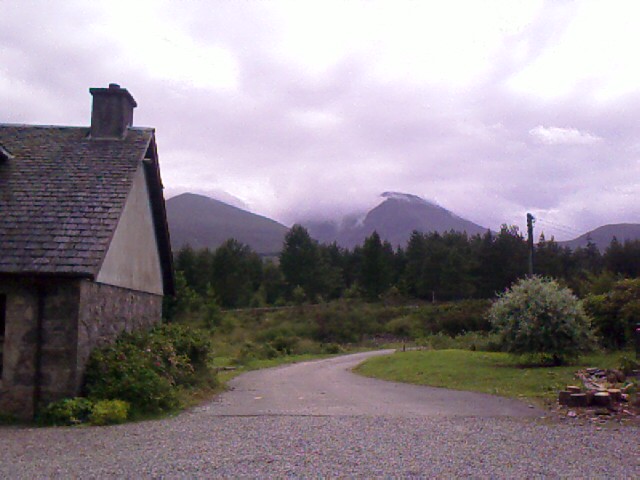
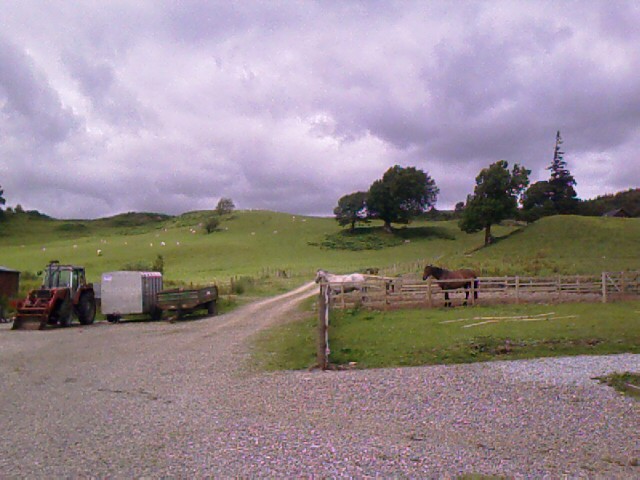
Torlundy Farm is an amazing place. It covers over five hundred acres of fields, woods, brooks, and hills. It is practically at the base of Ben Nevis, the highest mountain in Britain, over 4,400 feet. I didn’t see its top for three days because of cloud cover.

Legend has it, according to Charlie, that if the one particular spot of snow on the side of Ben Nevis ever melts, it will signal the end of the world. I check each day to make sure the snow is still there, especially as hotter days burn the clouds off toward the end of the week. I proposed to Charlie that maybe someone has painted the white spot on the side of the mountain so people don’t lose faith, like in that O. Henry story about the man who paints a leaf on an ivy vine to prevent a sick woman from dying when the last leaf falls. Charlie just rolled his eyes at me and grinned.
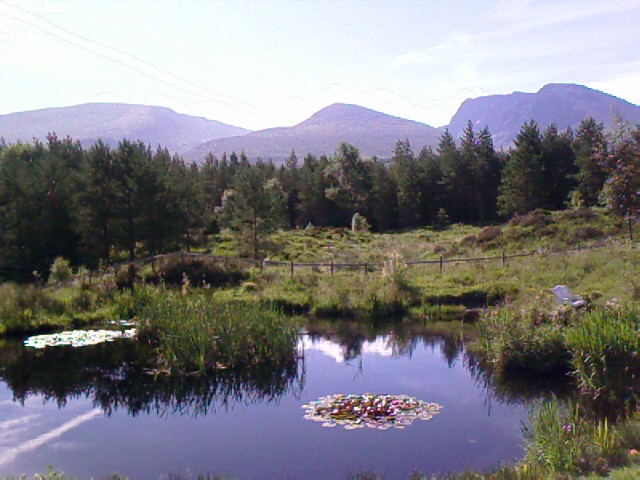
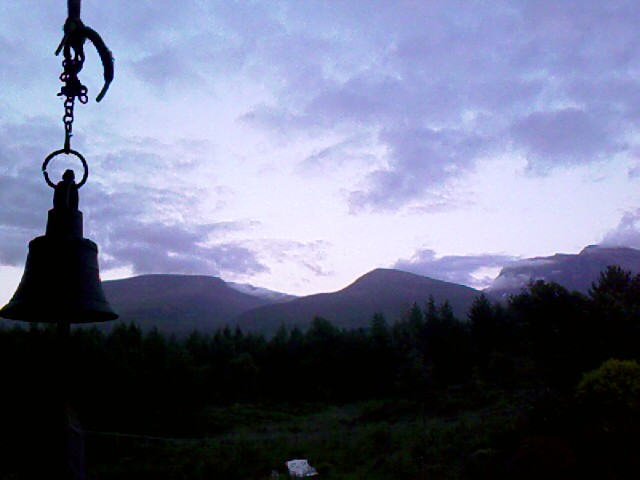
Ben Nevis and its two companion mountains, Carn Mor Dearg and Aonach Mor, are visible over the front garden from the window of my large private bedroom. The evenings are deep-blue sky. In the middle of one night, I woke up to moonlight flooding across my bed. There’s no sight like a full moon over Ben Nevis. I’m sad that Perry’s camera couldn’t capture it.

My first few days here were spent under Siobhan’s instruction about the animal feeding and horse routines, coupled with stall and tack cleaning, general farm chores, helping Chris with some computer problems, and grokking the reservation process for the chalets. I’m glad that Charlie has done that part before.

Siobhan took me on several horseback rides over hills and through shady glades on trails that are in almost constant view of Ben Nevis. We were checking on the horses or sheep, or taking a chalet guest for a ride. I haven’t ridden much for about two years, and have ridden the same horse for seven, and I felt really out of shape and clumsy riding the different horses from Torlundy. Trail riding takes a different kind of confidence in the horse and myself than arena riding, and I could tell it’s not a confidence I’ve cultivated yet.
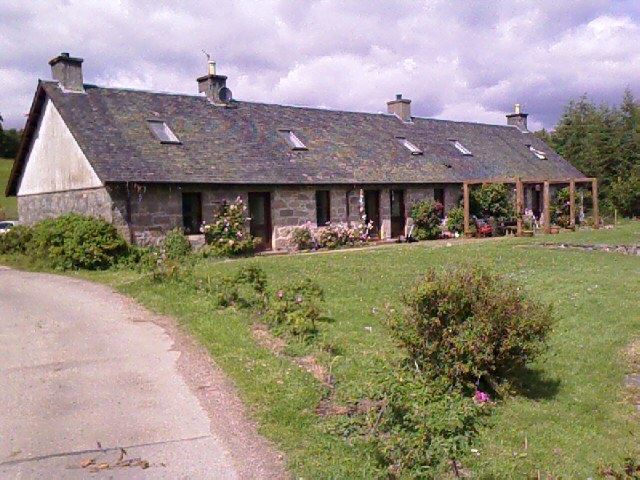
Mealtimes for the first two or three days united the entire family around the kitchen table over home-cooked food. Breakfasts had farm-fresh eggs (when we could get to them before the dogs did) and lunches and dinners had home-grown salad greens and organic foods bought from a tightly-stocked local grocery store outside of Fort William.

Siobhan and the girls are all wonderful chefs, and over the week I enjoyed a smorgasbord of from-scratch cheese soufflés, stew, and Thai food in between my favorite piece-together lunches of cheeses, meats, bread, and salads. I kept expecting (and hoping for) leftovers, but everything goes into the slop bucket for Miss Nicolette, including her daily dose of caffeine in the form of used coffee grounds and tea bags.

Daisy and Gemma left for their respective points east and south in Glasgow and London Tuesday, and Siobhan and Chris headed for London on Wednesday night. In their absence, Charlie and I fell into an easy routine of animal and yard chores. I took care of the animals and he took care of the yard work and “strimming” (weed-whacking using a string trimmer, or “strimmer”), and we both managed the phones for the guest house reservations.
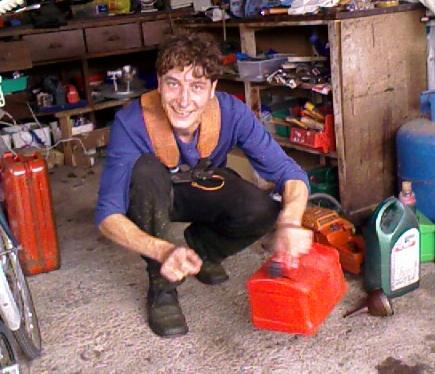
Charlie is great fun to be around—27, delightfully energetic and artistic (ask him about his lawn sculpting with a strimmer), with a brilliant mind for details, history, song, humor, and theatre. He has a willing heart and willing hands, and is thin as a strimmer himself.

He’d spend all morning in the gardens near the house with the strimmer, then disappear for hours on the tractor to mow acres of fields somewhere in the Scottish outback that’s the Carver property. I usually took care of the cooking or lunch prep, and Charlie was tops in adulation over the meals.

Thursday brought some excitement with helicopters all over Aonach Mor next to Ben Nevis. A gondola on the lift that goes to a restaurant halfway up the mountain had somehow collided with another one and fallen. It felt weird to watch the rescue activity from the driveway of Torlundy. Radio reports were sketchy. We found out later that no one was killed, although several people were flown to hospitals.

Charlie drove every day to Fort William to buy three to four local newspapers for their crossword puzzles. We’d spend lunch or dinner grappling with one puzzle, getting stuck, and moving to another. I cleaned the huge red-enamel gas stovetop one night with almost no effort because we were laughing so hard over mystifying crossword clues and Charlie’s horrible spelling, which often produced far more creative answers than the puzzle writers had anticipated.
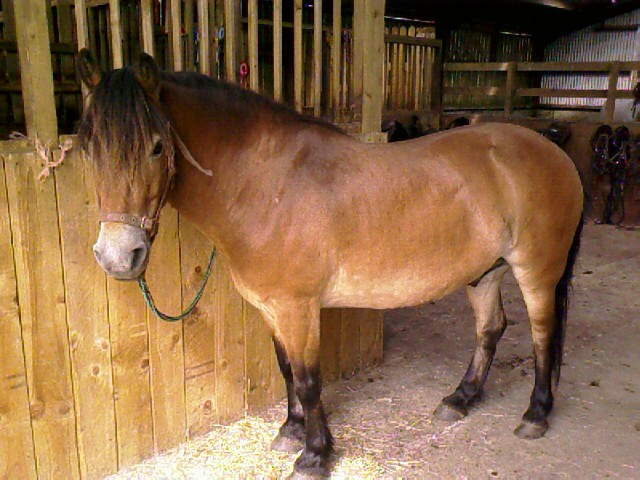
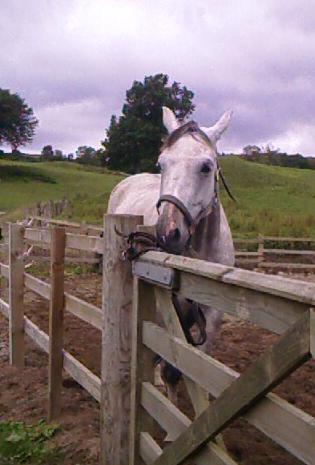
Working with Eric and Celene this week was both challenging and satisfying. Eric, pictured here, is an Exmoor pony who’s skittish about things coming at him from both sides, can be hard (as in last) to catch, moves away from anything near his feet and legs, and jerks away if someone reaches for the top of his head. I wanted to see if I could help him be more comfortable and confident in the world. Celene is a young-adult horse, and Siobhan had asked if I could help her be less head-shy with haltering and bridling.

I worked with both Eric and Celene using TTouches and techniques that I learned at the TTEAM training in Farmborough (sheesh, was that only a month ago?). I enlisted two young guests from the chalets—Tanya and Shaunie—to help me guide the horses through a labyrinth and other ground exercises a couple of times a day.
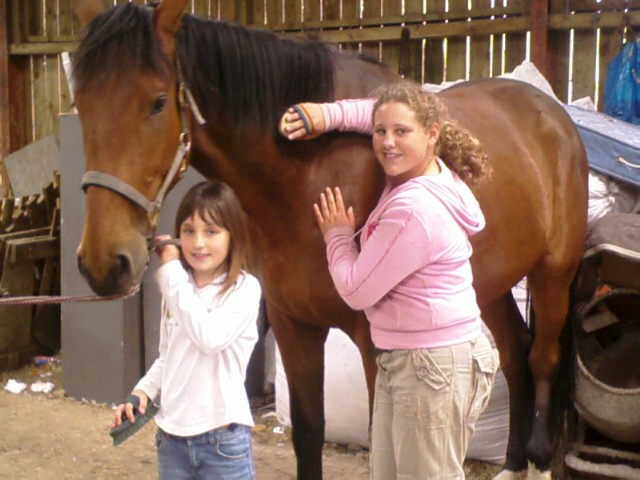
Tanya and Shaunie were both very good at learning the TTouches, and were a tremendous help getting Eric used to more skin contact. That’s them grooming Chris’ horse, Great Glen, in the barn.
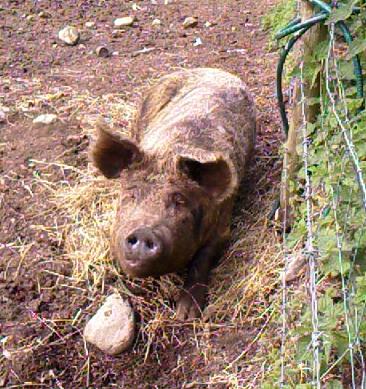
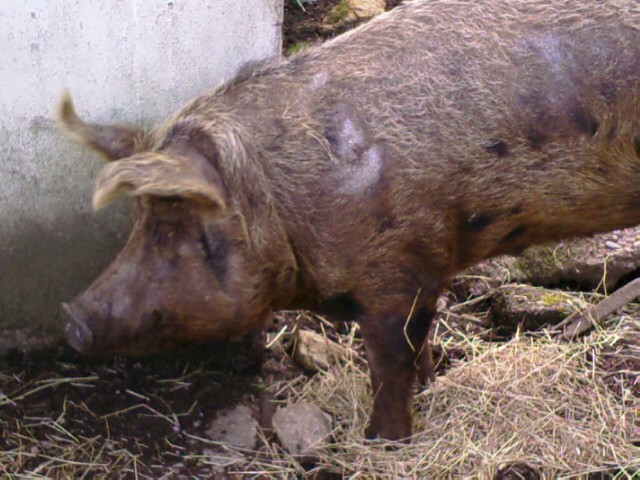
Even Nicolette loved the TTouch. I’d lean over the fence of her sty and she’d move around on her wooden feeding platform to present first her butt, then her head, then turn around at my request so I can do her other side. Her hair is wiry and her skin is wrinkly, but softer and warmer than I expected. And those ears are so big I could put my whole palm on them for stroking. She liked having her jowls TTouched, too. I’ve never gotten this chummy with a pig before; I liked the opportunity as much as Nicolette seemed to like the TTouch.
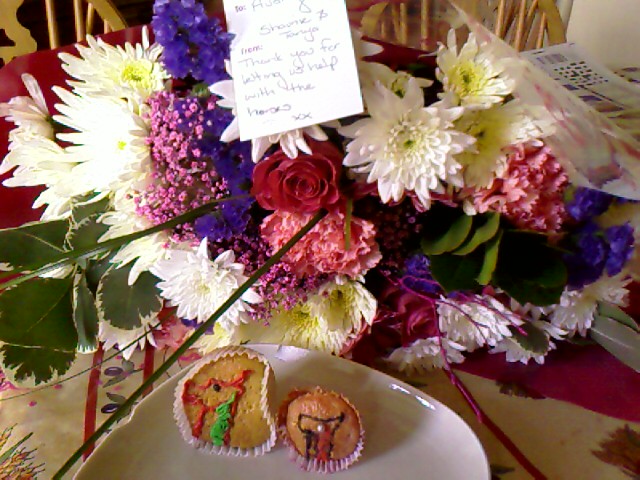
After our last TTEAM session on Friday, Tanya and Shaunie surprised me by coming back from the chalets with a gift of flowers, homemade cupcakes, and a lovely thank-you note for letting them help with the horses. They were indeed a great help to me, for Celene and Eric were both showing remarkable progress since we started with them on Thursday. By Saturday, I was able to halter Celene without her turning away, and Eric was not only coming in ahead of the rest of the horses, but was also OK with things all around his sides, and open to having his legs and feet touched without moving away.

Siobhan arrived home in the morning on Saturday, and I helped Liz, their chalet housekeeper, with some of the cleaning to get the chalets ready for the new guests.

Saturday afternoon lazed by as a picnic with Siobhan and Charlie at River Lochy, a primary salmon run whose banks demark a border of the Carver property. Siobhan explained that many rivers in Scotland have strict fishing rights and regulations. This one is fishable for trout, and only for fly fishing.

Siobhan took us to the river in her truck, driving straight through several seat-jouncing sheep fields and parking under a tree next to a barbed wire fence. We covered the fence with cushions, handed over picnic basket, wine, blankets, and other goodies, and climbed down through bracken to reach a sandy, half-shaded beach.

The day was hot. The water was cold. I swam across the river (another first for me, like the loch swim at Jura). We slathered melting Flora margarine over bread and crackers, peeled off slices of warm salami and cheese, ate olives and salad greens, nestled wine glasses in the sand to hold them up, and talked and laughed and napped in the sunshine.

On the way back, Siobhan gave us a driving/historical tour of the Fort William area on both sides of the river, including many views along the Caledonian Canal that runs from Fort William to Inverness. Neptune’s Staircase is here—eight locks to navigate through the elevation change of the canal. Sometime I’d like to grab a friend and rent a canal boat to travel part of the UK this way.
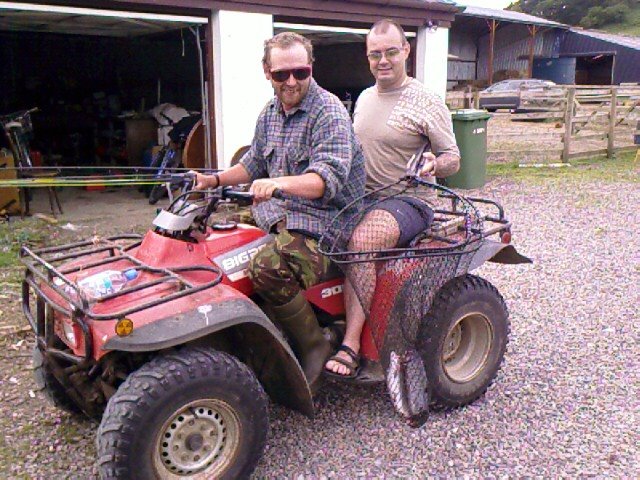
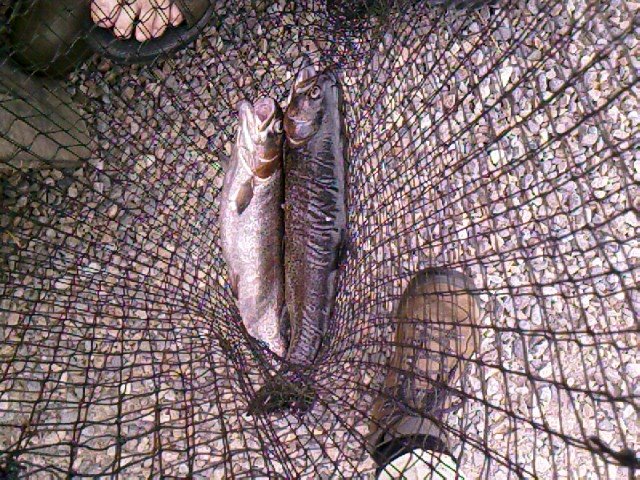

I had been invited all week by Ian, Torlundy’s almost-resident ponds-keeper, to drop in for a free fly fishing lesson, and I finally took the time out on Saturday to do it. Besides teaching fly fishing, Ian manages the catch records, trout stocking, and fishing fees for the three ponds on the property. That’s him driving the ATV with a guest who caught two large trout in the upper lake.

Now let me begin by saying that my only other foray into fishing was almost twenty years ago, with Richard on the Snohomish river in Washington. We had brand-new gear, freshly minted fishing licenses, and no idea what we were doing. We somehow found our way to a part of the river where no one else was fishing, and where the water ran rapidly over some rocks. I snagged a 4-inch fish, which was so under the size limit that the thought of having it for dinner gave a whole new meaning to “small fry.”

The only other catch of our day was also mine, and it put up a bit of a fight against the current and over the stones. I was already salivating for supper when my prize cleared the water—a sodden, black leather work glove. Richard and I guffawed, and he unhooked it and flung it away behind us. When it landed in the bushes, the glove was palm up, with only its middle finger extended to give us the bird. Years later, we sold all that brand-new fishing gear in a garage sale.

With this redoubtable record, I wasn’t particularly hopeful about fly fishing, but decided it was worth trying as something new. I arrived at the pond about an hour before sunset, and the water was quiet and still. Even the midges weren’t biting. Ian was happy to put a pole in my hand and explain the nuances of the toss and the fly and how the fish respond to it in the water.

Ian is a good teacher. Because I was a beginner, he had me use repeated tosses to get the fly way out into the water, instead of trying for a long-range throw all in one shot. Within only a few minutes, I could do a few semi-decent casts that actually reeled line out and sent the fly away farther each time. Consistency was harder to achieve.
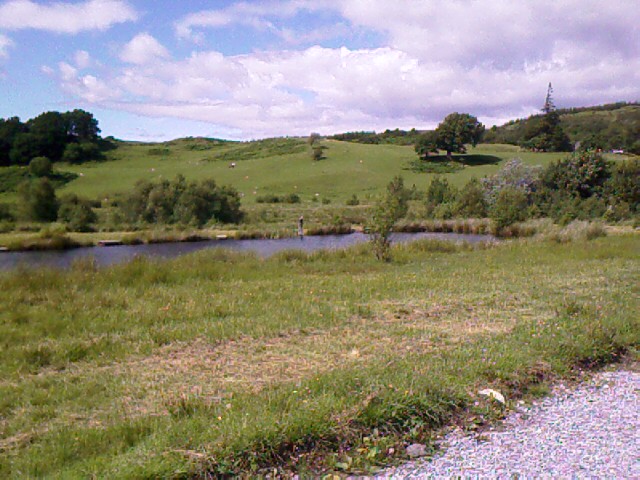
I found out a lot of ways that casts don’t work. Sending the rod too far back over my head meant that I’d hook a wad of meadow grass and fling it—plop!—into the water, no doubt scaring every fish in the pond. I could just hear them muttering to each other below, “Hey, man, stay away from that dock. There’s some big sh!*&^# comin’ down!”

Part of the trick was knowing when to release the fishing line from where I pinned it under my finger during the throw. If I released too soon, the line would whiiiinggg straight up into the air and the fly would drop down almost on top of me. It I freed it too late, no fresh line would reel out, the fly would snap-stop in mid-air, and the whole would plummet straight down—kerplunk—creating a watery ripple of “Oh, god, another amateur” spreading outward over the pond.

Ian, of course, could consistently send the fly arcing up and over with one graceful throw that spun out yards and yards of line in a satisfying whir and never got snagged on anything. Years of practice does that.

Thirty minutes later, Ian and I were still casting from our respective little docks at the edge of the pond. I was enjoying the relaxing rhythm and companionable silence. Fly fishing is one of those sports that’s enjoyable even if nothing more happens than flinging the fly through the air. I like the soft whizz of the reel feeding out line, the gentle plink of the fly landing in water, the subtle V that forms on the surface when I drag the lure back in. Being pond-side and in the open air seems to be enough.

Just as I was feeling the fatigue of continuous casts and ready to stop, Ian hooked a trout and called me over so I could reel it in. He taught me how to let it play out the line, then to pull it in steadily for him to scoop up into the net. It was a lovely shimmery thing, maybe a foot long, full of whipping muscle and gaping mouth and gills. I couldn’t bring myself to cook it for supper, so we let it go free back into the pond. I’m officially recorded in the log as someone who did a catch-and-release.

Sunday, my last day at Torlundy, I taught Siobhan some of the TTEAM basics with Eric, and we worked with 2-month-old foal of a mare named Jura (there’s that Jura again).

Siobhan thinks I should continue with the animal work and WWOOFing. She says I’m good at working with animals. I agree. This week has taught me that I really like farm environments, and that I prefer to work with animals much more than with plants, although I can still take or leave dogs. I have so much to learn about working with horses, too—young, old, different breeds and sizes.
Siobhan commented on Sunday that Eric was “much easier to catch; he doesn’t walk away from me anymore,” which I was very glad to hear. I felt I’d done well by Eric, the WWOOFing program, and the Carvers’ generous hospitality.

Monday, July 10, 2006

Farm Duty at Fort William

I was so glad to get out of Oban today that I was nearly halfway to Fort William before I realized I was feeling anxious about the week ahead. I feel nervous about fitting in, giving good service, doing well by the horses and family expectations, etc.

This WWOOFing idea of providing physical service on a farm in exchange for room and board is at once appealing and scary. Appealing because I’m trying out another way of living in the world and interacting with people. Scary because I’ve made my way by my writing skills for so long that I really wonder what else I have of value to offer. Of course I know there’s lots I can do, but I’ve rarely put it to the test as a means of barter before. And I feel the familiar butterflies of meeting a new family I’m supposed to share space with for a week.

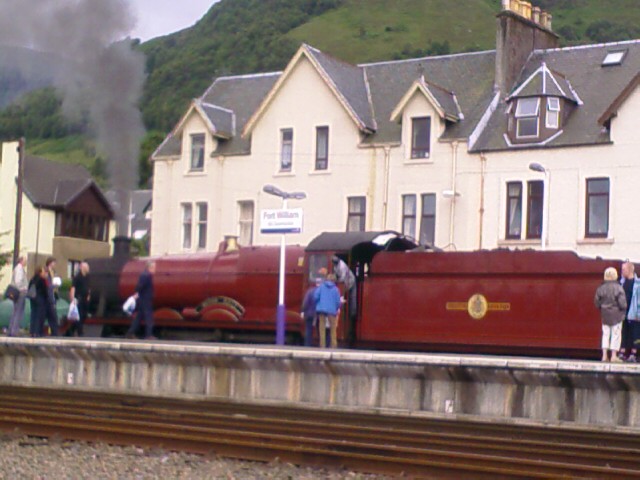
The morning has been cloudy but not rainy, and the Argyll Coastal Road to Fort William offered some lovely views of coasts, forests, and villages that I tried to take in without much success. I arrived at the Fort William bus/train depot in time to see the Hogwarts Express Railway puffing at the platform across the way. It’s a coal-burning train that heads into the Glenfinnan region, where parts of Harry Potter were filmed. Lots of people were hanging around it, having their pictures taken next to the emblems emblazoned on the train’s side and nose. I would be there too, probably. I snapped this photo through the chain link fence that stands between the train tracks and the bus station, but Perry’s built-in camera wasn’t quite up to the task of a good zoom.

My WWOOFing hosts, Chris and Siobhan Carver, picked me up at the bus depot. Siobhan asked me a lot of questions to find out what skills I could offer (had I ever WWOOF’d before, how well did I ride, what experience did I have with horses, oh, you do Tellington Touch—how does that work, etc.). It seemed a bit like a grilling, but I later welcomed her direct way of speaking.

Siobhan had an errand at the train station, so Chris took me into Fort William for a quick look at the town while he ran errands, too. As we drove, he told me that he and Siobhan were leaving on Wednesday for London for a few days, that their daughters would be leaving town too, and that I’d be taking care of the house, grounds, and guest-chalet business with somebody named Charlie who’s also staying at the farm in their absence.

I tried to soak in this information while dozens of thoughts zinged through my brain. All of them were variations of, “Hey, wait a minute, you can’t just leave me with that kind of responsibility—I just got here! And, golly, you’d entrust all that to someone you just met?” But then I recognized that that’s also part of the WWOOFing experience—Siobhan and Chris have had lots of WWOOFers before, and the program probably attracts honest, earnest people by default.

Still, I was eager to be of use the first day and to assure them that I was no slacker who had just dropped in for a week of free room and board. That was hard to accomplish when the first thing Siobhan did after showing me my huge private bedroom was to sit me down to the kitchen table and offer me food and conversation. I felt more like a welcome guest than a traveling work-hand. I began to suspect that perhaps that blend is the whole point of WWOOFing.

The morning was mostly spent meeting the other occupants at Torlundy Farm. First were two of the daughters, Daisy and Gemma, in their early twenties. They are two years apart but may as well be twins for the way they do practically everything together and feed off each other’s enthusiasm. They all but hugged me in greeting. Gemma is an up-and-coming fashion designer; Daisy is, I think, the chef of the pair and does a lot of painting. Both of them are artists, musicians, dancers, horsewomen, festival directors—you name it, they’ve probably done it.

Charlie turned out to be a family friend who’s been a fixture at the house for what seems like years. He works the grounds, rents an apartment down the lane, and adores Daisy and Gemma, with whom he plays theatre, music director, and fashion dress-up with great aplomb.


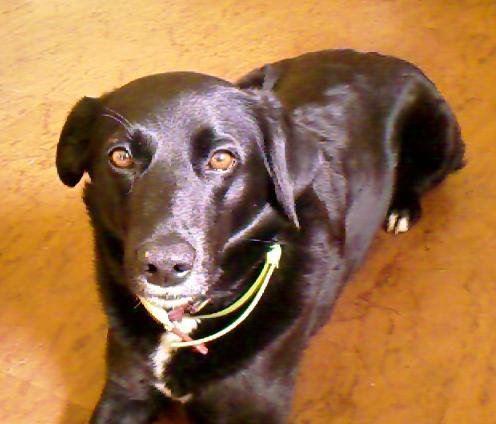
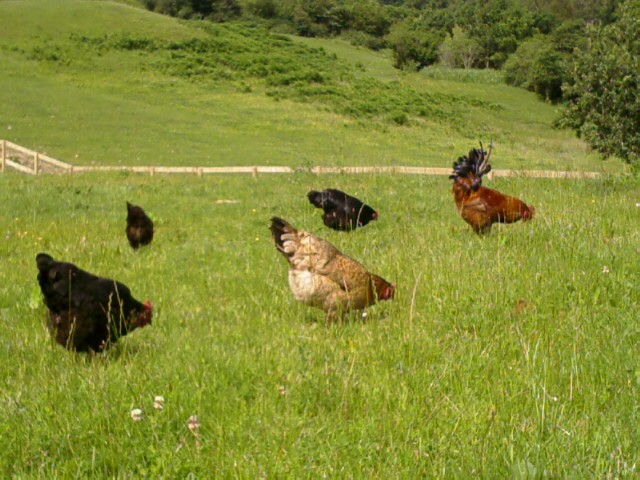
The critter contingent of the farm comprises two dogs, Pip and Tarka (shown here); a pig named Nicolette; a dozen or so horses (Cory, Merlin, Eric, Boswell, Great Glen, Celene...I was already having trouble keeping them straight); and lots of free-roaming chickens. I don’t see any cats yet.
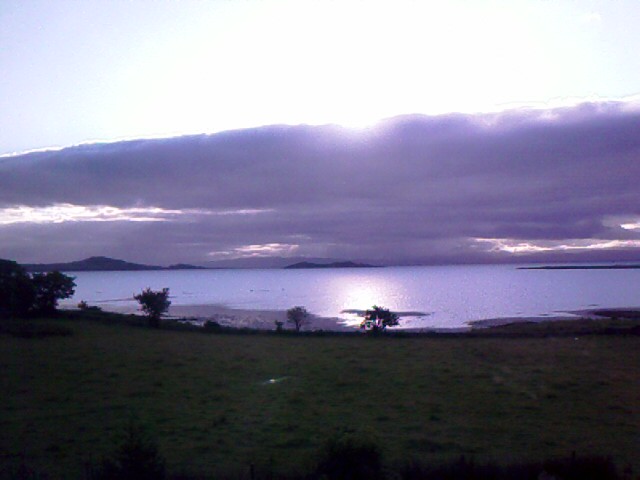
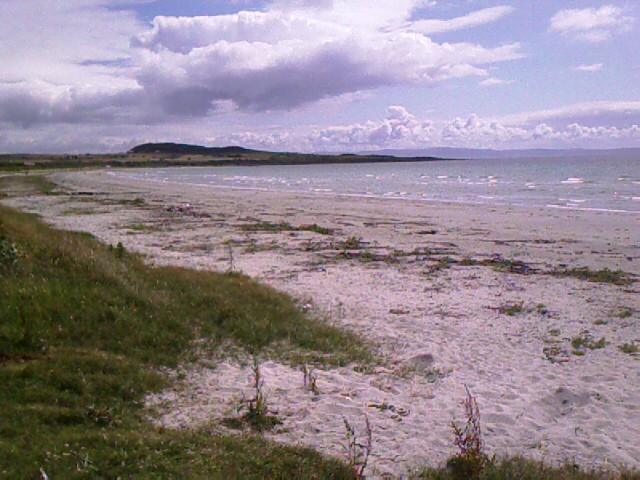
I can’t help but like this family and feel welcome here. They’re all loving, down-to-earth people who happily share tales of when they were extras in Braveheart and Rob Roy (both filmed in the Fort William area), and when they pastured and worked with the horses for these movies. Chris and Siobhan are going to a garden party at The Buck House (Buckingham Palace) this week to celebrate 50 years of The Duke of Edinburgh Award (for youth) work. The family organizes and runs an annual “nothing commercial” music and arts festival, and Gemma is part of the Queen’s birthday celebration by having one of her fashion garments on display in London this week.

They relate all this news with a refreshing matter-of-factness that has no hint of arrogance or name dropping. It’s more an attitude of, “This is what we do every day and, oh, by the way, we have to muck out the stalls and feed the pig this afternoon.”

Things are quiet at the farm right now. They just finished shearing all the sheep, so the big work is done; the long-term WWOOFer who helped left a few days ago. The guest cottages on the property—they run Great Glen Chalets here—are at the beginning of their week-long rent schedule and don’t need any attention.

So my “service” today started with an hour’s trail ride with Siobhan and her friend Jennifer, to exercise the horses and check out part of the property. I was on Cory, a gray, and Jennifer rode Eric, a little Exmoor pony. I’ll be cleaning saddles and bridles all week, and I got through four saddles today to the sound of rain falling on the barn roof.

Nicolette’s daily routine, which I’ll be managing, involves putting slop and grain into whichever pen she’s not in, opening the gate to the one she is in, and getting the hell out of her way as she beelines for the food. This girl is strong enough to knock over a VW bug if it were between her and her breakfast.

Siobhan showed me where to look for chicken eggs among the bales of straw and hay. The chickens have favorite hidey-holes, but Pip and Tarka know of them, too, and Siobhan says the dogs sometimes get an egg breakfast before she does.

The rest of my duty list this week will involve taking care of the house and guest house reservations with Charlie while the family is gone, and helping with the change-out of guest houses on Saturday. I also hope to do some TTEAM and TTouch with the horses and other animals. I’m glad the Siobhan is interested in that opportunity, too.

Sunday, July 09, 2006

Farewell, Jura; Nice Knowin’ Ya, Oban

Slept soundly last night and woke at 4:20am to sunlight blazing into the room. Got up at 7:00 to shower and organize my gear for the afternoon bus ride back to the dock. Today’s itinerary, although full of traveling on two ferries and three buses from 2pm to 9pm, leaves me enough time to walk one of Jura’s beaches in the morning, something I’ve been eager to do all week.


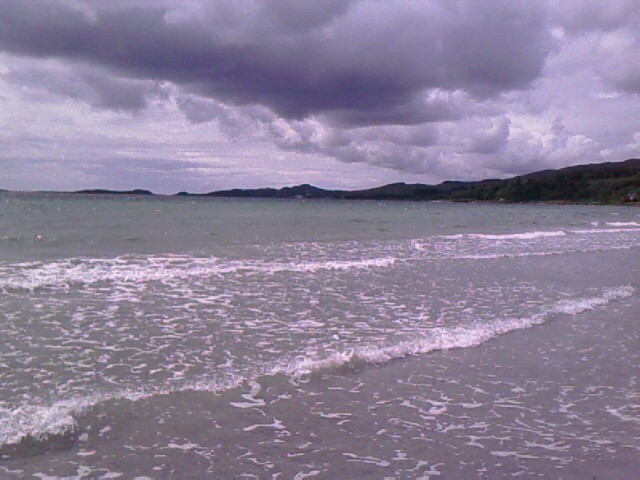
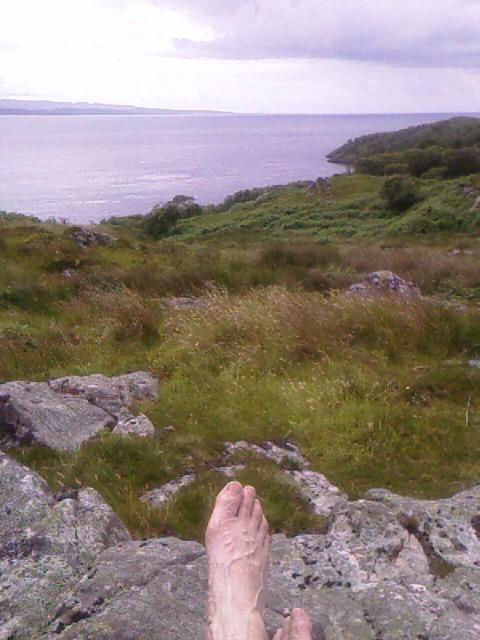
The beach nearest to The Manse is Corran Sands, where I stripped off my shoes and socks, rolled up my trousers, and walked the strand to the sound of lapping waves and wind. The sands here are white, sometimes hard as cement, sometimes soft as flour, sometimes yielding under a heel or toe like foam-rubber accepting weight. I let my bare feet explore all the textures, from hard smooth rocks and crackly dried brown seaweed to the padding of green prickly-looking groundcover. The sky was as gray as the water, but the wind wasn’t so cold that I needed more than a light jacket.

I kept remembering the lyrics from a song by Joni Laurence—“Let it out, and let it in; let it out, and let it in. It’s like breathing.” The waves seemed to keep time with the song, and an hour and a half passed in no time at all while I filmed video with my camera and took in the views.


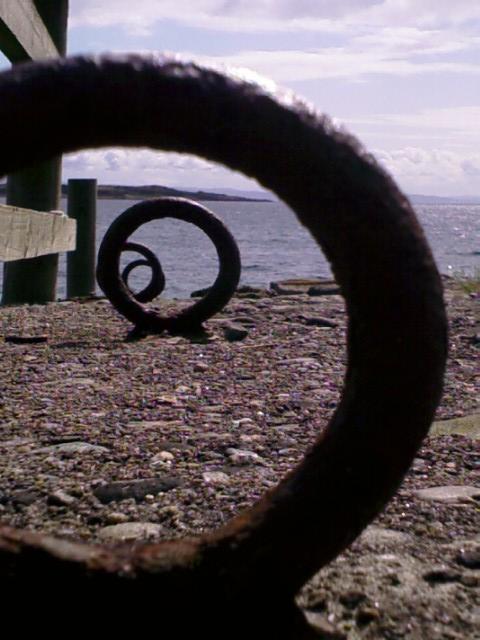
I meandered a lot on the way back, watching the tide at the pier, lying down to get a picture of the islands in the bay through the pier rings. The bicyclists riding by must have thought I was nuts sprawled out on the pier with my cheek to the ground and my camera level with the cement.

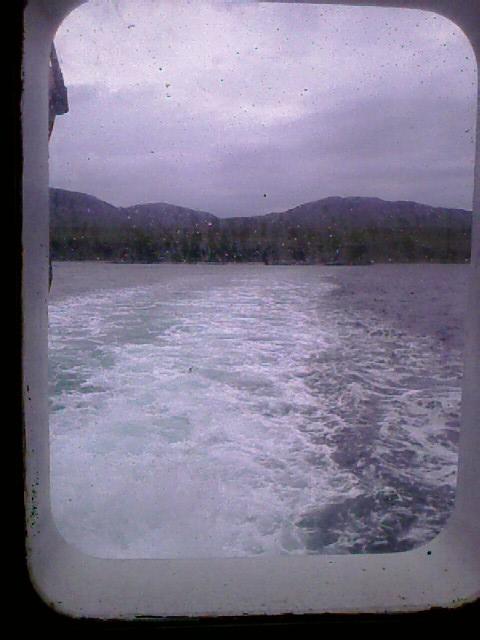
A hugged George and Margaret goodbye, took my last bus ride with Gwen, and the little Eileen Dhiura chugged me back to Islay. Waiting outside a general store for the big ferry, I met a gal named Christine (kres steene eh) from Holland, who was also taking the boat from Islay to Kennecraig, and the same bus as I was from Kennecraig to Inverarary. She had just finished visiting a sister in Jura who works on the Jura House gardens. We passed the time quickly from Islay to Inveraray, talking about our lives, our families, and our respective stays on Jura. She went on to points east, while I hopped the next bus northwest to Oban.

The adage “you get what you pay for” rings true for hostels in Oban. The YHA hostel was booked, so I ended up reserving at an independent hostel a short walk from the bus stop. At a mere £9/nite, it’s serviceable at best, with only a toilet in the WC (the washbasin is in my room), a separate shower (with only a handheld showerhead and a questionable door bolt), and a cramped and cluttered dining room/kitchen combo that’s barely big enough for three people to function in comfortably, yet is expected to serve eight or more at a time.

I’m here for two nights, giving myself a day to transition from Jura before I head off to the WWOOFing week in Fort William on Monday. Besides, travel options on a Sunday are limited, and getting to Fort William from either Jura or Oban would have been near impossible.

I got to Oban around 9pm (still daylight) and bunked my first evening, Saturday, with three 20-something gals from near Inverness who are on a bicycling/surfing holiday. Somehow surfing and Scotland just don’t pair up in my mind, but apparently it’s quite a sport on the west coast. I was astonished that so much gear and clothing and groceries strewn around the room last night could fit into the three small bags they took when they left this morning.

Taking advice from one of the hosts last night, I avoided the morning rush by showering before 7 on Sunday morning and dining before 7:30. No one was going for a ferry (they don’t run that early on Sundays), so the morning rush turned out to be just me and a fellow who works at the hostel until about 8.

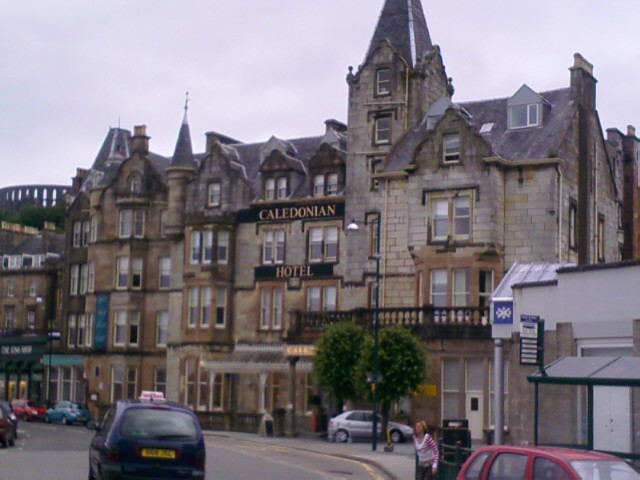
When I got in last night, a worker was handing out tickets to a full “Scottish Show” Saturday and Sunday at McTavish’s Kitchens down the street. (McTavish’s is also affiliated with the hostel.) I passed the restaurant and the Caledonian Hotel last night, and wonder whether this town was one of the evening stops that Mosu and Grandma and I had on our 1978 bus tour through the UK. I specifically remember a Caledonian Hotel on that trip, and an evening of traditional Scottish music and food, including haggis. And I think the bus stopped at Fort William for a tour, which would be a logical place to visit from Oban before circling back south. I’ll need to check my old travel notes to see if they have that detail.

Sunday was lazy and somewhat boring, mainly because Oban itself feels like a ho-hum, in-between place, a tourist-driven port city that ferries folks to the Hebrides, whale watching tours, nature treks, and other water- and island-based activities. Dozens of three-story stone hotels line the waterfront, and one street behind the main drag is elbow-to-elbow row houses, all converted to B&Bs. Although houses surround the city, Oban feels as if it exists solely to move tourists from one place to another with all the efficiency and charm of a trucking company.

After walking around town and laughing over an Oban ambulance, I spent over two hours at midday at the only Internet café in town, posting blogs for June 4-6 and feeling grateful to have this service available on a Sunday. Caught the 2pm showing of Pirates of the Caribbean 2. I was glad to see it, but was confused over several plot points (how are the monkey and the captain still undead?), thought the sword fights went too far over the top, and found the sea creature men hard to swallow. Especially Hammerhead, who looked more like a reject from Dr. Moreau’s lab or a Harry Potter jinx gone awry.

“It was all much more fantasy than the first one.” A woman at the table next to me at The Pancake Place echoed my own thoughts to her companions afterward. “There’s absolutely nothing real about the second movie.”

The film had let out a little before 5, and I was hungry. Pubs and restaurants usually don’t start serving until 6 or so, and nothing looked appealing. The one promising restaurant I found, the Studio tucked out of the way on a hill, was booked all night. So I ordered some takeaway fish and chips from Norie’s, went to the bay, and watched the swans groom themselves on the sparkling water. It was warm with a light breeze. I walked around the streets some more, got to Tesco’s grocery store and a local coffee shop too late to buy dessert (each was closed), and decided on this place on the main street of Oban.

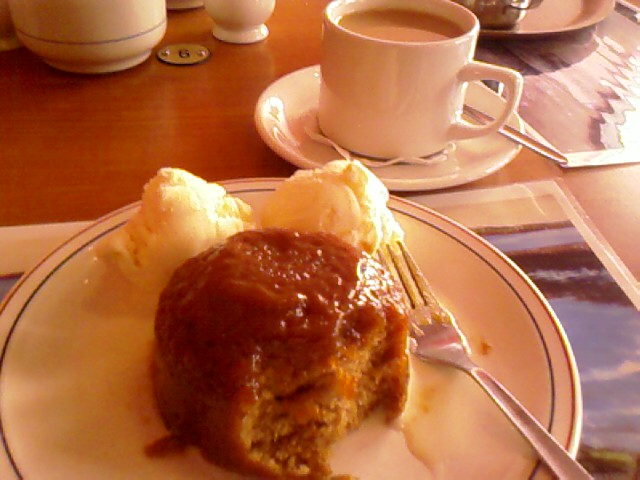
They’ve got good hot sticky toffee pudding here. Sweet, cakey, and moist. The UK can’t make a good cake and call it a cake, but they do make a good cake in the name of pudding.

My mood today has been inward, and although I wasn’t in the mood for much interaction when I got back to the hostel, the evening picked up good energy after I met my new roomies, Donna and Isla.

Donna was bright and youthful. At just nineteen or so, she was staying for a second stint of four days at the hostel to work at the seal recovery center ten miles outside of Oban. She’s from Glasgow, and has a weekend job now at the center, after doing her internship/volunteering there. She bursts with excitement over her new career.

Isla was just coming off a deeply personal woman’s retreat on Mull, and was trying to ease her return to the real world to avoid the spiritual bends. I was feeling the same about my time on Jura, and we had a wonderful sharing of how important it is to stay with the moment, to listen for and heed the signs of our spirits, no matter what.

“Oban doesn’t hold energy,” concluded Isla, who has had the same response to the city as I have. “It leaks away.”

That’s a good way to describe this place—an energy leak, a transition place, a pass-through location. I’m glad to be one of those travelers who are leaving first thing tomorrow morning.

Friday, July 07, 2006

The Paps Are Alive to the Sound of Music

Got up at 6:20am to plan today’s walk to Barnhill and have an earlier breakfast so I could catch the 8:05 bus to its northernmost point, Ardlussa, which is about six miles from Barnhill. Gwen makes only two runs a day during summer, unless by special appointment.

I ducked into a garden for a photo of some lovely prayer flags catching the breeze, then headed north on the narrow lane. I was soon accosted by a handful of very friendly orange cows who probably would have come up for pets on their very wet noses had I not gently edged them away over a ditch so I could pass.


The road to Barnhill is paved, then graveled, before it degenerates for the last four miles to a rugged road that only a 4x4 with new shocks has any business going over. The view is endless grasses in all directions (green at this time of year), with occasional glimpses of deer and the Sound of Jura and the mainland of Scotland beyond. The UK has so much coastal land, yet most of it is completely undeveloped. In America, houses would be crawling over every hillside in an attempt to claim their part of the water view. Certainly that’s what it feels like in California and most of the west coast.

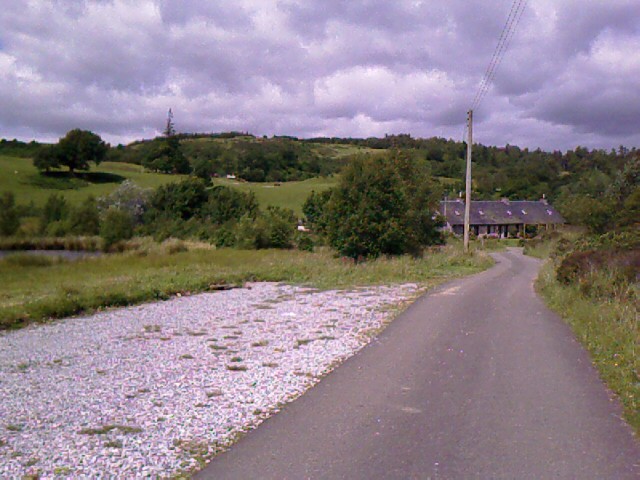
Barnhill is famous for having been George Orwell’s home while he wrote 1984 in the Forties. It’s a pilgrimage site for diehard literary fans, but the place is a private residence and closed to the public, which tends to dampen the effect of bragging rights. It’s the white house in this photo.


For me, going to Barnhill was a chance to try out a long-distance walk—12+ miles in preparation for the coast to coast walk in two weeks. I covered it in 6.5 hours, including 45 minutes for lunch and another 50 dallying for photos, breaks, and rests.

On the way back, I sang—loudly. Only the hills and grasses and heath birds could hear, so I really belted. “Somewhere Over the Rainbow” (while it was raining), “Memories” (loads of ’em), “Magic All Around Me” (which was absolutely true), “This Is the Moment” (and it was)—lots from the repertoire I created while I was learning from Scott. I felt totally happy and in love with life, and the four miles of rocky road went by in just over an hour.

Arrived back at Ardlussa in time for a siesta waiting for the bus, and enjoyed the banter with Gwen and another rider as Gwen delivered milk and bread and forgotten sunglasses to residents and pointed out landmarks such as “her” viewpoint (a section of road that friends cleared of trees so she could enjoy an unobstructed view of Loch Tarbert on her daily runs).

I felt very tired when I got back, so I showered and napped before walking into town for my last supper at the Jura Hotel—leek and potato soup, haddock with cheese, mushrooms, and shrimp, and the Craighouse Special for dessert: toffee ice cream, bananas, butterscotch, and whipped cream. Thoroughly replenished in the fuel department.

I have found that the most deeply affecting parts of this trip are also the ones most difficult to record. Tomorrow I leave Jura, and I feel both sad and glad. I saw the guestbook waiting for me to sign at The Manse and felt tears spring to my eyes—this has been the best stay of the trip so far. I’ve felt fully received as family at The Manse. Being able to learn about the island’s unique culture from Ani, to sit with her friends over tea, to share personal time (and laundry duties) with my B&B hosts, and to get out in nature in ways I never have before—they have all created an experience that surpasses all others to date.

As fearful as I was to come to a place where there’s “nothing to do and nowhere to go,” I’ve been rewarded for following my intuition. I’ve cracked open parts of me that I once barely sensed were there. To attempt to put them into words is as pointless as it is difficult. This has been a deeply internal process, at a subconscious level, to grant me a new kind of self-poise and balance.

I discovered solitude and its joys. Clarity and its patient ways. Resiliency and its reservoir of optimism that keeps affirming my body, my mind, my spirit’s ability to meet each day, each challenge as it comes.

Today it doesn’t matter if I’m alone or with other people. I am as I am, walking this planet along with millions of others who are here to experience this world.

Until now, I didn’t ever feel as if I truly owned my life. I get that now. I have infinite choice available to me, all of it good, all of it okay, all of it safe.

What will I choose next for this life that is mine?

Thursday, July 06, 2006

Ghosts, Gardens, and Guests

Slept poorly last night thanks to a headache that moved from the left side of my forehead to across my skullcap. I think it’s from the exertion in the heat yesterday. This body has never taken well to the high temperature + exercise combo deal, and a headache and a day’s recovery time aren’t unusual. I need to get back to drinking a liter of water a day, instead of all these liters of tea.

I put a load of laundry into Margaret’s washer this morning, and have spent the past hour reading in bed. National Geographic, Aug ’05 edition. About alternative energy sources, cave paintings in Indonesia, Brazil’s wet time of year.

The hand soap here is from Avon and scented as Jasmine/Exotic Rose. It smells like Sandra and the comforts of home. I feel loved every time I use it.

I don’t quite tiptoe around rooms, but I don’t like to make a lot of noise in the B&Bs I stay in. Even ringing the bell for attention at the Jura Hotel pub took me several times to feel comfortable about. This is old stuff, outmoded ways of living in which I’m supposed to be quiet, not a bother, not intrusive on my host’s privacy. At all the B&Bs I’ve visited so far, I’ve been the sole guest or eating breakfast alone. I don’t like that form of solitude—I feel self-conscious being the only patron, although I do like having the bathroom to myself at any time of day. George and Margaret tell me that having only one guest for a few nights has been a relief after being solidly booked for the past week or so, which sets my mind at ease. I’m less worried about interrupting their routine as I tromp in and out all day long.

George and Margaret have invited me to join them to hear a singing group that comes once a year to Jura. They’re performing at noon at the Jura House gardens, a place I wanted to visit but hadn’t quite figured out how to get to miles down the road. I feel like one of the family, being included in their outing this way.


In the meantime, I spent a somewhat rainy morning visiting Keils cemetery, about half a mile from The Manse. It has an older and newer section, with a famous marker of the purportedly oldest person on the island buried there—a 180-year-old man who died in 1645! At the opposite end of this spectrum is the body of a fetus, buried here a few years ago by the child’s unwed young mother. George officiated that one; I could hear the grief in his voice as he talked of that ceremony.

In the older part of the cemetery, I came upon a large, fading tombstone that read, “In Memory of Jenny, daughter of John McPhail Tenant in Knockrom, who died the 8 August 1835 aged 3 years & 1 month.” A smaller stone in front of it said, “MARION, 11th Oct 1907.”

I stood at Jenny’s grave and suddenly felt weak-kneed and nauseated. I sat down and bile rose in my throat. A golden-haired girl, died of fever. A story comes. Her work, undone, to ride the sea lions and seals in the bay. She flings her arms around its neck, dives and collects fish and shells. They rise together, she comes up laughing and dry. They swim to the small islands in the bay, she astride the seal’s back. She collects pebbles, strings them together, tosses them into the air. They return to the ground as jeweled necklaces. She returns and gives them to her father so he can buy his own croft and no longer be a tenant.

I mentally calculated—3 years, 1 month old. Today could very well have been her birthday, July 6, 1832, 178 years ago. Happy Birthday, Jenny.

I stopped at Jura’s parish church to look over the island’s photo gallery, hoping to find some information on Jenny’s family. Alas, the oldest pictures date back only to the 1850s. One shows the cemetery as it looked around Jenny’s era. There’s another of the McPhails of Lealt—the wedding of Angus McPhail and Mary McColl, 1854; they had seven children, who all moved away from Jura as adults. I wonder at their relationship to John McPhail and his young daughter whose bones lie beneath that stone.


Went to the wee beach that’s across from The Manse and found some interesting shells and stones and the white husk of a crab that’s barely half an inch long. It kept blowing off my hand when I tried to photograph it.

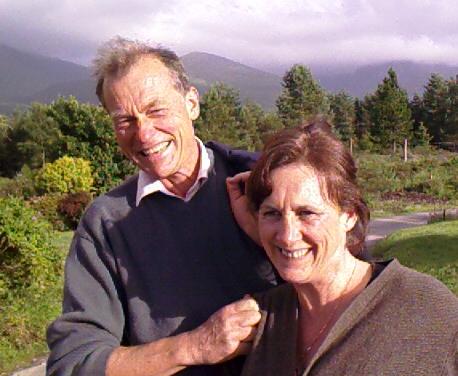
The visit to the Jura House with George and Margaret (shown here in the garden) was like entering a little Eden under overcast skies. It has a wonderful walled garden that’s overgrown and lush—and, amazingly, tended by only two people. They sell many plants and seeds there. It was like the Lost Gardens of Heligan all stuffed into a few acres. We walked quite a ways through a shaded wood to reach the heart of the garden and the famed “tea tent” where they sell tea and homemade baked goods and gifts during summer.

We went to hear a “harmony” concert—a group of a capella singers who sing songs in Gaelic and African and other languages. The setting was exquisite. We were at a wooden table beside a seven-foot tall flowering plant whose sweet fragrance kept filling my nose as the voices filled my ears. Little birds—siskins, robins, and others—darted among the branches and took scone crumbs from my fingers in midflight. Bees buzzed the flowers. I felt like we were listening to the beginning of Will Vinton’s Mountain Music, when all the music that people make is in harmony with birdsong and forest growth.

I was getting tired of eating only at the Jura Hotel, so when we got back, I went into town to buy dinner at the Spar, but found little to select from for premade meals. They heated up a frozen cheese and ham toastie for me, and I added an apple and a yogurt and picnicked on a cement wall overlooking the tiny harbor outside the store.

Took the mile+ walk back to the B&B for the seventh time, at least, since coming here, and I am still seeing new things all the time. The swans were closer on the beaches, their little gray cygnets poking their beaks into sand beneath the algae and kelp shallows. I missed the otters again this evening at the river near The Manse; I think I came home too late.

A new guest arrived at The Manse tonight—George had said someone was coming on Thursday—and to my surprise I recognized the voice booming from the room next to mine. It was Geoff, the biologist I met at the Inveraray hostel.

When I heard him talking to George, I was pleased; then I caught myself circling my room, unsettled, wondering how to announce my presence, wishing my hair were clean and tidy. I laughed at myself. Calmed down. Forgot about the hair. Finished gathering my freshly brewed cup of tea and Perry’s computer parts, which I was already collecting to take downstairs, then headed out the door, deciding then and there to stop to say hello, instead of scampering by, trying not to get noticed and hoping I would be anyway.

He was surprised to see me. George left us to chat—me leaning against the banister with my tea, Geoff in his room, leaning back against the wall. We exchanged stories about getting here, and he asked if I wanted a lift into town for dinner at the hotel. I declined, having already eaten and being ready to work on organizing my journals for the first time in a week. I felt fine with this choice, knowing it was right for me, and was actually glad I had no energy about either staying or going in his company. He’s here on more hunts for red- and black-necked divers, leaving tomorrow after he checks out his 5k square plot of land near the ferry dock.

Right now it’s 8pm and the sky is still very bright. Even when I wake at 2:30am, the sky is so light that I can’t see stars. A dull orange glow in the east is Glasgow—sheesh, it’s miles and miles away. I’ve watched early morning sunrises glow pink on the water.

Both sky and water are gray right now. The midges have been OK today—the two sprays I’ve been using have kept them from biting. The product of choice from everyone I’ve asked is Avon’s Skin So Soft moisturizer. It really works.

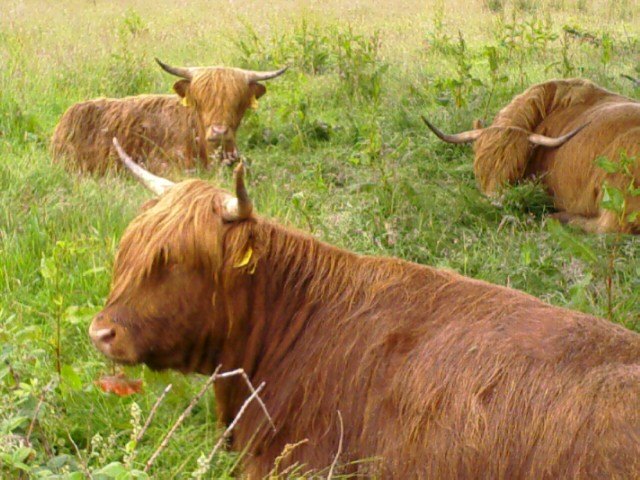
The highland cows are moving around in the field tonight. They’re here for grazing only—the manse rents the field out. One of the cows is very pregnant, but Margaret says they’re not sure when she’ll pop. She was bred twice, and by her size should already be due. But if the calf isn’t born soon, it will be a September baby, which would coincide with the timing of the second breeding attempt.

I like everyone I’ve met on the island so far. This is a place where people wave from their cars as they pass me on the road, and almost everyone smiles and says hello when I approach. Even the grocer at the Spar has been amenable and gruffly humorous.

As Christine said over tea in her kitchen two days ago: “It all depends on what you put out to the world. You get it back.”

I like what I’ve been getting back here on Jura.