Saturday, June 03, 2006

TTEAM Week, and Dinner with a Lord and Lady


The TTEAM training was held by Edie Jane Eaton (leftmost in this photo), a Tellington Touch trainer whom I've had the good fortune to learn from twice before for the TTOUCH companion animal work. Our group has about 15 women (why is it that men don't get involved with this challenging, peaceful, intuitive work?). TTEAM is equine based, although many of the principles transfer to work with other animals.

We spent the week alternating classroom time, demo time, and hands-on time with the many horses and two knee-high donkeys on the farm.

This course, I didn't take as many notes as I have in the past. My learning energy was more tuned to taking things in without trying extra hard to study and perfect them. As this is my fifth TT-related training, I was feeling anchored in the basics, and just soaked in the new stuff as introduction that I can build on later.


It feels different to not stress out as a student, not try to catch every word and to be perfect in everything from the get-go. I like this style of learning. I would have made a good Socratic student, I think. Certainly this trip is its own opportunity for peripatetic learning.

Sunny, sunny all week. Got a farmer's tan, plus a little bit of burn on my shoulders and neck when I jumped at the chance to wear a tank top for the first time in what feels like a year. Am glad I changed my TT training session from the week before to this one. The week before it was rain, rain, rain for all five days. They could barely go outside to do anything. This week has been sun, sun, sun, and everyone is in a very good mood.
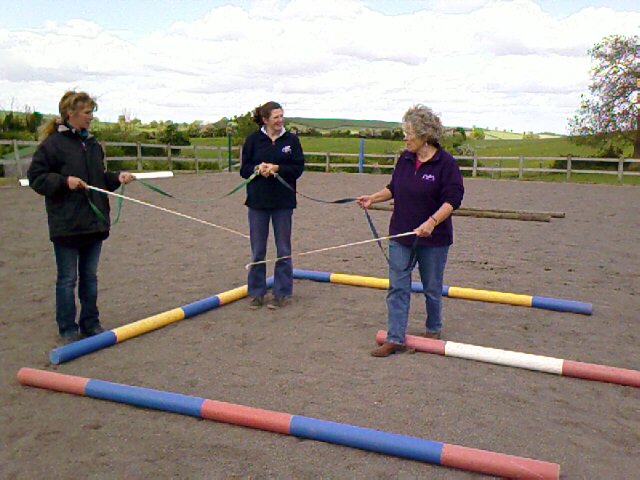

Aside from actually working with the animals, the best parts of the training, as usual, were the hands-on demos, where we got to pair off and play the parts of the horses and people as we practiced things like quick-release knots, special leading and tying techniques with ropes and wands, and how pressure on bridles work.

For the latter, Edie Jane had each of us wear a bridle on our head and hold the bit in our hands while someone else worked the reins. I was astonished that the pressure was so much on the top of the head instead of the bit. Anyone watching from the outside would have thought we were into some bizarre form of S&M.


We also got some chances to ride before, during, and after we did TTouches on the horses. TTEAM helps horses become balanced emotionally, physically, and mentally, so they're more prepared to meet situations with less fear. Part of the work can be teaching the horse to be ridden without a bridle. Riders use a bit of stiff rope looped around the horse's neck at the chest to steer and halt the horse.

A few of the students had brought their own animals to work with. I was surprised at how little time it took to get the horses willing and able to respond to this kind of riding and direction. The horses loved the freedom of movement, and everything was easy and gentle and step-by-step for training both the animal and people in how to go bridleless.


As usual at these sessions, everyone I met there was delightful to get to know, and we all bonded in various ways over the five days. Several women invited me to drop in on them if my travels take me to their regions of the UK. Even if I don't make it to their areas, I feel happy that I actually know people here, and that could call on them for help or information in a pinch.

My plans for next week are to be in Cornwall for seven days. I booked a cabin on the Lizard Peninsula, which both Julie and Erica, TTEAM participants, highly recommended as The Place To Go in Cornwall. I used the Ramblers listing book that Norman loaned me to find a self-catering cabin in Mullion, which, it turns out, isn't very far from where Julie lives.

Friday night I had dinner with David and Lisa at The Butchers Arms. I started with drinks with a few of the TTEAM gals at the back grassy area of the pub, where we nearly tipped the picnic bench over when everyone on one side of the table got up at the same time and we on the other side were still sitting down. Drinks slid, we all screeched, and we barely saved the whole table from going over backwards. We were still laughing minutes afterward.


David and Lisa, self-proclaimed "Lord and Lady of Farmborough," treated me to supper at The Butchers Arms. We laughed and shared stories of Londoners with wacky haircuts who charge for photos, US travel and Los Angeles, American vs. British English, pets and horses, and Halloween costumes--especially the one Lisa once made from a bin liner (trash bag) that, she claims, is the foundation of every good halloween costume.

David and Lisa live in Farmborough which, yes, is large enough to have a small grocer that's also the post office. They're only a block or so from the pub, and they walked me to my B&B with their new yellow labrador puppy, Reggie, who made a point of checking every doggie mail stop on the way.


Our final TTEAM dinner was Saturday at The Hunters Rest. These evenings are always bittersweet for me--acknowledging new friends and a great week, and knowing we're going to say goodbye the next day. Learned some new Sudoku tricks from Edie Jane by playing the game on Perry over dessert, which was fun.

Our TTEAM week ended on Sunday, and Julie (the one being led through the labyrinth in the photo above) offered to drive me to Cornwall and have me stay overnight at her farm, then to take me to my cabin the next day. She's shearing alpacas on Monday, and I get to help.

Monday, May 29, 2006

Walking to Farmborough


My lodging for this week is like a little apartment set off from the main house, and is the first "en suite" place I've stayed at--bathroom in the room, instead of somewhere down a hall. Come to think of it, it's the first lodging that hasn't been up three flights of stairs...a welcome change after hauling my full pack for 5+ miles today. My legs are going to rival those of Hercules by the time I get done with this trip.


Dinner tonight is per force very light--an apricot Cliff bar and lapsong suchong tea, since the one pub in this hamlet is closed for the holiday and I haven't yet found the local grocer (presuming there is one...this place is pretty small). The view from my B&B window overlooks pasture and the town.

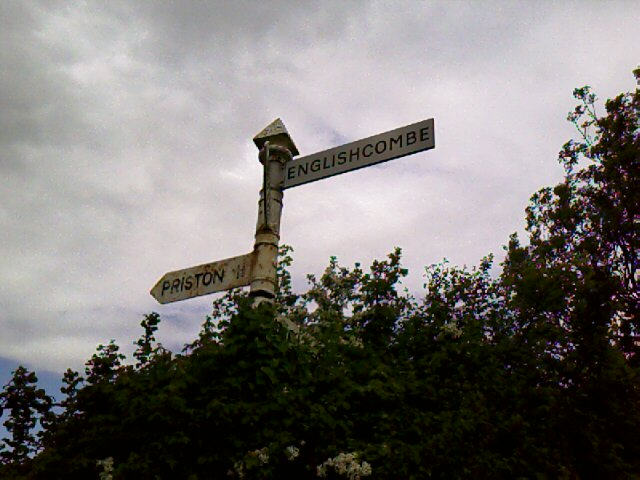
I've spent much of the day getting here by bus from the Bath train station to a spot at the edge of town called South Down, then walking about 5 miles through Englishcombe and Priston to Farmborough. Priston had a pub, where I ate a big ploughman's lunch (having also scarfed down a large traditional English breakfast at the YMCA in Bath in preparation for the walk).


I'm finding that a village, while on a map, doesn't necessarily mean anything more than a few houses. At Englishcombe, a tall gray-haired, ponytailed fellow was in the driveway of his house at a crossroads. When I asked him for directions to the village center, he grinned and said "This is it." We chatted and immediately found common ground--we're both doing the Coast to Coast walk: he in June and I in July. He had retired last year and done the entire Southwest Coast walk--all 1200 miles of it--in spates. Took him 4 months of walking.

At the Ring o' Bells pub in Priston, I met a young family from Farmborough--David, Lisa, and their daughter Amelia--who live near Tilley Farm, where I'll be on the TTEAM training this week. They'd biked down the two miles from Farmborough to take advantage of the mostly rainless, sometimes sunny, primarily fair weather today. They've invited me to dinner at the local pub, The Butchers Arms, sometime this week. We exchanged phone numbers so we can connect.


Walking the backroads of Britain offers lovely views in between miles and miles of hedgerows that are too tall to see over, even from a car. The breaks in the rows indicate either a crossroads, a gate for farm equipment to mow the fields, or an entrance to a farm or animal field.


Country roads here are very narrow, no painted lines to mark them as two lanes. They seem built wide enough for one car, yet somehow two cars are always able to pass. Even a bus and a lorry can do it...very very carefully, and not without some nasty-sounding scrapes from the flail-cut blackberry stubs in the hedgerows.


When I can't duck into a bit of a hollow on side of the road, I crush into the hedgerow to avoid getting hit. Most drivers know to be on the lookout for walkers and opposing traffic, though, and they give me lots of space.

Sunday, May 28, 2006

Playing Tourist in Bath


Spent much of today, Sunday, with Sarah, a gal from Melbourne, Australia, who's living and working in London and takes weekend trips all over UK and Europe. We did the "touristy" things today, which is much more fun with a friend.


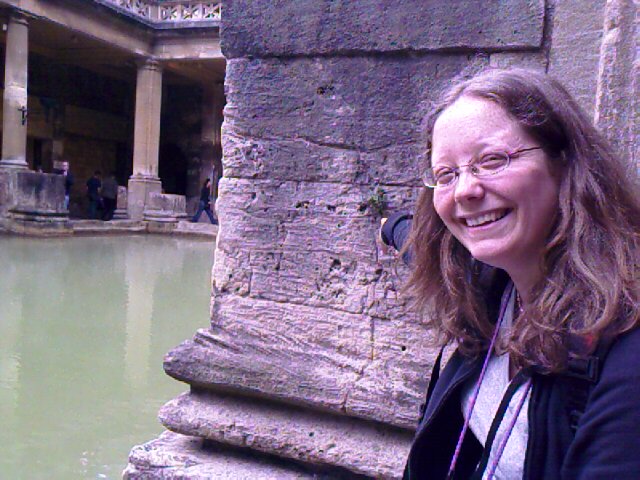
These included the Roman Bath House self-guided tour, which was much better than the guided tour they offered ten years ago. They've got numbered stations that are keyed to audio descriptions of what you're looking at. The sound effects of water and background voices and music really makes it easy to picture people using the spa in the old days. The mosaics they've recovered are quite lovely, although there's very little of it on display. I don't know if that's because there's so little available, or if they just didn't put it all out. The water's green with algae because the building has no roof and it's exposed to the sun. It's quite a pretty green, however, and the water is very warm.

After a lunch near the Royal Theatre in which we shared a toffee-drenched cake with clotted cream, we also took the Costume Museum self-guided tour (more interesting than I expected, and lots of giggles trying on the corsets).

We walked to Royal Crescent and then toured House #1 on the Crescent, which I didn't think was worth the £5 entrance fee.

Flagging by now, we took a sustenance break near the abbey in a lower courtyard off of York St. It was 5:30 by now, and we were the last diners to be seated. We opted for aubergine and tomato soup instead of tea and scones.

We parted for the rest of the day, whereupon I headed for the town's best Internet cafe, the one nearest the train depot. The workers here really know their internet stuff, and went an extra mile to help me load the applications I needed onto Perry. I checked a few touring websites including www.goodleaf.co.uk, which does tree climbing on the Isle of Wight, and went online and found my Sudoku unlock code--yay, I can play again! My final task was to walk around the block to scope out the bus stop I need to go to on Monday.

I took a supper of my picnic leftovers in the Y's dining room with Sarah. We split my last two Minerva chocolates, including the rose violet one. It was like eating a sugared sachet; half a piece was plenty.


Did up my scrapbook through Bath--happy to get that done. I still need to blog. I'm feeling the desire to do that, and looking forward to it this week.

I have discovered that I'm supposed to spend about a week in one place along the southern coast in Cornwall. Need to find the lodging for that--a cabin or something to let.

I'm feeling a little worried about tomorrow's walk, and aware after talking with Sarah that it's time for me to let go of inadequacies about how I choose to travel and live on the road. I am ready to release comparisons to my mom and her love for venues that, frankly, bore my spirit as much as they feed hers. I need to follow my own intuition and guidance about what is right for me. Hmmm. Scare's gone for now.

Saturday, May 27, 2006

Inner Workings

Up today at 6:30, qi gong, shower, and breakfast--finally--of eggs, ham, hash browns, fried toast, stewed tomatoes. Feeling very fortified.

I packed up my stuff to move to the 14-girl dorm room for the weekend. Seven bunk beds; I snagged the bottom bunk in a corner near the window. I wonder whether I'll be the den mother of the group. There are older-than-I women at the Y, but they seem to be in singles rooms.

I walked most of the morning after breakfast, heading for the bus station and taking a wrong turn in the area of North Bridge. Ended up south of the Avon in Widcombe. I made my way back mostly by following my nose. Checked into which bus to take on Monday to start my walk to Farmborough. Am hoping for dry weather for the walk. And that my back and feet hold up carrying all my gear.

I bought a semi-autobiographical book about Audrey Hepburn last night (a slim volume full of her own quotes), and found another reference to her today in a thrift shop--a VHS set of her movies. I've been open to guidance on life intentions. Not clear what to make of these signs right now.

Walked toward the Crescent again today on the way to the Widcombe open artists' studios and wandered in and out of a few shops, especially art galleries. So many marvelous paintings and statues and cards and wall hangings to buy. So little space to put them in now.

I feel sad, a little, to not be buying art things--nowhere to put them but into storage now that Whimsor's out of my life. And happy to not be acquiring more stuff. And growing more aware that I'm becoming less attached to the stuff I still have at home. And feeling curious about how we humans are always creating more stuff to put onto store shelves.

Stuff, stuff, stuff. All of this stuff we create will go somewhere else on the planet--onto people's walls and floors and tabletops, into galleries, to thrift stores, antique stores, museums perhaps, into a landfill at some time in the future. Passed down through wills or family lines or the need to pawn for cash. Maybe even be assessed at some remake of the Antique Road Show, Year 2237.

Stuff. Lots of it. We build, craft, paint, dismantle, rearrange, regurgitate, recycle, refresh all in the natural progression of creating, marketing, selling, taking home, dragging along, moving along.

How would this planet be different if people went to each other and asked to have something they liked or needed made, instead of people making lots of something and then trying to convince others why they should have it?

Would "industry" gain a deeper meaing of being fully absorbed in the act of creation, in being more present to that which we are making because we personally know the one who will use it? Would love be poured more readily into the product? Would we pause a bit longer when the work was done, gain more free time to live instead of work, to be with each other, to be still without needing to explain why we are idle in between bouts of production?

Factories could still produce, but by fulfilling demand and special orders, not by glutting the world with supply, and then trying to generate demand for the overproduction. Would such an economy collapse or thrive? Would it bring social imbalance or greater connection? Would it feed a sense of abundance or continue the sense of scarcity that underlies our current economic choices?

How did I get off on that topic? A clarity for myself: I don't want to produce stuff for a living. I don't want to create art in a form that sits on a shelf or that hangs on a wall. Let others who have such skill create them. I would like to make art that people can walk around, be organically part of, that lives lightly on the planet. That the planet can take back easily if needed.

I am sitting and writing all this right now at the Bath Ales House for lunch, which may be coming shortly. Meals arrive very leisurely in a pub. Good, once you get to know it that way. Not so good if you're on a deadline.

It's funny. I am here in Bath and could, despite the many accents and uniquely aged buildings around me, be just about anywhere else in the world, the scenes are so universal.

Small parties of people cluster around tables not two feet round. Two mates, twenty- or thirty-somethings, dressed in jeans and T-shirts work on pints of beer. A group of five chatters in French in a corner at my right, laughing, interrupting each other, sharing the minutiae of their lives.

A server walks by, and the floorboards give beneath the wooden stool I sit on. How many feet have these planks yielded to over the years? To what myriad collection of heels and soles and body weights?

A couple in their 20s sits at their small round table at my left. She is blonde, in jeans and aqua jacket and pumps, a foot propped on the rung of the empty stool next to her at the table. He leans onto the tabletop as they talk. He is brunette, in black jeans, soiled trainers, an untucked shirt with rolled up sleeves and a hair style that stands up in a cock's crown of six spikes from nape to forehead. A gal at the Y said it takes lots of gel to create that effect.

Now that makes sense to me--body art, turning your body into a canvas with hair gel or tattoo paint. I suppose we all do this with our wardrobes--turn our bodies into a canvas each time we dress. Saw a woman my first day here who was a splash of red and oranges and hot pink and chartreuse combined in garishly mismatched patterns of jacket, shirt, skirt, leggings, and a shock of red hair, all under an umbrella of equally brilliant hues and pattern. She pulled it off. I would look like a dork.

My travels are not about touring. I came to Britain to reclaim my vision. I need a place to sit and think. A comfortable place, with food and bed and room to write in and spaces to walk in. A place without the obligation to tour, to shop, to be out, to be among people. Even the effort of meeting people feels like a chore today. Meeting people, being outgoing is not my life's work right now. I came here to meet with my Self. Or, rather, my Self called me here to meet.

Napped back at my room after a game attempt to hook into the local music scene at the Orange Spiegaltent this afternoon. Left after one song. Couldn't take the amps, and the brass was too shrill in the tiny space. Trying too much to like what other folks seem to like. Trying it on and finding it doesn't fit.

Remembering A. Hepburn's words, "Know who you are and who you are not." right now, I would add, "Be OK with both of them."

Friday, May 26, 2006

Belly Up to the Dancefloor

Started slow today, and got into town around 11 to search for a Vodafone store. Bought a pair of handmade crystal earrings at a shop behind the abbey. Their dangle of multicolors goes nicely with the primarily black clothing I've brought.

Vodafone consumed 2 hrs of tech support time on their in-store "white phone" trying to get MMS working on Perry (never did, fully) and find out why it cost me £8 to check my e-mail using GPRS via my cellphone (need to not download files/content--headers only). The clerk took pity on me and credited me £10 on my acct, although he was just as baffled as I by the MMS problems.

Sitting now at the Hands Tea House on York St. behind the abbey, working down an early lunch of chunky Irish stew of lamb, carrots, baby corn cobs, peas, cauliflower, and barley. I'm missing the big breakfasts I used to get at B&Bs. All this walking makes me hungrier and the cereal and yogurt at the Y just doesn't cut it. It's been two weeks without the egg breakfasts I usually make for myself at home, and I'm missing them.

I have been in a watching mood the past few days, sort of looking for company and just as glad not to have it. A quiet, grieving, inward sort of time, although I don't feel particularly sad about anything. Pensive is closer. Travel puts a lot in and takes a lot out at the same time.


Unlike London, Bath looks the same wherever I go--same basic building style, same basic building materials, same basic cream-colored stone rising like a tide up the hills around the city's core. It's both comforting in its consistency and tedious in its sameness. Only ground floor shopfronts and signage and the new Bath Spa show many 20th-century influences. Time may be frozen in buildings, but definitely not in the people. I loved watching this gal in skirt and heels mop her storefront, and the younger set favor zipping around in micro Mini-Coopers, which are about the size of a roller skate.

I have inadvertently come to Bath at the height of a three-week International Music Festival (mostly chamber music) and the annual Fringe Festival of local arts and music.

Tonight was opening night for the Fringe Festival. Before the first event, I took a table in front of a closed pizzaria in the abbey courtyard and had a dinner of picnic parts I bought today at a French open-air market that had come in for the festival weekend. It took some time to dredge up enough of my weak French to order fruit from one stall, slices of meat from another, and ask about the best cheese to include from a third. The olive vendor had bushels of olives that shoppers could sample. Bought a few of the really hot ones and some with garlic.

I piece-mealed together, literally, an apricot and cherries, 3 slices of salami, soft camembert-like cheese, baguette, cookies, and olives. Shared the bread with a plucky pigeon that ate from my hand and then flapped up to sit on my finger after I'd put it all away. "What, no more?" it was saying. Its feet felt cold on my skin, and the bird was heavier than it looked.

I missed the Fringe's wine and art tour, which was shepherded from one venue to the next by a pudgy fellow who warned his wine-glass-and-yellow-printed-program-toting paying guests to "not be contaminated" by people who weren't part of their group. He was looking straight at me when he said it, for I had followed them into the Podium shopping mall to find out what was going on with a mass of 50 people all crossing the street at the same time.

Actually, I had followed the pink hairdo of a drag queen and his escort. The companion, of average height, was gray haired, portly, dapperly dressed in slacks and suit coat. He took the arm of his much-taller companion, who was replete in 3" patent-leather black stilettos, black fishnet stockings whose seam was crooked at the right ankle, white midthigh skirt, 3/4-length white fur coat with black flecks and wide fold down collar, and (I'm not making this up) a cotton-candy pink pageboy wig.

When they stopped in a department-store doorway to refit the stilettos, I paused to comment in sympathy, "A real pain, those are, aren't they?"

The drag-queen was leaning a hand on her friend's shoulder for balance and working the heel of the stiletto. "Yes," she grunted. "They are." Pale makeup was slathered over a pocked masculine face.

"Have you been at a Fringe Festival opening party?" I asked.

She straightened, readjusted her fur coat, and reclaimed her wine glass from her escort. "We're part of the wine tour, darling," she said in a throaty, lovely upper-crust Brit accent while looking down at me from her stiletto-amped height. "You should come next time."

They rejoined their posh tour while I headed for the festival's main stage.


A set of spiraling stone steps beyond Pultaney Bridge led me to the riverside walk of Avon River and to the main venue of the Fringe Festival--the Orange Speigeltent set up on the cricket field. I arrived late and walked in without a ticket.


The place was standing room only around small tables that circled a stage. A troupe of belly dancers was doing their lovely fluid dance to a blend of Arabian/Indian/Mediterranean music. (So the program said--I can't tell one style from another, let alone recognize a mix of it.)

I took an empty seat at a front table with two 50+ ladies from Bath and Bradford-on-Avon, 2 miles away. It was too noisy to talk even during the break because they had piped-in music for guests to dance to. The floor was filling up with girls and young women, mostly in pairs of friends. My feet wanted to move, but the old gals at my table didn't want to join me. I finally plucked up the courage to get onto the dance floor, hanging around the edge with a few other women who were also dancing alone and inviting them to interact with some success. I felt pretty wooden at first, trying not to compare myself to others, or worse, to those lovely skilled belly dancers whose every movement is sinuousness itself.


The rest of the evening involved single belly dancers. One of them was in her forties, at least, and moved like an 18-year-old. By the enthusiastic reception of the players and other dancers, she was the teacher of the bunch.

I loved watching the energy of the music flow through the dancers--spine, belly, shoulders, hips, arms, wrists, fingers, neck, feet. It was luscious and awesome and inspiring. Ah, to be so free and fluid in my own body. It takes me much effort to tap it unselfconsciously.

Thursday, May 25, 2006

Bath Bonus—Song Sung Abbey


Thursday, May 25. Sitting at 6:37p inside the abbey waiting for the sung eucharist of Ascension Day. Not that I've gone catholic or anything...I want to experience a cathedral in the purpose it was built for.

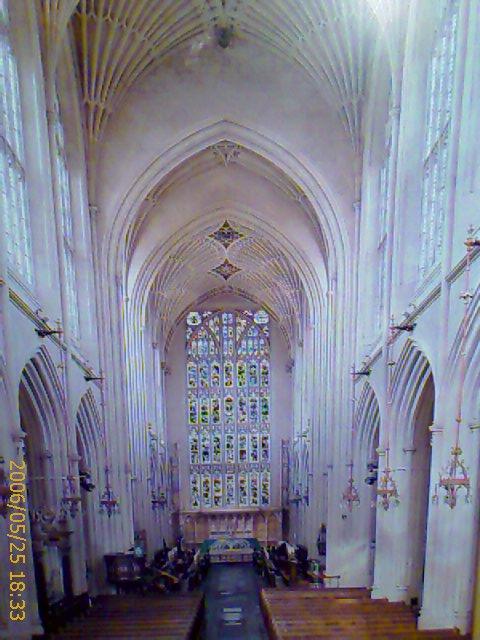
The building is hushed, yet every sound is magnified in the vaulted space. The creak of a pew and the wooden boards beneath them. The jangle of keys. The elderly women's whispered agreements on where to sit. A cough. Shoes scuffing and heels slapping on the granite and marble tombstones that form the flooring. The sliding shush of fabric as a jacket is removed.

The clear strains of yet another piper in the courtyard drift in through the open side doors at the back of the church. Earlier I had walked the floor and read the tombstones--one of a mother and daughter who died 40 years apart, each aged in their 80s, in the 1800s--and heard the tune of "Somewhere Over the Rainbow" from the single flute.

The dark, wood pews are covered in a pad of red carpet, and kneeling cushions--blocks of red vinyl and fabric--hang on brass rings and hooks in front of us on the pews ahead.

The walls of the corridors that flank the abbey are lined from the floor to about 8 feet up with marble tomb markers. Elegant, elaborate, simple, carved, uncarved. No matter. Each one is a way to commemorate and notice that someone lived and died. Loved. Was loved. Lived, worked, sometimes served the community or a regiment, sometimes created something famous, sometimes did nothing more notable than be a beloved spouse or son or daughter.

The next 12 to 20 feet above rises with arched, stained glass depictions of biblical scenes--picture books put to glass. One window shows myriad coats of arms, and carvings of coats of arms decorate the junctions in the vaulted ceiling.

It is easy to feel somber in a place that is so redolent with death and reminders of the brevity of life. Yet each time the choir sings and the pipe organ plays during the service, the abbey seems to come alive from the inside out.

The deep bass vibrates through my feet in the floorboards. The midtones reverberate from the walls. The choir's clear notes slide up and over in rolls of music that lift to the rafters and fold back to us like audible light.

Gone are morbid thoughts of people long buried, with granite markers their only memory. In their place is a thrill of living, of breathing, of hearing song that flows out and returns with tenfold force. My hands and heart open in prayer, and the abbey sends it gloriously on.

Creamy Stone and Clotted Cream

Ate breakfast at the Y's cafeteria (more cereal and toast, but I could supplement with yogurt bought at the counter) while I re-input contacts after a last-ditch, hard-restart on Perry (my pocket PC) last night. I needed to return it to the proper default settings for use in the UK with Vodafone. What a pain in the bum to take care of this. I only hope I managed to record all the right info on paper so I can reinstate it. And that I can reinstall my important supplemental programs--Sudoku and my keyboard and mouse software.

My hunt for Internet access began at the library, where they're in the middle of a computer changeover, with many systems down. I got 15 minutes of visitor's access on one of the few computers that were functioning, but couldn't reinstall PC software (or even reply to email) because of administration limitations on the computers. I can tell this technological learning curve is going to be uphill a little longer.

Giving up on Perry's reset for a while, I walked around waiting for the free Bath walk to start at 10:30. Just when I got used to looking right first when crossing streets in London, I come here, which has lots of one-ways requiring left-hand attention. How do people know a street is one-way here, anyway? They all seem equally narrow and there are no one-way signs posted. Some streets have "no entry" painted on the asphalt, but not consistently. I'm on my toes at every intersection.


Near the abbey a fountain reads, "Water Is Best. Erected by the Bath Temperance Association, founded June 15th 1836, June 8th 1861." Subtle, weren't they?

I arrive at the abbey courtyard, which also fronts the Pump Room and Roman Bath entrances. A street piper plays in the square, locals talk to locals with "See ya, guv'nor" and "Hello, love," and tourists query the driver of Bath sightseeing bus. Bath is much quieter than London...I can record the piper but couldn't hear Big Ben above the traffic noise.


Enough people have congregated for the Bath walking tour that they split us into three groups of about 12. We have Myra and a trainee guide David. We started with the Abbey, which was built on the site of former churches by order of Bishop Oliver King. He had dreamt the church was to be decorated with Christ surrounded by a heavenly host and angels going up and down ladders to and from heaven. These are depicted in stone on the front of the church. One upside-down angel looks like he's falling, but he's the one climbing downward.


On either side of the entrance, a rebus of the bishop's name is carved in stone--a bishop's miter (Bishop), an olive tree (Oliver), and a crown (King). They say the average person couldn't read and needed pictures to help him get along, but I think it takes a lot of smarts to figure these things out--plus a healthy dose of pun to pull it all out.


We went past the new Bath Spa, which was supposed to open in 2001 and has been plagued with costly delays, including the use of a pool paint that wasn't waterproof! Halt construction, enter litigation, point fingers, find solutions, etc.

This is to be the first time Bath has had a public spa since the 1800s when Jane Austin lived here, so there's a lot of hoopla around it. There are signs that it may be opening soon at last (furniture was being delivered this morning), but the skyrocketing costs and endless delays are a sore point for many Brits. Most snipe that the spa is likely to be more for the wealthy set than anyone else. Pensioners (senior citizens) are supposed to get a price break.


Bath used to be walled in Roman times, and some parts of wall still exist. We wound around back alleys to pass the Royal Theater, where professional London troupes start their run for a week before they head off to the big city, then got a description of architecture by Wood the elder and Wood the younger.

The elder Wood is the one who set up the Palladium [sp?] style of mathematical precision and Roman balance throughout Bath's architecture, and the younger followed on, only with less regimentation. Nearly every building in Bath looks the same thanks to these two, and to the use of the creamy yellow local stone.

Wood the elder was not particularly liked for his arrogance--he was only about 27 when he started rearranging Bath's layout to suit his vision--but he was listened to. He defined the look of Georgian architecture for Bath, insisting that the aristocracy follow his lead.


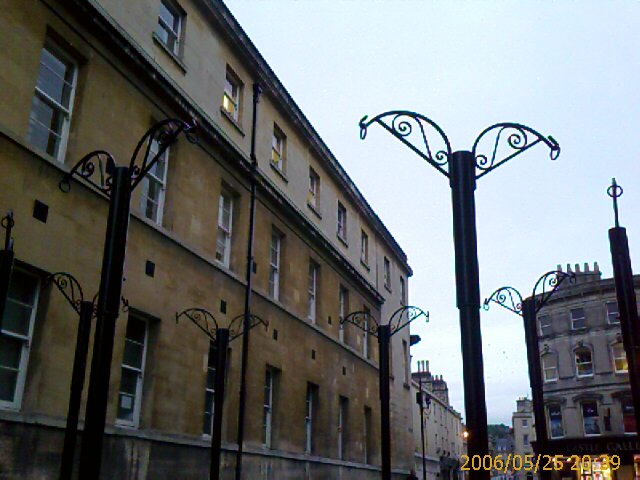
Myra explained that the buildings on Queen and Gay (a doctor) streets shows his style and his approach. It uses the best quarried local stone for the pristine front facade, yet uses inferior (lower from the quarry) rubble stone for the rest of the building behind the facade. These two photos show the front and back.

We also walked along roads and gravel paths mentioned in Jane Austen's Persuasion (which is set in Bath), and took in a brief history of the famous Royal Crescent and Royal Circus (circle), designed, some say, in homage to the moon (crescent) and sun (circle) just a few long blocks apart.

Napped at my room after the two-hour tour, then walked the short distance to Holburne Museum of Art, home of several Gainsboroughs and Turners and a small Wedgwood collection.

They also have an interesting exhibit celebrating the building of the Great Western Railway, which goes from London to Bristol in almost perfect level. The engineer/designer, Isambard Kingdom Brunel, cut new-fangled tunnels and channels and worked around geology in creative ways to keep the track flat the whole way.

The site of the Holburne estate, Syndey Park, was dissected for the rail by a channel with pedestrian walkways over it, and then given a promenade so strollers could watch the construction and enjoy the trains going by. I walked some of the promenade and imagined the workers and first train carriages rumbling by. That was nearly 200 years ago--the anniversary of Brunel's achievements. (Brunel also built the first ocean liner to go across the Atlantic in a week. That's being celebrated nearby at Bristol this year, too.)


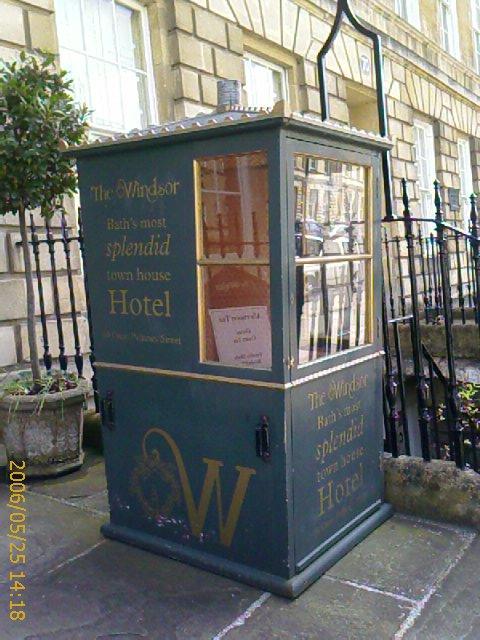
I was feeling peckish after so much walking, and had high tea at 4:15 at Windsor Hotel on the way back. In the front of their hotel, they have a sedan chair (litter) like the kind the rich folk hired to carry them all over this hilly town, and sometimes up and down stairs inside buildings, in the 1800s. Myra had told us about them. A local leader got the sedan runners, a rangy crew at best, to register and number their chairs, and taxis have done so ever since.

Whoever invented clotted cream had a good thing going. I plopped it generously on strawberry-jammed scones while sitting in a 19th-century Bath hotel, propped on the edge of a period rose-colored chair, leaning over an oval, brass claw-footed wooden coffee table. Its varnish is white in spots--heat wounds made during countless teas before me.

In between bites on my tuna sandwiches (I was allowed to order one flavor of sandwich from their menu and they brought me two of them--sheesh, who wants to eat two full tuna sandwiches in one sitting?) I pecked at Perry and updated my contacts list with 21st-century technology.

So weird, this juxtaposition of old and new, slow and fast. It's everywhere. At the Holburne, I had studied fastidious embroideries and miniature paintings that would have kept their creators busy for months. Not thirty minutes later, I watched boys playing football on the grass at Sydney Park. "Get the ball, don't waste time!" one of them yelled when the ball went out of bounds on their makeshift field.

Yet everywhere I go here, galleries and antique shops and streets are filled with examples of slow living, slow creation. Times when buildings took decades and centuries to erect, when a friend might wait 11 years for a portrait to be finished by Gainsborough, and when the idea of speeding at 45 miles an hour in a train smooth enough to drink coffee and write in (as Brunel predicted) was the glorious promise of the technological age.

"Don't waste time," said the boy of 10. Sad that one so young already thinks there's not enough time to go around. I walked by at my holiday leisure, no doubt a classic example of a time-waster, and feeling the old pull of that belief--that any hour not spent in complete industry, in busyness, in doing or creating or achieving or learning, is time that has been frittered. Debunking this belief is one of my purposes on this trip.

I stirred sugar and cream into a refill of tea and sipped it. An oak still takes 100 years to become 100 years old. Tea still takes 3 minutes to brew just right. Some things, thank god, can't be rushed.